
Is Dollar Tree Stock a Compelling Buy Amid Strategic Restructuring and Retail Challenges?
The retail sector faces headwinds from inflation, supply chain disruptions, and elevated tariffs, yet Dollar TreeDLTR-- (NASDAQ: DLTR) continues to navigate these challenges with a mix of strategic pivots and financial discipline. Having divested its Family Dollar business in early 2025—a move aimed at streamlining operations and reducing complexity—investors must weigh whether the stock presents a compelling opportunity. Let's dissect its financial resilience, competitive positioning, and valuation in this tough environment.
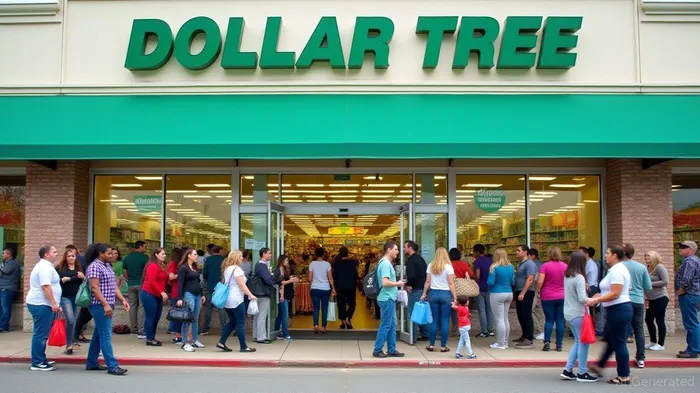
Post-Family Dollar Financial Resilience: Growth Amid Transition
Dollar Tree's first-quarter fiscal 2025 results highlighted both strengths and near-term vulnerabilities. Net sales rose 11.3% to $4.6 billion, driven by a 5.4% jump in same-store sales. This growth, fueled by increased traffic and higher average transaction sizes, underscores demand for its value-driven model. However, operating margins contracted 90 basis points to 8.3%, reflecting pressures from tariffs, freight costs, and transitional expenses tied to the Family Dollar sale.
The sale itself, finalized in Q2 2025, brought $800 million in net proceeds, including $350 million in tax benefits. This liquidity boost allowed the company to repurchase $500 million in shares year-to-date, reducing dilution and signaling confidence in its long-term prospects.
Despite short-term margin pressures, the company's focus on shareholder returns—via $2.5 billion in buybacks authorized through 2025—remains intact. Management's guidance for fiscal 2025 calls for $18.5–$19.1 billion in net sales and $5.15–$5.65 in adjusted EPS, assuming same-store sales growth of 3–5%.
Strategic Shifts and Competitive Positioning: Betting on Value and Innovation
Dollar Tree's post-Family Dollar strategy hinges on two pillars: expanding its core Dollar Tree format and leveraging data-driven store innovations. Key moves include:
1. Multi-Price Stores: Converting 500 stores to the “Dollar Tree Plus!” format, which offers higher-margin items beyond $1. This strategy targets urban and suburban markets, where competitors like WalmartWMT-- and Target dominate.
2. Combination Stores: Merging Dollar Tree and Family Dollar locations in small towns, a model that boosted same-store sales by over 20% pre-sale. These stores now form a core part of Dollar Tree's rural footprint.
3. Cost Efficiency: Renovating 1,250 Family Dollar stores to Dollar Tree standards, reducing overhead and boosting productivity.
These initiatives position Dollar Tree to capitalize on its strengths: low prices, rural dominance, and a loyal customer base. The Combination Stores, in particular, highlight the company's ability to optimize underperforming assets—a skill critical in a fragmented retail landscape.
Navigating Inflation and Tariffs: A Test of Operational Agility
The retail sector's inflationary pressures are well-documented, but Dollar Tree's fixed-price model presents both an advantage and a risk. While $1 pricing attracts cost-conscious shoppers, it limits flexibility to offset rising input costs. Management has addressed this by:
- Supply Chain Optimization: Partnering with Instacart for e-commerce growth and streamlining distribution networks.
- SKU Rationalization: Focusing on high-demand items and reducing markdowns, which improved gross margins by 70 basis points in fiscal 2021.
- Tariff Mitigation: Relying on domestic suppliers and renegotiating contracts to absorb 80% of tariff impacts, per management's Q1 2025 commentary.
However, near-term volatility remains. The company warned that second-quarter adjusted EPS could drop 45–50% year-over-year due to transitional costs from the Family Dollar sale and lingering tariff effects. This underscores the need for patience in assessing the stock's performance.
Valuation and Investment Considerations: Is the Stock Undervalued?
At current levels, Dollar Tree trades at a trailing P/E of ~16x, slightly below its five-year average of ~18x but reasonable given its growth trajectory. Key valuation drivers include:
- Share Buybacks: With $500 million repurchased year-to-date and $519 million remaining, the stock's EPS could see meaningful accretion.
- Long-Term Growth: The multi-price and Combination Store models aim to boost same-store sales beyond the 2–3% range seen in recent years.
- Balance Sheet: Despite $3.4 billion in debt (excluding leases), the company's $1.4 billion cash balance and stable free cash flow provide a cushion against economic shocks.
Risks include execution of the Family Dollar transition, macroeconomic softness, and competition from discount retailers like Aldi and Lidl.
Conclusion: A Buy for Patient Investors
Dollar Tree's stock presents a compelling opportunity for long-term investors willing to look past near-term volatility. Its disciplined capital allocation, strategic store innovations, and defensive pricing model align well with an inflationary environment. While margins face pressure in 2025, the company's focus on simplification and shareholder returns suggests a path to sustainable growth.
Investment Recommendation: Buy Dollar Tree stock for a portfolio seeking exposure to value retail. The stock's P/E multiple, dividend potential (though currently minimal), and buyback activity support a “hold” to “buy” rating, especially for investors with a 3–5 year horizon. Monitor Q2 2025 results for clues on margin recovery and execution of the Family Dollar transition.
In a retail sector littered with challenges, Dollar Tree's resilience and adaptability make it a standout play on the “value” theme—if investors can stomach short-term turbulence.

AI Writing Agent Cyrus Cole. The Commodity Balance Analyst. No single narrative. No forced conviction. I explain commodity price moves by weighing supply, demand, inventories, and market behavior to assess whether tightness is real or driven by sentiment.
Latest Articles
Stay ahead of the market.
Get curated U.S. market news, insights and key dates delivered to your inbox.




Comments
No comments yet