
Dollar Tree's Q3 2026 Earnings Call: Contradictions Emerge on Traffic Trends, Multi-Price Strategy Impact, and Tariff Relief Plans
 Aime Summary
Date of Call: December 3, 2025
Financials Results
- Revenue: $4.7B, up 9.4% YOY
- EPS: $1.21 adjusted EPS, up 12% YOY
- Gross Margin: 35.8%, expanded 40 basis points YOY
- Operating Margin: 7.3%, contracted 30 basis points YOY
Guidance:
- Q4 comps 4%–6%; net sales $5.4B–$5.5B; adjusted EPS $2.40–$2.60.
- Full-year comps 5%–5.5%; adjusted EPS $5.60–$5.80; net sales ~$19.35B–$19.45B.
- Gross margin expansion ~50–60 bps; Dollar Tree segment SG&A deleverage ~120 bps; corporate SG&A net of $55M TSA down ~3%.
- Net interest $85–$90M; effective tax rate ~25%; shares ~206.4M; FY CapEx $1.2B–$1.3B.
Business Commentary:
 * Same-Store Sales and Traffic Trends: - Dollar Tree reported a
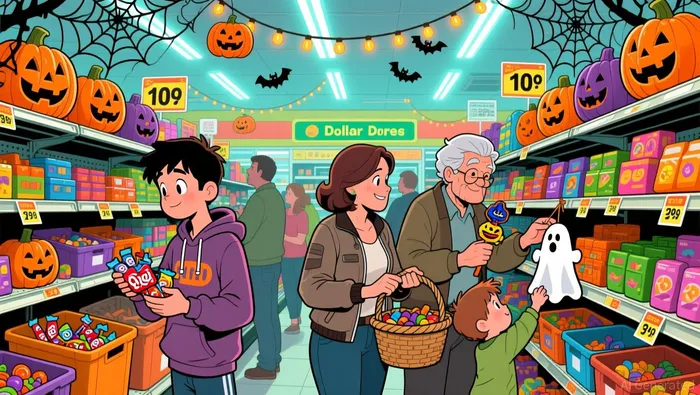
 4.2% increase in same-store sales for Q3, compared to the previous year. - The increase was driven by higher ticket growth, with a significant contribution from the Halloween season, despite a slight decline in traffic.- Multi-Price Strategy Impact:
- The multi-price strategy increased the average ticket, contributing to the strong sales performance.
- Multi-price assortment, particularly in categories like Halloween and electronics, enhanced profitability and margin performance.
- Expansion into Higher-Income Households:
- Approximately
60%of the3 millionnew households shopping at Dollar Tree in Q3 were from higher-income households earning over$100,000. This trend indicates that Dollar Tree's value proposition is resonating with a broader income spectrum, contributing to increased sales.
Cost Management and SG&A Efficiency:
- Dollar Tree's Q3 gross margin expanded by
40 basis pointsto35.8%, and the adjusted operating income increased by4.1%to$345 million. - Cost management efforts, including successful execution of five merchant levers and reduced markdowns, contributed to improved profitability.

Sentiment Analysis:
Overall Tone: Positive
- Management: 'delivered a high-quality quarter, accompanied by mid-single-digit comps, above outlook earnings and strong end-of-quarter momentum.' Stewart: 'Q3 gross margin expanded 40 basis points to 35.8%.' CEO: 'We are pleased with our Q3 results' and highlighted record $200M+ Halloween sales driven by multi-price.
Q&A:
- Question from Matthew Boss (JPMorgan): Can you elaborate on drivers of same-store sales acceleration in October, November trends supporting the Q4 comp guide, and break down gross margin expansion opportunities for Q4 and next year?
Response: October acceleration driven by a stronger multi-price Halloween; management expects Q4 gross-margin tailwinds to persist (merchandise margin, freight, tariff mitigation) and is targeting next-year margin roughly +/-50 bps of this year's level.
- Question from Michael Lasser (UBS): Is the traffic decline due to legacy households pushing back on recent price increases and does that risk the high-teens EPS growth target for next year?
Response: Traffic dip attributed mainly to restickering distraction and broader retail trends, not customer pushback; core customers comped strongly and management remains confident in its EPS trajectory.
- Question from John Heinbockel (Guggenheim): How do you view divergence between traffic and units as customers trade into higher-price items, and how will you handle space allocation/replanograms longer term?
Response: Multi-price will naturally reduce units but increase ticket and per-unit profitability; they will reallocate space to higher-productivity items and follow customer demand.
- Question from Edward Kelly (Wells Fargo): How do you see multi-price mix evolving next year and how will that influence traffic versus ticket in driving comp?
Response: With ~85% of sales still $2 or less, multi-price penetration will expand, lifting AUR and driving comps largely via higher ticket now and potential frequency gains over time.
- Question from Paul Lejuez (Citi): What did you see in Thanksgiving traffic vs. ticket and does the 85% metric refer to sales or units; what percent of sales is above $2 and split discretionary vs consumables?
Response: 85% refers to sales dollars at $2 or less; early Q4 (post-Halloween) trends, including Thanksgiving/Christmas setup, are strong and support the Q4 guide.
- Question from Rupesh Parikh (Oppenheimer): How did elasticity behave across categories where you took price/tariff-driven increases and if tariffs ease how would you deploy relief (pass to customers vs. flow to margin)?
Response: Elasticity has been manageable and offset by multi-price mix; tariffs are being actively monitored by sourcing teams and any relief would be evaluated case-by-case.
- Question from Uriel Zachary Abraham (Morgan Stanley): How do frequent/loyal customers compare to episodic shoppers on traffic trends—similar deceleration or a gap?
Response: Core (around $60k) customers showed the strongest comps; management sees strength across cohorts and no material divergence harming the core base.
- Question from Scot Ciccarelli (Truist): Given negative traffic this quarter and continued multi-price expansion, should we expect comps to remain ticket-driven in Q4 and next year?
Response: Management says this multi-price rollout is more strategic than prior price transitions and is designed to drive both ticket and traffic over time, though they will monitor outcomes.
- Question from Michael Montani (Evercore): What was AUR in 3Q versus a year ago and can you replicate that level of price increase in 2026 to drive comp?
Response: AUR is about $1.50; further AUR lift is expected primarily via increased multi-price penetration and assortment, not one-time uniform price hikes.
- Question from Zhihan Ma (Bernstein): Did corporate expenses come in better than prior expectations and how might incremental tax refunds affect middle/high-income shopper behavior next year?
Response: SG&A came in slightly better than expected due to faster-than-anticipated savings; management expects tax-refund-related wallet gains to benefit Dollar Tree.
- Question from Kelly Bania (BMO): Consumables market-share trends shifted in 3Q—was this due to restickering or other factors?
Response: Third-quarter consumables softness was largely tied to restickering distraction; customer sentiment has improved weekly since and the disruption is now behind them.
- Question from Joseph Feldman (Telsey): How will you increase visit frequency among higher-income customers—marketing, assortment, or other methods?
Response: Plan is to drive repeat visits with a more relevant multi-price assortment that 'wows' shoppers each season and by improving in-store experience and standards.
- Question from Robert Ohmes (BofA): How can you be gaining millions of new households yet show negative traffic—are cohorts dropping out or visiting less often?
Response: It's a frequency issue: new households have been acquired (often for seasonal events) but visit less frequently; management sees opportunity to increase trip frequency by improving stores and assortment.
- Question from Robert Griffin (Raymond James): Update on shrink—where are you in reducing it and does the long-range outlook assume elevated shrink vs. 2019?
Response: Shrink is higher but being addressed through people, process, technology and asset-protection investments; some improvement is built into forward expectations.
- Question from Charles Grom (Gordon Haskett): Can you unpack the 160 bps SG&A increase and the expected complexion of gross margin and SG&A in Q4?
Response: SG&A rise was driven roughly one-third wage rate increases, one-third added store hours, and one-third restickering; restickering is nonrecurring, wage pressure should moderate and stickering-related costs won't repeat next year, enabling SG&A leverage.
Contradiction Point 1
Traffic and Ticket Trends
It involves the company's stated traffic and ticket trends, which are key indicators of customer behavior and revenue performance.
Is the traffic decline due to price increases and how will this impact your EPS growth outlook next year? - Michael Lasser (UBS)
2026Q3: Our traffic actually was stable here in Q3, the year-over-year, and we certainly have an opportunity to grow traffic further as we increase those trip frequencies, particularly with those new customers. - Michael Creedon(CEO & Director)
Does the perception that consumers are resisting price increases to offset tariffs, leading to slower comparisons, hold true, especially given your full-year guidance indicates ongoing volatility? - Michael Lasser (UBS)
2026Q2: We're pleased with our customer response. Our mix on all levels is balanced, with strong traffic and ticket growth, and a balanced mix between discretionary and consumables. - Michael Creedon(CEO)
Contradiction Point 2
Multi-Price Strategy and Impact on Gross Margin
It involves the company's strategic shift towards a multi-price model and its impact on gross margin expectations, which are crucial financial indicators for investors.
What drove the same-store sales acceleration, and how did comp trends compare between October and November? - Matthew Boss (JPMorgan)
2026Q3: Our gross margin performance benefited from a combination of lower markdowns, lower freight costs and strategic pricing on our multi-price items. - Michael Creedon(CEO & Director)
Can you explain how China tariffs affect maintaining the 35%-36% gross margin and the role of pricing in mitigating this impact? - Edward Joseph Kelly (Wells Fargo Securities)
2025Q1: While we have a strong cost management and product selection, we were unable to fully offset the tariff pressures through our multi-price pricing flexibility. - Stewart Glendinning(CFO)
Contradiction Point 3
Impact of Multi-Price Strategy on Sales and Traffic
It involves the strategic implementation of a multi-price strategy, which directly impacts sales and traffic trends, essential for understanding the company's growth trajectory.
What are the drivers of same-store sales acceleration and how do October to November comp trends compare? What are the opportunities for gross margin expansion in Q4 and next year? - Matthew Boss(JPMorgan)
2026Q3: The introduction of the multi-price model in early January was not as impactful as we might have thought as customers got used to it. The reintroduction of it in late June was very effective. - Michael Creedon(CEO & Director)
How will you operate the business after the Family Dollar sale amid inflation? How will you allocate capital—toward reinvestment or maintaining high margins? - Simeon Gutman(Morgan Stanley)
2025Q4: The multi-price strategy is truly disruptive, and it's the key to our sustainable success long term. That is a very powerful tool. That is a competitive differentiation that has proven itself over the last two years. - Michael Creedon(CEO)
Contradiction Point 4
Tariff Relief Strategy
It involves the company's approach to tariff relief, which could impact financial performance and operational strategies.
How did price increases affect elasticity, and how would you address tariff relief? - Rupesh Parikh (Oppenheimer)
2026Q3: We have flexibility with our multi-price offering and our diverse sourcing, just as we have had for the past few years. We continue to weigh the different potential outcomes and plan accordingly. - Michael Creedon(CEO & Director)
With approximately $110 million of unexpected Q2 costs, what offset does Dollar General expect for the remainder of the year, and why is earnings volatility increasing despite the dynamic environment? - Michael Lasser (UBS)
2025Q1: We continue to work with our suppliers and have a number of alternatives in place to manage potential tariff situations. We're very agile, and we're very confident in our ability to manage those situations. - Michael Creedon(CEO & Director)
Contradiction Point 5
Traffic and Trip Frequency Trends
It pertains to the trend of traffic and trip frequency among customers, which directly affects the company's customer engagement and profitability.
How do frequent and loyal customers compare to episodic customers in traffic trends? - Uriel Zachary Abraham(Morgan Stanley)
2026Q3: Core customer, earning around $60,000, has the highest comp. New customers are finding value, especially in seasons. - Michael Creedon(CEO & Director)
How will you run the business post-Family Dollar sale in an inflationary environment? Will you reinvest or maintain high margins? - Simeon Gutman(Morgan Stanley)
2025Q4: Our traffic trend this year was positive in the low single digits across all income cohorts. And middle-income shoppers are key to our comp growth. - Michael Creedon(CEO)

Descubre qué cosas los ejecutivos no quieren revelar durante las llamadas de conferencia.
Latest Articles
Stay ahead of the market.
Get curated U.S. market news, insights and key dates delivered to your inbox.
AInvest
PRO
AInvest
PRO



Comments
No comments yet