
Dollar Tree's 3.81% Gain Fueled by Technical Breakout, Faces $125.79 Hurdle
 Aime Summary
Dollar Tree (DLTR) closed its most recent session with a 3.81% increase, reflecting a strong bullish impulse. The candlestick pattern suggests a potential continuation of the uptrend, as the price has been consolidating above key support levels identified at $117.43 and $118.865. Resistance appears to be forming near $125.79, where a prior bearish reversal occurred. The recent upward movement, particularly the 5.67% spike on December 5, indicates a breakout attempt from a descending channel. However, the absence of a confirmed bullish pattern (e.g., a piercing line or a morning star) suggests caution in interpreting this as a definitive trend reversal.
Candlestick Theory 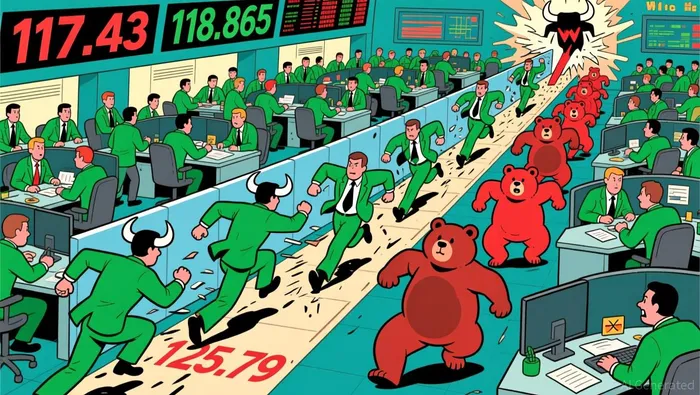 The price action over the past month reveals a series of mixed signals. A bullish engulfing pattern emerged on December 5, followed by a bearish harami on December 8, which may signal indecision. Key support levels at $117.43 and $107.4401 are critical for maintaining the uptrend, while resistance at $125.79 and $124.65 could cap further gains. The recent 3.81% rally forms a potential three-white-soldiers pattern, but its validity depends on volume confirmation and follow-through buying.
Moving Average Theory
The 50-day moving average (approximately $110–$112) is currently below the 200-day MA ($104–$105), indicating a bearish bias in the intermediate term. However, the price has crossed above the 50-day MA in recent sessions, suggesting short-term bullish momentum. The 200-day MA acts as a critical long-term threshold; a sustained close above this level would signal a shift in the dominant trend. The 100-day MA ($108–$110) aligns with recent support, creating a confluence zone that could reinforce the uptrend if volume increases.
MACD & KDJ Indicators
The MACD line crossed above the signal line in late November, confirming a bullish crossover, but the histogram has been flattening, indicating weakening momentum. The KDJ oscillator (stochastic) shows the stock entering overbought territory (K at 85, D at 75), suggesting a potential pullback. Divergence between the K line and price action on December 5–8 may signal a near-term correction. However, the MACD’s positive divergence from the price low on December 1 implies residual bullish energy.
Bollinger Bands
Volatility has expanded significantly since mid-November, with the bands reaching a width of ~$10. The price has recently tested the upper band (around $125.79), which historically acts as a resistance. A break above this level could trigger a parabolic move, but the bands’ contraction on December 1–3 suggests a period of consolidation before the next directional move. The current position near the upper band, combined with an RSI above 70, raises caution about overbought conditions.
Volume-Price Relationship
Trading volume spiked to $880 million on December 5 during the 5.67% rally, validating the breakout attempt. However, volume has since declined to ~$300–$400 million, indicating waning conviction. The recent 3.81% surge was accompanied by a volume of $313 million, which is below the average of the preceding five sessions. This discrepancy suggests the move may lack sustainability unless volume increases on the next rally.
Relative Strength Index (RSI)
The RSI has entered overbought territory (>70) in recent sessions, with a reading of ~75 as of December 10. This historically warns of potential exhaustion, though the RSI has not yet peaked. A failure to surpass prior highs on the RSI (e.g., 85 on November 26) could signal a bearish reversal. Conversely, a sustained close above 70 may indicate a continuation of the uptrend, albeit with increasing risk of a correction.
Fibonacci Retracement
Applying Fibonacci levels between the recent high of $125.79 and low of $107.4401, the 23.6% retracement level (~$118.80) aligns with key support identified in candlestick analysis. The 38.2% level (~$113.00) coincides with the 100-day MA and could act as a secondary support. A break below the 61.8% level ($109.50) would invalidate the short-term bullish case and target the 78.6% level ($106.50).
Confluence and Divergence
The confluence of the 50-day MA, Fibonacci 23.6% retracement, and candlestick support at ~$118.80 suggests a high-probability area for continuation. However, divergences between the MACD histogram and price action, as well as the RSI’s overbought warning, indicate a potential short-term correction. A break above $125.79 would require confirmation from both volume and the 200-day MA crossing above the 50-day MA to solidify a long-term bullish case.
The analysis highlights a mixed outlook: while technical indicators like the 50-day MA and Fibonacci levels support a continuation of the uptrend, overbought conditions and divergences in momentum oscillators caution against aggressive long positions. Traders may consider scaling into positions near the $118.80 confluence zone, with tight stops below $117.43. A failure to hold this level would likely trigger a retest of the $107.4401 psychological support.

If I have seen further, it is by standing on the shoulders of giants.
Latest Articles
Stay ahead of the market.
Get curated U.S. market news, insights and key dates delivered to your inbox.




Comments
No comments yet