
Dollar General Rises 3.05% on Bullish Moving Averages and MACD Momentum Amid Overbought RSI Conditions
 Aime Summary
Dollar General (DG) recently closed with a 3.05% gain, signaling a bullish reversal amid a volatile trading environment. Candlestick Theory reveals a strong green candle on the most recent session, with a long upper wick indicating rejection of higher prices and a decisive close near the high. Key support levels emerge at $132.57 (Dec 31 low) and $130.78 (Dec 12 low), while resistance clusters near $137.84 (Dec 26 high) and $139.83 (Dec 29 high). A potential bearish engulfing pattern forms around Dec 31, suggesting caution if the price tests the $132.57 level again.
Moving Average Theory shows the 50-day MA crossing above the 100-day and 200-day MAs, confirming a medium-term bullish trend. The 50-day MA currently sits at approximately $134.50, while the 200-day MA lingers near $105.50, indicating a strong upward bias. However, the 200-day MA’s lagging nature suggests the uptrend may consolidate before resuming, especially if the price dips below the 100-day MA (~$135.00).
MACD & KDJ Indicators reveal mixed signals. The MACD line (12,26,9) is positive at ~$2.50, with the histogram expanding, signaling growing momentum. However, the KDJ oscillator (14,3,3) shows the %K line at ~85 and %D at ~80, entering overbought territory. This confluence of bullish momentum and overbought conditions suggests a potential pullback, though the MACD’s strength implies a retracement rather than a reversal. 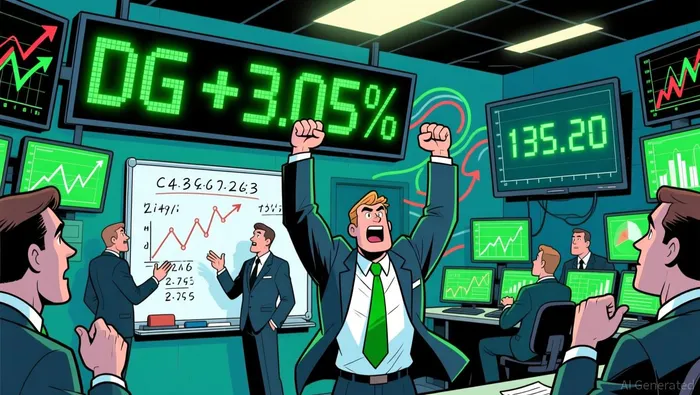 Bollinger Bands highlight heightened volatility, with the price near the upper band (~$139.83) and a 20-period width of ~$5.00. The recent contraction in band width during mid-December implies a potential breakout, which the current rally may confirm. If the price remains above the mid-band (~$136.00), the bullish trend could persist.
Volume-Price Relationship validates the recent rally, as the session’s ~3.54 million shares traded align with the 3.05% gain, indicating strong participation. However, volume has been inconsistent during the prior consolidation phase (Dec 12–Jan 2), suggesting the uptrend may face challenges if volume wanes during pullbacks.
RSI stands at ~72, nearing overbought levels, with a 14-day average gain of ~$1.80 and average loss of ~$0.70. While not yet in extreme overbought territory, the RSI’s flattening slope warns of potential exhaustion. A close below 60 would signal a retracement, though the RSI’s alignment with the MACD suggests a sharp rebound is probable.
Fibonacci Retracement levels drawn from the Dec 26 high ($137.84) to the Dec 31 low ($132.57) highlight critical areas: 38.2% at $135.50 and 50% at $135.20. The price’s recent pullback to these levels (Dec 30–Jan 3) and subsequent rebound suggest $135.20 is a key support. A break below 61.8% ($133.80) would trigger a deeper correction.
Confluence points emerge where the 50-day MA, Bollinger mid-band, and Fibonacci 50% level (~$135.20) converge, acting as a pivotal zone. Divergences appear in the KDJ and RSI, which signal overbought conditions, versus the MACD’s bullish momentum, creating a probabilistic tug-of-war between continuation and reversal. A sustained close above $137.84 would invalidate bearish scenarios, while a retest of $132.57 could trigger a broader consolidation phase.

If I have seen further, it is by standing on the shoulders of giants.
Latest Articles
Stay ahead of the market.
Get curated U.S. market news, insights and key dates delivered to your inbox.
AInvest
PRO
AInvest
PRO



Comments
No comments yet