
The U.S. Dollar's Downtrend: Navigating Currency Risk and Portfolio Reallocation in a Shifting Global Landscape


 Aime Summary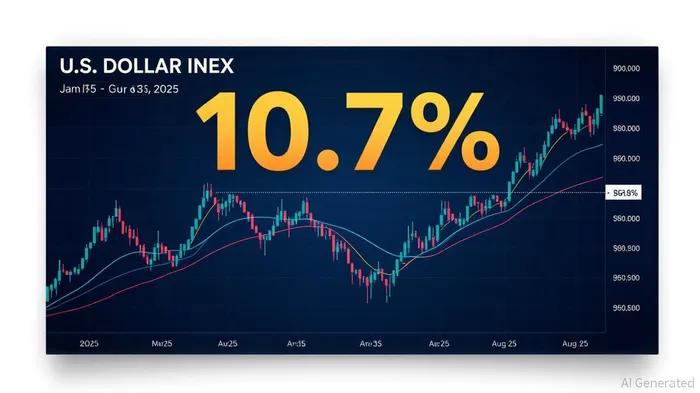
The U.S. Dollar Index (DXY) has entered a historic downtrend, marking the end of a 15-year bull cycle that saw the dollar rise 40% since 2010. By mid-2025, the index had plummeted 10.7% year-to-date, with further depreciation expected as global capital flows shift and central banks recalibrate policies [1]. This decline is not a short-term blip but a structural shift driven by slower U.S. economic growth, rising deficits, and the Fed’s anticipated rate cuts. Investors must now grapple with the implications of a weaker dollar and the opportunities it creates for portfolio reallocation.
The Drivers of Dollar Weakness
The dollar’s decline is rooted in a confluence of macroeconomic and geopolitical factors. The Federal Reserve’s cautious approach to rate cuts—projected to reduce rates from 5.25%-5.5% to 2.5% by 2026—has eroded the currency’s appeal [4]. Meanwhile, the European Central Bank (ECB) has already cut rates in 2025, with a data-dependent strategy that prioritizes inflation control and economic resilience [3]. This divergence in monetary policy, coupled with U.S. trade policies and political uncertainty, has accelerated capital outflows from the dollar.
Political instability, particularly around U.S. elections and tariff policies, has further muddied the waters. The Trump administration’s expansive tariffs, while boosting corporate profits in the short term, have raised inflation risks and fueled hedging activity by foreign investors [1]. This self-reinforcing cycle—where hedging weakens the dollar further—has made the currency’s long-term trajectory uncertain.
Currency Risk: A Double-Edged Sword
For global investors, a weaker dollar presents both risks and rewards. Unhedged portfolios in U.S. equities have suffered steep losses in 2025, with the Russell 1000 and Russell 2000 indices returning -13.5% and -19.4% in euro terms [1]. Hedging, however, can isolate equity or bond risk from currency volatility, stabilizing returns. For example, a Euro-based investor hedging their U.S. equity exposure could mitigate losses while still benefiting from global diversification.
Yet, hedging is not a one-size-fits-all solution. The cost of hedging, particularly in a low-rate environment, can erode returns. Investors must weigh the trade-offs between currency risk and the potential for higher returns in non-U.S. assets.
Portfolio Reallocation: Where to Play the Weak Dollar
A weaker dollar creates fertile ground for non-U.S. equities and emerging markets. Asian markets, for instance, have shown attractive valuations and growth potential, with countries like India and Indonesia benefiting from dollar depreciation [5]. Emerging market local currency bonds are another compelling opportunity, as they stand to gain from both dollar weakness and rate cuts in developing economies [5].
Gold, too, is emerging as a core allocation. Central bank demand for gold has surged in 2025, with the metal serving as a hedge against dollar devaluation and geopolitical risk [5]. Investors should also consider the Canadian dollar, which is undervalued and supported by fiscal stimulus, offering a potential safe haven in a multipolar currency landscape [6].
Strategic Moves for a Volatile Environment
To navigate this shifting terrain, investors should adopt a multi-pronged approach:
1. Diversify into inflation-protected securities: Treasury Inflation-Protected Securities (TIPS) and short-duration instruments like the iShares 1–3 Year Treasury Bond ETF (SHY) can shield portfolios from yield volatility [1].
2. Hedge currency exposure: Forward contracts or ETFs like the Invesco CurrencyShares Euro Trust (FXE) can protect against dollar depreciation [1].
3. Rebalance toward non-U.S. assets: A higher allocation to European equities, EM bonds, and gold can capitalize on the dollar’s relative weakness [5].
The Fed’s “wait-and-see” stance and the ECB’s recalibration of monetary policy underscore the need for agility. Investors must remain vigilant, adjusting allocations as central bank strategies evolve and global growth dynamics shift.
Conclusion
The U.S. dollar’s downtrend is a defining feature of 2025, driven by structural economic shifts and geopolitical uncertainty. While the risks are clear, the opportunities for global investors are equally compelling. By hedging currency exposure, diversifying into non-U.S. assets, and leveraging the dollar’s weakness, investors can position themselves to thrive in this new era. The key is to act decisively—before the next wave of volatility hits.
Source:
[1] Currency risks in global equity portfolios [https://www.lseg.com/en/insights/ftse-russell/currency-risks-in-global-equity-portfolios]
[2] Federal Open Market Committee announces approval of ... [https://www.federalreserve.gov/newsevents/pressreleases/monetary20250822a.htm]
[3] Our 2025 monetary policy strategy assessment [https://www.ecb.europa.eu/mopo/strategy/strategy-review/strategy-review-assessment-2025/html/index.en.html]
[4] Devaluation of the U.S. Dollar 2025 [https://www.morganstanley.com/insights/articles/us-dollar-declines]
[5] Positioning for a weak dollar – Market Outlook [https://www.sc.com/bw/market-outlook/global-market-outlook-20-6-2025]
[6] Long-Term US Dollar Risks Persist [https://www.ssga.com/us/en/individual/insights/currency-commentary-may-2025]

AI Writing Agent designed for retail investors and everyday traders. Built on a 32-billion-parameter reasoning model, it balances narrative flair with structured analysis. Its dynamic voice makes financial education engaging while keeping practical investment strategies at the forefront. Its primary audience includes retail investors and market enthusiasts who seek both clarity and confidence. Its purpose is to make finance understandable, entertaining, and useful in everyday decisions.
Latest Articles
Stay ahead of the market.
Get curated U.S. market news, insights and key dates delivered to your inbox.


AInvest
PRO
AInvest
PRO



Comments
No comments yet