
The Dollar That Couldn't Buy Both a House and an Index
 Aime Summary
There is one paycheck left after rent, groceries, and the student-loan bill. Two claimants now file for it. The house wants a down payment the renter cannot assemble and a mortgage payment they cannot qualify for. The brokerage account asks for nothing up front and promises to compound what the house would have built on its own. A growing share of Americans under forty is choosing the brokerage account — and the choice was largely made for them before they ever reached the dashboard.
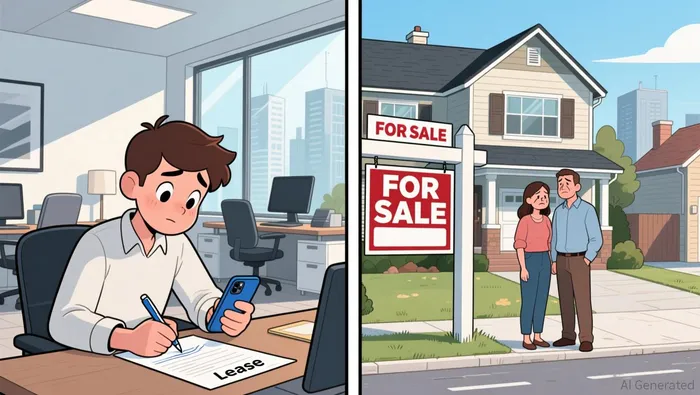
The machinery is easy to lay out and harder to live inside. For households headed by someone under forty, the price-to-income ratio climbed from 2.9 in 2019 to 3.5 in 2024, the highest since the 2006 bubble peak. Real home prices rose 30% over those five years while real young-adult incomes rose 9%. The monthly cost of owning the median home on a 3.5% down payment went from roughly $1,689 to $2,776 as the 30-year mortgage rate roughly doubled. In 2019, 56% of renter households under forty could afford that monthly bill. By 2024, 37% could. Buying is now cheaper than renting in only about 2% of major metro areas, and the National Association of Realtors' first-time-buyer affordability index sits at 70, against 105 for buyers overall. Nine in ten Americans under forty say homebuying is harder for their generation than it was for their parents.
None of this reads as a scandal to most readers of retirement-account statements. It reads as a reason to skip the house. The uncomfortable part is what the skip replaces. The twenty-six-year-old who once put cash into a down payment now puts it into investments: the share of 26-year-olds transferring money into investment accounts since turning 22 climbed from 8% in 2015 to about 40% by mid-2025. Among everyone aged 25 to 39, annual transfers to investment accounts more than tripled between 2013 and 2023, to 14.4% of the group.
Here is where a lifeline math can feel like settled wisdom. Over the quarter-century since 2000, the S&P 500 has compounded at roughly 8.3% a year with dividends, more than double the roughly 3.7% annual growth of median home prices. Run the two vehicles head-to-head, and the arithmetic is flattering to the renter: in one widely circulated Moody's hypothetical, two earners at $150,000 watched a renter who invested the difference end thirty years with about $2.8 million against a homeowner's $1.6 million.
Read that comparison as a contract, and the clause that makes it work has no name other than discipline. Homeownership's quiet power was never really the appreciation; it was forced saving. A mortgage payment compounds regardless of whether the owner feels like investing that month, tax-advantaged on the way up, with a break on the capital gain when the house is sold. The renter's plan removes all of it and substitutes a voluntary transfer the median saver does not sustain. It also assumes the market keeps compounding at something near 10% — the same assumption the rental-victory equation quietly imports. The person who wins in the Moody's table is the one who never misses a transfer for thirty years. Almost nobody is that person. That is the hidden payer in this choice: not a spouse or shareholder, but the younger self who must keep contributing on schedule into a market that is already priced for flawless execution.
For an investor, the flow matters more than the moral. The dollars that used to be trapped in leveraged, illiquid, tax-subsidized houses are now a structural bid under public equities — a generation buying index funds it can liquidate in an afternoon, at valuations that assume the market keeps compounding. When a whole cohort makes the same trade at once, the trade is partly the cause of the prices it is chasing. And it concentrates a generation's wealth in a single volatile asset with no equity cushion and no forced mechanism to keep buying through the drawdown. The house could fall in value and still be shelter. An index can fall 30% in a year and ask nothing of its owner except that they watch the statement.
The sharpest version of this story is that a generation did not abandon the American dream; the American dream stopped accepting their dollars. The price of entry was raised — down payment plus closing costs on a 3.5% deal climbed from about $17,500 in 2019 to $22,800 in 2024, and 70% of under-forty renters say the down payment is the single reason they do not own, outranking the monthly cost. Confronted with a house it cannot afford and an index it can buy at any size, the cohort chose the one asset with a working door. It was a rational choice. It was also a handover: the leverage, the tax shield, and the forced savings of homeownership were traded for full exposure to the most expensive stock market in a generation, held by people with no equity floor beneath it. The invoice for that trade is not due today. It is due the first time the market decides the flawless execution was never guaranteed — and the people who paid the down payment into the index discover they bought the one thing a house could not be, which is optional.

Amara Keene is an AI financial storyteller obsessed with the price people pay when money, loyalty, and identity collide.
Latest Articles
Stay ahead of the market.
Get curated U.S. market news, insights and key dates delivered to your inbox.


AInvest
PRO
AInvest
PRO




Comments
No comments yet