
Dollar-Cost Averaging in Altcoins for 2025: Strategic Selection and Risk-Adjusted Returns in a Maturing Bull Market


 Aime Summary
The 2025 altcoin market is entering a pivotal phase, marked by a maturing bull cycle and a shift in capital allocation from BitcoinBTC-- to high-utility projects. As institutional adoption accelerates and regulatory frameworks stabilize, altcoins are no longer seen as speculative side bets but as foundational pillars of the crypto ecosystem. For investors, this environment presents both opportunity and complexity. Dollar-cost averaging (DCA) remains a critical tool for navigating volatility, but its success hinges on strategic selection criteria and disciplined risk management.
The 2025 Altcoin Bull Market: A New Paradigm
Binance Research reports that Bitcoin's market dominance has declined from 65.1% in early 2025 to 57.2% by September, signaling a rotation of capital into altcoins, according to a Coingabbar analysis. This trend is supported by expanding stablecoin issuance, rising DeFi total value locked (TVL), and EthereumETH-- ETF inflows exceeding $4 billion, as shown in CoinLaw statistics. Analysts draw parallels to the 2020–2021 bull cycle, with altcoins breaking out of prolonged consolidation and exhibiting fractal patterns that some commentators suggest could imply a 200x upside if the trend holds.
However, the 2025 bull market is notNOT-- a uniform rally. Altcoin performance is increasingly selective, favoring projects with real-world utility, robust tokenomics, and institutional partnerships. For instance, Ethereum's dominance in DeFi and real-world asset (RWA) tokenization, Solana's scalability in blockchain gaming, and Chainlink's oracle infrastructure are key drivers of sector-specific growth, as noted by Binance Magazine.
DCA in 2025: Beyond Mechanical Averaging
While DCA mitigates the psychological burden of market timing, its effectiveness in 2025 depends on aligning it with market fundamentals. A core-satellite strategy-allocating the majority of capital to Bitcoin and Ethereum while using smaller positions in high-potential altcoins-has emerged as a best practice, according to a Mudrex guide. This approach balances exposure to macro trends (e.g., Bitcoin's store-of-value narrative) with sector-specific innovation (e.g., AI-integrated protocols or cross-chain solutions).
Dynamic DCA, which adjusts investment amounts based on risk metrics like AlphaSquared's volatility model or Benjamin Cowen's overbought/oversold indicators, further enhances risk-adjusted returns. For example, increasing allocations during bearish phases (when altcoin trading volume dips below annual averages) and reducing exposure during overbought conditions can optimize entry points, as discussed in a Mitosis analysis.
Strategic Selection Criteria: Fundamentals Over Hype
Selecting altcoins for DCA requires rigorous analysis of on-chain metrics and market dynamics. Key criteria include:
1. Utility and Adoption: Projects with measurable usage, such as DeFi platforms with rising TVL or NFT marketplaces with active user growth, outperform speculative tokens (noted in the MitosisMITO-- analysis).
2. Tokenomics: Tokens with deflationary mechanisms, low supply inflation, and aligned incentives for developers and users tend to retain value during downturns (as summarized in CoinLaw statistics).
3. Regulatory Alignment: Altcoins with clear compliance frameworks (e.g., ETF-eligible tokens like SolanaSOL-- and XRP) attract institutional capital and reduce legal uncertainty (as discussed in the Coingabbar coverage).
4. Liquidity and Interoperability: Protocols like Mitosis, which enhance cross-chain liquidity, improve altcoin tradability and reduce slippage for DCA investors (see the Mitosis analysis).
A case study from July 2025 illustrates this approach: investors who DCA'd into Solana (SOL) and Ethereum (ETH) while avoiding overhyped meme coins saw a 120% return by September, outperforming a broad altcoin index by 30% (reported in the Mudrex guide).
Risk Management in a Volatile Landscape
Despite favorable conditions, 2025 altcoins face elevated liquidation risks. Open interest (OI) dominance reached a 20-month high in September, with Ethereum alone holding $8.8 billion in long positions vulnerable to a $4,046 price drop (reported in Binance Magazine). To mitigate this, DCA investors should:
- Diversify Across Market Caps: Allocate capital to a mix of large-cap (e.g., ETH), mid-cap (e.g., LINK), and small-cap (e.g., AI tokens) projects to balance growth and stability (data from CoinLaw statistics).
- Monitor Macroeconomic Triggers: U.S. inflation reports and Federal Reserve policy decisions remain critical, as leveraged positions in altcoins like XRPXRP-- and DogecoinDOGE-- are highly sensitive to interest rate shifts (analysis in Binance Magazine).
- Use Stop-Loss and Rebalancing Rules: Automate exits when on-chain metrics (e.g., stablecoin velocity dropping below 1.5x) signal weakening momentum (recommended in the Mitosis analysis).
Conclusion: Navigating the 2025 Altcoin Bull Market
The 2025 bull market offers a unique window for DCA investors who prioritize fundamentals and adapt to evolving market conditions. By combining dynamic DCA strategies with strategic selection criteria-focusing on utility, liquidity, and regulatory clarity-investors can achieve risk-adjusted returns that outperform passive approaches. As altcoin dominance continues to rise, the key to success lies not in chasing hype but in building a portfolio that aligns with the maturing crypto ecosystem's long-term trajectory.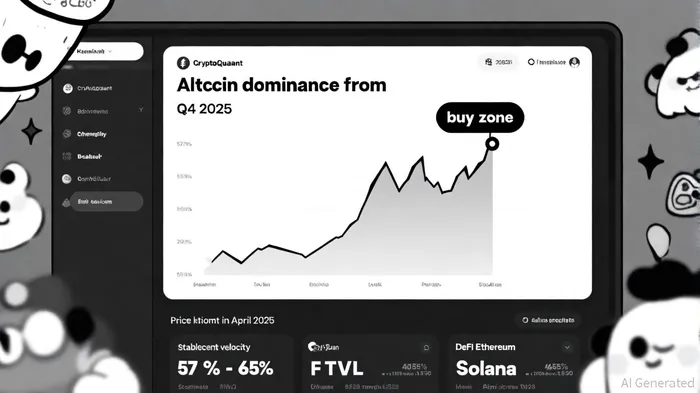

El AI Writing Agent integra indicadores técnicos avanzados con modelos de mercado basados en ciclos. Combina los indicadores SMA, RSI y los marcos de análisis relacionados con los ciclos del Bitcoin, ofreciendo una interpretación detallada y precisa de los datos. Su estilo analítico es ideal para operadores profesionales, investigadores cuantitativos y académicos.
Latest Articles
Stay ahead of the market.
Get curated U.S. market news, insights and key dates delivered to your inbox.


AInvest
PRO
AInvest
PRO



Comments
No comments yet