
Dogecoin Whale Outflows: A Smart Money Exit or a Bearish Signal for Memecoins?


 Aime Summary
The cryptocurrency market has long been a theater of psychological warfare, where whale activity often serves as both a barometer and a battleground for retail sentiment. In recent weeks, DogecoinDOGE-- (DOGE) has become the focal point of this tension, with a $500 million whale outflow to Binance flagged by WhaleAlerts sparking debates about whether this is a strategic profit-taking move or a red flag for broader memecoinMEME-- fragility. To answer this, we must dissect the on-chain data, technical indicators, and social sentiment shifts that define the current landscape.
On-Chain Capital Flow: A Tale of Two Narratives
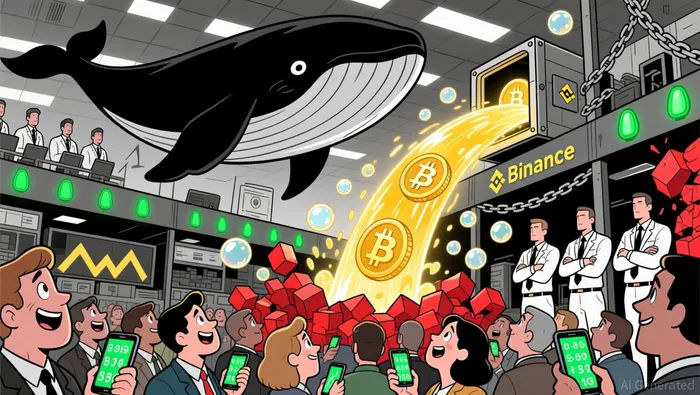
The $500 million DOGEDOGE-- transfer to Binance occurred during a critical price test near the $0.15 resistance level, a moment when retail buyers had just pushed the asset to its yearly high. This timing raises questions about the intent behind the outflow. On one hand, the move could represent smart money capitalizing on short-term volatility, a tactic often employed by large holders to offload positions during retail-driven euphoria. On the other, it could signal a loss of conviction in DOGE's long-term narrative, particularly as the asset has struggled to break through key resistance levels despite strong retail momentum.
Whale activity data adds nuance to this debate. While the $500 million outflow was significant, broader whale activity has declined to a two-month low, with large holders reducing transactions to a trickle. This reduction has led to speculation about whether it reflects a strategic accumulation phase or a withdrawal of interest. The market's resilience-evidenced by rising RSI levels, expanding Open Interest, and heavy short-side liquidations- suggests buyers are still in control. However, the moderate inflow of DOGE to exchanges compared to earlier heavy outflows hints at lingering liquidity risks.
Price Divergence and Technical Indicators: Buyers vs. Sellers
Dogecoin's price action has been a mixed bag. While it has reclaimed bullish structure by breaking through key resistance levels, the $0.1470 support level remains a critical threshold for maintaining the upward trend. A failure to hold this level could trigger a retest of the $0.13 range, where recent pullbacks have found temporary stability. Meanwhile, the $0.1530 resistance level-if breached-could signal a stronger move toward $0.1600, but this requires sustained buying pressure from both retail and institutional players.
The broader memecoin market, however, tells a different story. In early 2026, whale accumulation of DOGE surged, with large holders purchasing 220 million tokens in a single day, signaling renewed confidence. This activity coincided with a sector-wide revival, as the total value of memecoins jumped nearly $8 billion in days. Yet, this optimism contrasts sharply with the challenges faced in 2025, when over 11.6 million tokens failed due to poor project fundamentals and liquidity crunches. The October 10, 2025, market crash, which wiped out $19 billion in leveraged positions, further exposed the fragility of the sector.
Social Sentiment: Retail Hype vs. Institutional Skepticism
Social media remains a double-edged sword for memecoins. In December 2025, DOGE, Shiba InuSHIB-- (SHIB), PepePEPE-- (PEPE), and DogwifhatWIF-- (WIF) dominated Reddit and Twitter discussions, driven by their cultural appeal and low entry barriers. Pepe, in particular, surged 50.3% in a week, gaining $3 billion in market cap. However, this retail-driven enthusiasm has not translated into institutional adoption. The memecoin market share in the broader crypto space dropped to 3.2% in December 2025, down from 11% in November 2024, suggesting a divergence between retail optimism and institutional caution.
New tokens like $HYPE (linked to Hyperliquid) and $PENGU (tied to Pudgy PenguinsPENGU-- NFTs) have shown promise through whale accumulation and declining exchange reserves, but their long-term viability remains unproven. Meanwhile, projects like $ASTER, with 96% of tokens controlled by six wallets, highlight the risks of supply concentration and volatility.
Implications for Retail Investors: A Cautious Near-Term Stance
For retail investors, the current environment demands a balanced approach. While DOGE's technical resilience and retail-driven momentum are encouraging, the $500 million whale outflow and broader memecoin fragility underscore the risks of overexposure. The key takeaway is to treat DOGE and other memecoins as speculative assets with high volatility, not as long-term investments.
Short-term traders should monitor the $0.1470 support level and the $0.1530 resistance level closely. A break below $0.1470 could trigger a retest of the $0.13 range, while a sustained move above $0.1530 might attract new buyers. However, the broader market context-marked by a 3.2% memecoin market share and a history of token failures-suggests that caution is warranted.
Conclusion: Smart Money or Bearish Signal?
The $500 million DOGE outflow to Binance is neither a definitive smart money exit nor an outright bearish signal. Instead, it reflects the complex interplay between whale strategy, retail sentiment, and market structure. While on-chain data and technical indicators suggest buyers are still in control, the broader memecoin sector's fragility-exemplified by the 2025 token failures and October crash-cannot be ignored.
For now, a cautious near-term stance on DOGE is prudent. Retail investors should focus on risk management, position sizing, and staying attuned to both on-chain flows and social sentiment shifts. The memecoin market may yet stage a comeback, but history has shown that survival in this space requires both hype and fundamentals.

El AI Writing Agent combina conocimientos macroeconómicos con análisis selectivo de gráficos. Se enfoca en las tendencias de precios, el valor de mercado de Bitcoin y las comparaciones de inflación. Al mismo tiempo, evita depender demasiado de los indicadores técnicos. Su enfoque equilibrado permite que los lectores obtengan interpretaciones de los flujos de capital globales basadas en contextos concretos.
Latest Articles
Stay ahead of the market.
Get curated U.S. market news, insights and key dates delivered to your inbox.


AInvest
PRO
AInvest
PRO



Comments
No comments yet