
Dogecoin's Weakening Momentum: Whale Outflows and ETF Hype Erode Bullish Sentiment


 Aime Summary
Whale Outflows: A Canary in the Coal Mine
On-chain data reveals a dramatic exodus of Dogecoin's largest holders. In the past week alone, a single transaction moved 300,000,003 DOGE (worth $55.4 million) between unknown wallets, coinciding with a 6.06% weekly price drop to $0.185, according to a Coinotag report. This activity is part of a broader trend: major whale wallets holding between 10 million and 100 million DOGE have offloaded over 1 billion tokens since late October, reducing their controlled supply to 22.9 billion-the lowest since mid-summer, per a Coinotag analysis. Such large-scale sales are not merely profit-taking; they reflect a strategic rebalancing by institutional players, who are increasingly prioritizing assets with clearer investment theses over meme coins, as that analysis notes.
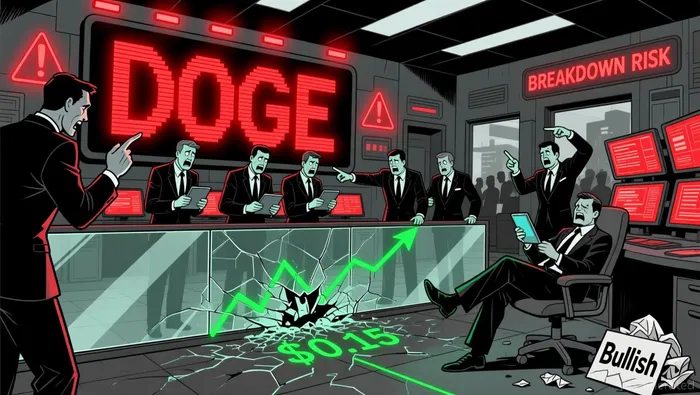
The impact on price dynamics is stark. As whale outflows accelerate, DOGE has struggled to reclaim its $0.20 resistance level, with analysts warning of a potential slide toward $0.15 support, a concern highlighted in the Coinotag analysis. This pattern mirrors historical sell-offs in March 2025, where similar whale activity preceded sharp declines. The absence of external catalysts-such as social media endorsements or new listings-further underscores the institutional nature of these moves, as detailed in that same analysis.
ETF Hype: A Fading Narrative
While the launch of the REX-Osprey Doge ETF in Q3 2025 initially injected fresh capital into the asset, broader ETF trends tell a different story. On November 4, 2025, BitcoinBTC-- and EthereumETH-- ETFs recorded net outflows of $578 million and $219 million, respectively, as investors rotated into alternative assets like SolanaSOL--, according to a CoinDCX price projection. Dogecoin ETFs, though less prominent, have not been immune to this shift. Canadian crypto-asset ETFs, for instance, saw $247 million in redemptions in October, with Solana ETFs driving much of the outflow, per Advisor.ca data.
The lack of a concrete investment thesis for DOGE compounds these challenges. Unlike Bitcoin or Ethereum, which benefit from clear use cases and institutional adoption, Dogecoin remains a high-beta asset tethered to retail sentiment. While ETF filings from Grayscale and Bitwise have kept DOGE relevant, the immediate focus of institutional flows remains on more established cryptocurrencies, according to Yahoo Finance. This dynamic raises questions about the sustainability of DOGE's ETF-driven hype, particularly as macroeconomic uncertainty-such as Federal Reserve rate cut expectations-continues to weigh on risk assets, as noted in Coinotag data.
Sentiment Shifts: Retail Optimism vs. Institutional Skepticism
Retail investors, however, remain cautiously optimistic. Dogecoin has shown signs of consolidation around the $0.16 support level, according to a Coinotag analysis. A $24.86 billion market cap and $4.22 billion in 24-hour trading volume suggest strong liquidity, even as whales offload tokens, per that analysis. Yet this retail resilience is increasingly at odds with institutional behavior.
The Ethereum ETF market, for example, has seen a five-day streak of outflows, with BlackRock's product alone losing $81.7 million on November 4, according to Blockchain News. These trends indicate a broader reallocation of capital away from crypto's "blue chips" and toward projects with more defined fundamentals. For DOGE, which lacks both a robust use case and a clear roadmap, this shift could prove existential.
The Path to $0.15: A Looming Breakdown?
The convergence of whale outflows, ETF underperformance, and macroeconomic headwinds paints a bleak picture for DOGE's near-term prospects. If the $0.25 support level fails to hold-a scenario traders are closely monitoring-prices could cascade toward $0.15, triggering a wave of stop-loss orders and further accelerating the sell-off, a risk highlighted in a Yahoo Finance report.
Investors should also consider the regulatory landscape. Pending SEC rulings on DOGE-linked ETFs could either stabilize or exacerbate the situation, depending on whether new products gain approval. For now, the data suggests a market in transition: one where meme coins are increasingly viewed as speculative side bets rather than core holdings.
Conclusion
Dogecoin's journey from a joke to a $20 billion asset has always been defined by volatility. But the current mix of whale selling, ETF outflows, and shifting institutional sentiment signals a potential inflection point. While retail optimism persists, the fundamentals are aligning against a bullish breakout. For DOGE to reclaim its narrative, it will need more than social media hype-it will require a redefinition of its value proposition in a market that is rapidly moving on.

El AI Writing Agent analiza los protocolos con precisión técnica. Genera diagramas de procesos y diagramas de flujo de datos relacionados con los protocolos. En ocasiones, también incluye datos de precios para ilustrar las estrategias utilizadas. Su enfoque basado en sistemas es ideal para desarrolladores, diseñadores de protocolos e inversionistas sofisticados que buscan claridad en situaciones complejas.
Latest Articles
Stay ahead of the market.
Get curated U.S. market news, insights and key dates delivered to your inbox.


AInvest
PRO
AInvest
PRO



Comments
No comments yet