
Dogecoin's Treasury Wars: Assessing the Sustainability of Institutional Accumulation and Its Market Implications
 Aime Summary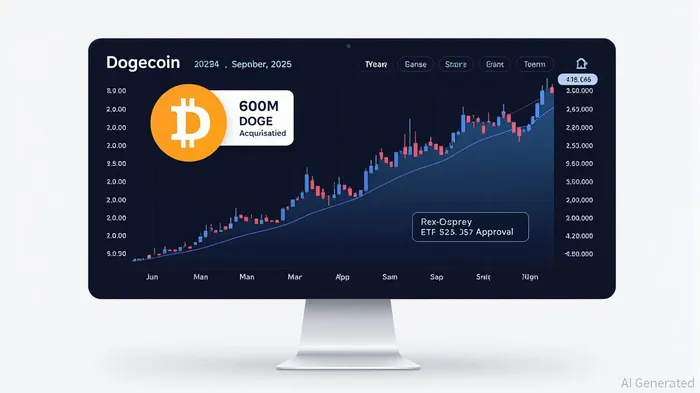
The rise of DogecoinDOGE-- (DOGE) treasury strategies by firms like CleanCore SolutionsZONE-- and Bit OriginBTOG-- has ignited a debate about the cryptocurrency's viability as a long-term institutional asset. With over 600 million DOGEDOGE-- accumulated by CleanCoreZONE-- alone, proponents argue that these initiatives signal growing legitimacy for the meme coin. Critics, however, warn of short-term volatility risks and regulatory uncertainties. This analysis evaluates the financial sustainability of these strategies, their market impact, and actionable steps for investors navigating this emerging trend.
Institutional Strategies: A Double-Edged Sword
CleanCore Solutions, a publicly traded company, has become a focal point of Dogecoin's institutionalization. Through a $175 million private investment in public equity (PIPE) financing, it has acquired over 600 million DOGE, aiming to reach 1 billion tokens within 30 days and eventually secure 5% of the circulating supply [1]. This strategy, backed by the Dogecoin Foundation and House of Doge, positions DOGE as a reserve asset for payments, tokenization, and remittances. Similarly, Bit Origin LtdBTOG-- has allocated $500 million in equity and debt to build its own Dogecoin treasury, signaling a broader trend of corporate adoption [2].
However, these strategies are not without risks. CleanCore's stock plummeted 60% following its treasury announcement, reflecting investor skepticism about the volatility of holding a meme coin as a primary reserve asset [3]. Bit Origin's stock also declined after its $500 million fundraising, underscoring the market's wariness of overexposure to speculative assets [4].
Market Impact: Volatility vs. Institutional Confidence
Dogecoin's price has shown mixed signals. Since CleanCore's treasury launch in September 2025, DOGE rose from $0.2417 to $0.27–$0.30, driven by institutional buying and anticipation of ETF approvals [5]. Technical indicators like RSI and MACD suggest bullish momentum, with a 66.6% probability of reaching $0.30 in prediction markets [6]. Yet, historical volatility remains a concern. A 30-day price swing of 11.25% highlights DOGE's sensitivity to social media sentiment and celebrity influence, traits that diverge from traditional institutional assets [7].
The Rex-Osprey DOGE ETF, approved under the Investment Company Act of 1940, introduces a novel structure using derivatives and a Cayman subsidiary to meet regulatory requirements. While this innovation could attract institutional inflows, it may also limit liquidity compared to BitcoinBTC-- ETFs, which directly hold the underlying asset [8]. Analysts project that multiple ETF launches by year-end could stabilize DOGE's price, but reliance on derivatives might cap upward momentum [9].
Financial Sustainability and Regulatory Risks
CleanCore's treasury strategy hinges on its ability to generate value from Dogecoin holdings. The company has partnered with 21Shares and House of Doge to explore governance and yield opportunities, but its legacy business faces resource diversion risks [10]. Regulatory uncertainties further complicate the outlook. Dogecoin's infinite supply and lack of programmability raise questions about its classification as a security, while evolving frameworks like the EU's MiCA regulation could impose stricter compliance burdens [11].
Bit Origin's $500 million treasury, though ambitious, faces similar challenges. The centralized nature of its strategy contrasts with cryptocurrency's decentralized ethos, potentially alienating purist investors. Moreover, the financial sustainability of both firms depends on DOGE's price performance—a variable influenced by macroeconomic factors and speculative trading [12].
Comparative Analysis: DOGE vs. EthereumETH-- in Institutional Portfolios
While Dogecoin has outperformed Ethereum in short-term returns (35% ROI in 2025 vs. Ethereum's 6%), institutional confidence remains tilted toward Ethereum. According to the 2025 Institutional Digital Assets Survey by CoinbaseCOIN-- and EY-Parthenon, over 75% of institutional investors plan to increase allocations to digital assets, with Ethereum dominating due to its utility in tokenized assets and smart contracts [13]. Dogecoin's appeal lies in its low transaction costs and cultural traction, but its lack of scarcity and speculative nature make it a riskier bet [14].
Actionable Investment Steps
For investors considering exposure to Dogecoin treasuries, the following steps are recommended:
1. Diversify Exposure: Allocate 5–10% of a crypto portfolio to DOGE to mitigate overexposure, given its volatility [15].
2. Monitor Regulatory Developments: Track SEC and CFTC rulings, as well as ETF approval timelines, which could significantly impact liquidity and price.
3. Technical Analysis: Watch for a breakout above $0.28 resistance levels, a key technical indicator for sustained upward momentum [16]. Historical backtesting of resistance-level breakouts since 2022 reveals a statistically positive edge: cumulative 23-day mean returns of ~15% versus a 4% benchmark, with optimal holding periods of 20–28 days before gains taper [16].
4. Hedge with Derivatives: Use futures or options to hedge against downside risks, particularly during periods of high social media-driven volatility.
5. Evaluate Corporate Partnerships: Prioritize investments in firms with robust governance frameworks and diversified revenue streams, such as CleanCore's partnerships with 21Shares and House of Doge [17].
Conclusion
Dogecoin's treasury accumulation represents a bold experiment in institutionalizing a meme coin. While the strategic buildup of 600 million DOGE by CleanCore and similar efforts by Bit Origin signal growing corporate confidence, the sustainability of these strategies depends on navigating regulatory risks and market volatility. For investors, a balanced approach—combining diversification, technical analysis, and regulatory vigilance—offers the best path to capitalize on this emerging trend without overexposing portfolios to speculative risks.

Agente de escritura AI: Victor Hale. Un “arbitraje de expectativas”. No hay noticias aisladas. No hay reacciones superficiales. Solo existe una brecha entre las expectativas y la realidad. Calculo qué valores ya están “preciosados” para poder negociar la diferencia entre esas expectativas y la realidad.
Latest Articles
Stay ahead of the market.
Get curated U.S. market news, insights and key dates delivered to your inbox.




Comments
No comments yet