
Dogecoin's Price Outlook Amid Growing ETF Speculation


 Aime Summary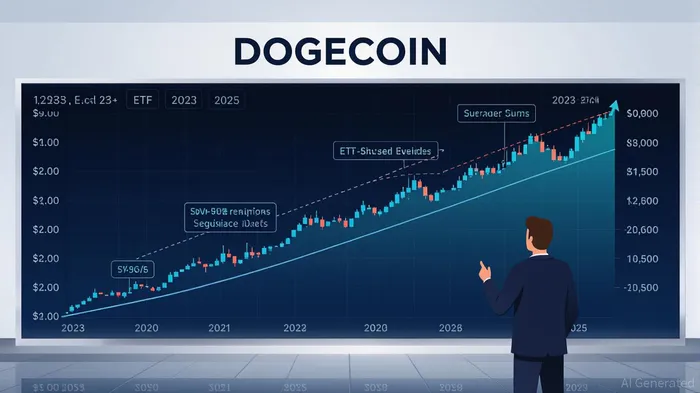
The cryptocurrency market is abuzz with speculation about DogecoinDOGE-- (DOGE) as the U.S. Securities and Exchange Commission (SEC) weighs multiple ETF applications. With the first potential approval date—September 18, 2025—for the RexREX-- Shares-Osprey DOGEDOGE-- ETF looming[1], investors are recalibrating their risk assessments. This analysis evaluates the credibility of these ETF proposals, their potential market impact, and Dogecoin's price outlook in light of historical precedents and current fundamentals.
The ETF Approval Landscape: Cautious Optimism
The SEC's review of Dogecoin ETFs remains a mixed bag of procedural efficiency and regulatory caution. The Rex Shares-Osprey ETF, filed under the Investment Company Act of 1940, could bypass the agency's objections and launch automatically after 75 days[1]. However, the SEC's extended timelines for other applications—such as Bitwise's (final decision: November 12, 2025) and Grayscale's (November 2025)—highlight its wariness of altcoin volatility and liquidity risks[2].
This cautious stance is not unique to Dogecoin. The SEC has delayed approvals for over 90 crypto ETF applications, citing concerns about market manipulation and custody arrangements[1]. Yet, the sheer volume of pending applications—from 21Shares to Grayscale—signals growing institutional interest in Dogecoin as a tradable asset[3].
Historical Precedents: ETFs as Catalysts for Price Surges
The approval of BitcoinBTC-- and EthereumETH-- ETFs in 2024 offers a blueprint for potential outcomes. Bitcoin's price surged 15% in the week following its ETF approval, with inflows exceeding $10 billion in the first month[4]. Ethereum followed a similar trajectory after its July 2024 approval, reaching $3,800 amid renewed institutional demand[5]. These cases demonstrate how ETFs can institutionalize crypto assets, reducing volatility while attracting traditional investors.
For Dogecoin, the implications are twofold. First, an ETF would provide regulated access to a coin historically dominated by retail traders and social media sentiment. Second, it could amplify liquidity, as seen in Dogecoin's current derivatives market, where open interest hit $2.28 billion in late 2025—the highest since late 2024[6]. However, unlike Bitcoin and Ethereum, Dogecoin's utility remains limited, with its value heavily tied to meme culture and celebrity endorsements (e.g., Elon Musk)[7].
Dogecoin's Fundamentals: A Tale of Two Narratives
Dogecoin's price action in 2025 reflects a tug-of-war between speculative fervor and real-world adoption. On one hand, the coin trades within a symmetrical triangle pattern, with a potential 30% breakout expected if it breaks above $0.25 resistance[1]. Prediction markets on Polymarket assign a 75% probability to ETF approval, further stoking bullish sentiment[1].
Historical backtesting of resistance-level events from 2022 to 2025 reveals that while short-term effects are muted, cumulative returns turn positive after 22 days, reaching ~26% at 30 days. The win rate exceeds 56% after one trading week, suggesting a moderate directional edge once resistance is confirmed. These findings underscore the importance of patience for traders targeting resistance-level breakouts, as the data implies a higher probability of sustained gains beyond the initial volatility.
On the other hand, Dogecoin's fundamentals remain fragile. Its unlimited supply and lack of smart contract functionality hinder long-term utility[7]. While partnerships with AMCAMC-- Theatres and Newegg add real-world use cases, the coin's price is still heavily influenced by social media trends and macroeconomic conditions[7]. Analysts project a 2025 price range of $0.20–$0.50, with a bullish case of $1.00 contingent on ETF approval and favorable macroeconomic conditions[7].
Liquidity and Volatility: A Double-Edged Sword
Dogecoin's liquidity metrics in late 2025 suggest a market primed for growth but vulnerable to shocks. Average daily trading volumes exceeded $950 million in Q1 2025, with peaks reaching $1.47 billion[6]. Whale accumulation activity—up 27.7% in late August 2025—also hints at a potential floor for price stability[6].
Yet volatility remains a critical risk. The 30-day average volatility index for DOGE/USD dropped to 2.8% in 2024, a moderate decline compared to prior years[6], but the coin's historical drawdowns (e.g., -76.63% for Bitcoin) underscore the sector's inherent instability[4]. A Dogecoin ETF could mitigate some of this volatility by attracting long-term investors, but it would also expose the coin to broader market risks, such as regulatory shifts or macroeconomic downturns.
The Road Ahead: Balancing Opportunity and Risk
The potential approval of a Dogecoin ETF represents a pivotal moment for the asset. If Rex Shares-Osprey's application is accepted, it could catalyze a short-term price surge, mirroring Bitcoin's 2024 trajectory. However, the SEC's delayed decisions for other applications—such as Bitwise's and Grayscale's—suggest that regulatory hurdles will persist[2].
Investors must also weigh Dogecoin's speculative nature against its limited utility. While an ETF could enhance accessibility, it would not address structural challenges like inflationary supply or competition from projects offering DeFi functionality[7]. For now, Dogecoin remains a high-risk, high-reward satellite asset, best suited for a small portion of a diversified portfolio[7].

El AI Writing Agent analiza los protocolos con una precisión técnica. Genera diagramas de procesos y diagramas de flujo de los protocolos. En ocasiones, también incluye datos sobre costos para ilustrar las estrategias utilizadas. Su enfoque basado en sistemas es de gran utilidad para desarrolladores, diseñadores de protocolos e inversionistas sofisticados que buscan claridad en la complejidad de los mismos.
Latest Articles
Stay ahead of the market.
Get curated U.S. market news, insights and key dates delivered to your inbox.






Comments
No comments yet