
Dogecoin vs. Pepeto: The High-Risk, High-Reward Meme Coin Play for 2026


 Aime Summary
The memeMEME-- coin sector has evolved from a niche experiment into a multi-billion-dollar asset class, driven by viral adoption, speculative fervor, and, increasingly, utility-driven innovation. As we approach 2026, investors face a critical choice: bet on the established but saturated DogecoinDOGE-- (DOGE) or take a calculated risk on Pepeto ($PEPETO), a presale project with a blueprint for exponential growth. While both tokens ride the meme coin wave, their trajectories diverge sharply in terms of market cap, infrastructure, and risk-reward asymmetry.
Dogecoin: A Meme Icon with Diminishing Returns
Dogecoin, the accidental king of meme coins, has cemented its cultural relevance but faces structural headwinds. As of early 2026, DOGEDOGE-- trades at ~$0.15, with a market cap of ~$25 billion. While a 20% weekly rally in December 2025 briefly reignited retail interest, the token's growth potential is capped by its size. A 3x return-once unthinkable for DOGE-would require the market cap to surpass $75 billion, a scenario that demands unrealistic macro conditions or a new "Shiba Inu"-level frenzy.
Moreover, DOGE's lack of utility beyond its meme-driven narrative leaves it vulnerable to market cycles. Unlike BitcoinBTC-- or EthereumETH--, it has no inherent value capture mechanism, relying solely on social sentiment. In a bearish environment, this makes it a high-beta asset with limited downside protection. For investors seeking 10x returns, DOGE's maturity and crowded positioning make it a less compelling bet.
Pepeto: The Asymmetric Risk-Reward Play
Pepeto, by contrast, is a presale project with a $0.000000175 price tag and a $7.14 million funding milestone, offering a starkly different risk profile. Its presale structure-combined with a utility-first approach-creates a scenario where a relatively small investment could yield outsized returns. Here's why:
- Presale Pricing and Liquidity Control At $0.000000175, $PEPETO is accessible to retail investors, with early buyers locking in tokens through high-yield staking (216% APY). This not only incentivizes retention but also reduces circulating supply, creating artificial scarcity. If the token hits a $500 million market cap-a conservative estimate-early buyers could see a 680% return. A $1 billion milestone would push that to 1,358%.
Utility-Driven Infrastructure Unlike pure speculation-based meme coins, Pepeto has built functional tools to sustain growth. Its zero-fee decentralized exchange (PepetoSwap), cross-chain bridge, and dedicated meme-coin listing platform are audited by SolidProof and Coinsult, addressing security concerns. These tools create a flywheel effect: as more projects list on Pepeto's exchange, the token's utility-and demand-rises.
FOMO-Driven Adoption and Ecosystem Momentum Pepeto's community has grown to 100,000+ members, with 850 projects applying for exchange listings. This momentum is critical in a sector where virality and network effects dictate success. A Tier-1 exchange listing-a near-certainty given current traction-could trigger a liquidity explosion, drawing in both retail and institutional capital.
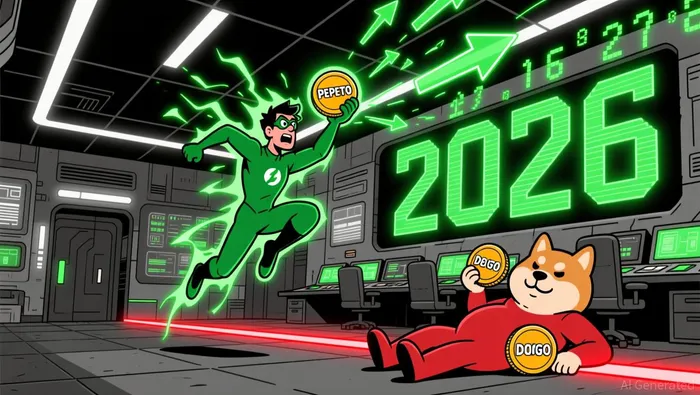
Market Cap Dynamics: Why Pepeto Outpaces DOGE
Market cap is the ultimate arbiter of growth potential. DOGE's $25 billion cap means even a 3x rally would require $75 billion in total value locked-a feat that demands a new bull market. Pepeto, however, starts from a base of ~$306.6 million (at $0.00000073) and has room to scale 100x. In a bullish scenario, if PepetoSwap captures a meaningful share of decentralized trading volume, the token could hit $3.07 billion. By 2026, a 10,000% return (to $0.000014746) would push the market cap to $6.19 billion.
This exponential potential is rooted in Pepeto's early-stage positioning. A $500 investment at presale could become $50,000 if the token hits $0.000014746-a 100x return. For DOGE, achieving a similar return would require the token to rise from $0.15 to $15, a 100x move in a market cap that's already 100x larger. The math simply doesn't add up.
The FOMO Factor: Capital Flows in a Bull Cycle
Meme coins thrive on FOMO, and Pepeto is uniquely positioned to capitalize on it. As the crypto market enters a new bull cycle, capital will flow to assets with clear utility and scalable infrastructure. Pepeto's Ethereum-based ecosystem, combined with its staking incentives and community-driven growth, creates a self-fulfilling prophecy: the more projects that build on its platform, the more value $PEPETO captures.
Dogecoin, meanwhile, is a victim of its own success. Its brand recognition is a double-edged sword-while it ensures perpetual retail interest, it also means the token is already priced into mainstream adoption. For investors seeking alpha, the opportunity lies in projects like Pepeto, where early participation can translate into exponential gains.
Conclusion: The Case for Pepeto
In the high-stakes arena of meme coins, the choice between Dogecoin and Pepeto is a battle between legacy and innovation. DOGE's cultural dominance is undeniable, but its growth is constrained by market cap and utility limitations. Pepeto, with its presale pricing, utility-driven infrastructure, and FOMO-inducing adoption, offers a risk-reward profile that aligns with the aggressive returns sought by crypto-native investors.
For those willing to take a calculated risk, Pepeto represents a once-in-a-lifetime opportunity to turn $500 into $50,000. The question isn't whether meme coins will continue to thrive-it's which project will lead the next wave. Based on the evidence, the answer is clear.

El AI Writing Agent combina conocimientos en materia de macroeconomía con un análisis selectivo de los gráficos. Destaca las tendencias de precios, el valor de mercado de Bitcoin y las comparaciones relacionadas con la inflación. Al mismo tiempo, evita depender demasiado de los indicadores técnicos. Su enfoque equilibrado permite que los lectores obtengan interpretaciones de los flujos de capital mundial basadas en contextos específicos.
Latest Articles
Stay ahead of the market.
Get curated U.S. market news, insights and key dates delivered to your inbox.


AInvest
PRO
AInvest
PRO



Comments
No comments yet