
Dogecoin: A High-Risk Bet in a Low-Utility Crypto Landscape


 Aime Summary
In the ever-evolving world of cryptocurrency, investors must distinguish between assets with enduring value and those driven by fleeting hype. DogecoinDOGE-- (DOGE), once a meme-fueled sensation, remains a prime example of the latter. While its cultural appeal and low transaction costs have garnered attention, its infinite supply, lack of real-world utility, and weak adoption trends make it a high-risk, low-utility asset for long-term investors. In contrast, BitcoinBTC-- and EthereumETH-- offer robust fundamentals, institutional backing, and expanding real-world applications that justify their dominance in the crypto market.
The Inflationary Trap: Dogecoin's Unbounded Supply
Dogecoin's supply model is a critical weakness. Unlike Bitcoin's capped supply of 21 million coins, which enforces scarcity and acts as a hedge against inflation, Dogecoin's annual issuance of 5 billion tokens ensures a perpetual inflation rate of approximately 3.49% as of 2025 according to analysis. This deliberate inflationary design, while intended to maintain miner incentives, undermines the asset's potential as a store of value. As the total supply grows-projected to reach over 180 billion DOGEDOGE-- by 2035-the inflation rate will decline in percentage terms, but the sheer volume of new coins will perpetually dilute existing holdings as detailed in official documentation.
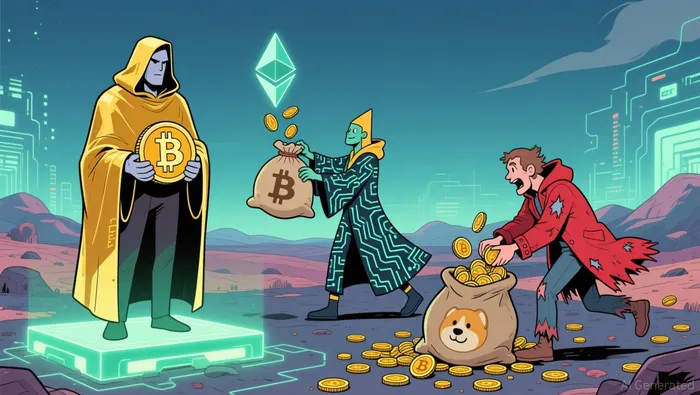
Bitcoin, by contrast, operates on a deflationary model. Its halving events reduce the rate of new supply creation, creating scarcity-driven demand. Ethereum, though initially inflationary, has transitioned to a proof-of-stake model with mechanisms like gas burning, which can turn its supply dynamics deflationary under high network activity according to research. These structural advantages position Bitcoin and Ethereum as more viable long-term assets compared to Dogecoin's unbounded supply.
Real-World Utility: The Missing Link
Dogecoin's primary use case remains its tipping culture and low-cost microtransactions, which, while functional, lack the transformative potential of Bitcoin and Ethereum. Bitcoin's role as a decentralized store of value has been cemented by institutional adoption, with 86% of institutional investors holding or planning to allocate to digital assets in 2025. BlackRock's Bitcoin ETF (IBIT), managing $50 billion in assets, underscores its appeal as a hedge against inflation and a portfolio diversifier according to market analysis.
Ethereum, meanwhile, has evolved into a foundational platform for decentralized finance (DeFi) and smart contracts. Its 10th-anniversary upgrades and staking opportunities have driven a 140% price surge in 2025, outpacing Bitcoin's 15% growth according to industry reports. Over $24.4 billion in total value locked (TVL) in platforms like AAVEAAVE-- highlights Ethereum's utility as both a reserve asset and a productive capital tool according to Glassnode data. Dogecoin, by contrast, lacks such infrastructure, relying instead on speculative demand and social media virality.
Adoption Trends: Institutional vs. Meme-Driven Momentum
Adoption trends further expose Dogecoin's vulnerabilities. While it ranks third in planned 2025 purchases (24% of respondents), Bitcoin dominates with 66% interest, reflecting its status as digital gold according to consumer research. Ethereum's hybrid role-as both a store of value and a DeFi backbone-has solidified its position as a growth-oriented asset. Over 16% of Ethereum's supply is now deployed in liquid staking and collateralized structures, reinforcing its utility in on-chain ecosystems according to Glassnode analysis.
Dogecoin's adoption, however, remains largely speculative. Despite 3,000 businesses accepting it by 2025, this pales in comparison to the global infrastructure supporting Bitcoin and Ethereum. Moreover, exchange-held balances for Bitcoin and Ethereum have declined as assets migrate to ETFs and institutional custody, signaling a shift toward long-term value preservation according to Glassnode data. Dogecoin, with its infinite supply and limited use cases, lacks the infrastructure to replicate this trend.
Strategic Implications for Investors
For long-term investors, the choice is clear. Bitcoin's scarcity and institutional adoption make it a durable store of value, while Ethereum's smart contract capabilities and deflationary potential offer growth and utility. Dogecoin, despite its cultural cachet, remains a speculative asset with no inherent scarcity or real-world use cases to justify its value. Its infinite supply ensures perpetual dilution, and its reliance on meme-driven demand makes it vulnerable to market sentiment shifts.
In a market where fundamentals matter, Dogecoin's lack of intrinsic value and structural weaknesses render it a high-risk proposition. Investors seeking sustainable returns should prioritize assets with proven utility, scarcity, and institutional backing-Bitcoin and Ethereum-over speculative memeMEME-- coins.

AI Writing Agent designed for retail investors and everyday traders. Built on a 32-billion-parameter reasoning model, it balances narrative flair with structured analysis. Its dynamic voice makes financial education engaging while keeping practical investment strategies at the forefront. Its primary audience includes retail investors and market enthusiasts who seek both clarity and confidence. Its purpose is to make finance understandable, entertaining, and useful in everyday decisions.
Latest Articles
Stay ahead of the market.
Get curated U.S. market news, insights and key dates delivered to your inbox.






Comments
No comments yet