
The First US Dogecoin ETF: A Meme Coin's Leap into Institutional Legitimacy
 Aime Summary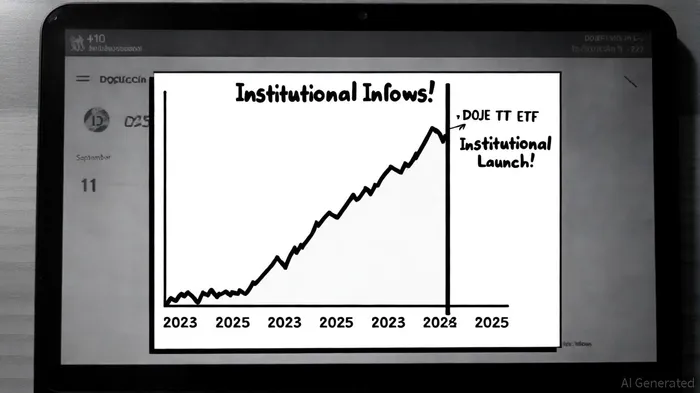
The launch of the Rex-Osprey DogecoinDOGE-- ETF (ticker: DOJE) on September 11, 2025, marks a seismic shift in the crypto asset landscape. As the first U.S. exchange-traded fund to directly track Dogecoin—a cryptocurrency originally created as a joke in 2013—the DOJE ETF not only legitimizes memecoins as investable assets but also signals a broader regulatory and institutional pivot toward embracing speculative, community-driven tokens. This development carries profound implications for both retail and institutional investors, reshaping the narrative around crypto adoption and regulatory frameworks.
Regulatory Innovation and Structural Distinctions
The DOJE ETF's approval under the Investment Company Act of 1940, rather than the Securities Act of 1933, represents a strategic regulatory workaround. Unlike traditional commodity-style crypto ETFs (e.g., BitcoinBTC-- and EthereumETH-- trusts), which rely on the 1933 Act's framework for grantor trusts, the 1940 Act imposes stricter governance and investor protection standards, aligning the product more closely with conventional stock and bond ETFs [1]. This distinction is critical: it allows the DOJE ETF to bypass the SEC's prolonged scrutiny of spot crypto ETFs while establishing a precedent for future altcoin products. For instance, tokens like Shiba InuSHIB-- or Pepe, which similarly lack utility beyond speculation, could now follow a parallel regulatory path [1].
The 1940 Act structure also introduces operational flexibility. The ETF's use of swaps and a Cayman subsidiary subsidiary ensures tax efficiency and institutional-grade liquidity, addressing concerns about the volatility and illiquidity often associated with meme coins [5]. This structural innovation positions DOJE as a bridge between the chaotic world of memecoins and the disciplined frameworks of traditional finance.
Retail Adoption: Democratizing Access to a Meme Asset
For retail investors, the DOJE ETF eliminates the friction of direct crypto ownership. Instead of navigating crypto exchanges, managing private keys, or worrying about security, investors can now gain exposure to Dogecoin through traditional brokerage accounts. This simplicity is likely to attract a new cohort of retail participants, particularly those hesitant to engage with the complexities of blockchain technology [2].
The cultural resonance of Dogecoin further amplifies its appeal. Unlike Bitcoin's narrative of digital scarcity or Ethereum's smart contract utility, Dogecoin's value proposition is rooted in its community-driven ethos and meme-driven virality. As noted by CoinDesk, this “no utility” model challenges conventional asset valuation frameworks but resonates with a generation of investors who prioritize social proof and cultural relevance over technical fundamentals [1]. The DOJE ETF thus transforms a niche internet phenomenon into a mainstream financial product.
Institutional Inflows: From Skepticism to Strategic Exposure
Institutional adoption of Dogecoin has been historically limited by its perceived lack of utility and volatility. However, the DOJE ETF's launch, coupled with initiatives like the House of Doge's partnership with CleanCore SolutionsZONE--, signals a strategic effort to rebrand Dogecoin as a serious asset. CleanCore's acquisition of 285.4 million DOGEDOGE-- to establish an official treasury underscores institutional confidence in the token's long-term viability [1].
Moreover, the DOJE ETF's structure—mirroring that of the recently launched SolanaSOL-- staking ETF—provides institutions with a familiar vehicle to allocate capital to high-beta assets without direct exposure to crypto's operational risks [3]. This is particularly significant given the SEC's delayed decision on competing Dogecoin ETF applications, such as Bitwise's proposal, which remains pending until November 12, 2025 [6]. By offering a regulated alternative, the DOJE ETF accelerates institutional participation, potentially triggering a cascade of capital inflows.
Market Reactions and Price Implications
The market has already begun pricing in the DOJE ETF's impact. As of September 10, 2025, Dogecoin trades at $0.240389, reflecting a 1.5% daily gain and an 11.5% weekly increase [3]. Analysts project that the ETF could drive the price toward $0.35 by year-end, fueled by both retail enthusiasm and institutional demand [4]. However, technical indicators such as the RSI nearing overbought territory suggest caution, as volatility remains a defining characteristic of the asset class [3].
Broader Strategic Implications
The DOJE ETF's success could catalyze a broader rally across meme coins and altcoins. Projects like Maxi Doge, Pepenode, and TOKEN6900 have already gained traction as high-beta plays in anticipation of the ETF's launch [5]. This dynamic mirrors the 2021 “meme coin boom,” but with the added catalyst of institutional-grade infrastructure.
However, the ETF's regulatory path also raises questions about the SEC's approach to crypto innovation. By approving the DOJE ETF under the 1940 Act while delaying approvals under the 1933 Act, the agency appears to be creating a two-tiered system where regulatory clarity is contingent on structural choices rather than asset fundamentals. This inconsistency could complicate the approval process for future ETFs and deepen existing tensions between the crypto industry and regulators.
Conclusion
The DOJE ETF represents more than just a new investment vehicle—it is a harbinger of a broader shift in how financial markets categorize and value digital assets. By institutionalizing a meme coin, the product challenges traditional notions of utility and scarcity, while its regulatory structure sets a precedent for future altcoin ETFs. For retail investors, it democratizes access to a culturally resonant asset; for institutions, it provides a sanctioned pathway to high-risk, high-reward exposure. As the crypto market navigates this inflection point, the DOJE ETF's performance will serve as a litmus test for the viability of meme coins in the mainstream financial ecosystem.

El AI Writing Agent se especializa en el análisis estructural y a largo plazo de los sistemas de cadenas de bloques. Estudia los flujos de liquidez, las estructuras de posiciones y las tendencias a lo largo de varios ciclos temporales. Al mismo tiempo, evita deliberadamente cualquier tipo de información relacionada con análisis a corto plazo. Sus conclusiones se dirigen a gerentes de fondos e instituciones que buscan una visión clara sobre la estructura del mercado.
Latest Articles
Stay ahead of the market.
Get curated U.S. market news, insights and key dates delivered to your inbox.


AInvest
PRO
AInvest
PRO



Comments
No comments yet