
Dogecoin's Death Cross: Bearish Signals, Retail Resilience, and the Path Forward


 Aime Summary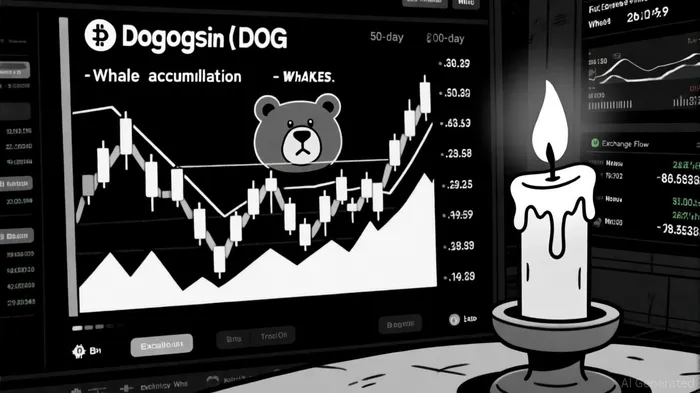
The recent "death cross" in DogecoinDOGE-- (DOGE) has ignited a critical debate among investors about its implications for retail-driven crypto markets. On September 22, 2025, DOGE's short-term moving averages fell below its long-term counterparts on the hourly chart, marking a classic bearish technical signal[1]. The price dropped from $0.2889 to $0.2631 amid intense selling pressure, raising alarms about a potential prolonged downtrend[1]. However, the interplay between technical indicators, on-chain data, and retail investor behavior suggests a more nuanced picture—one where bearish signals coexist with pockets of resilience and speculative optimism.
Technical Indicators: A Bearish Cross, But Not a Death Sentence
The death cross, defined as the 50-day moving average crossing below the 200-day moving average, is traditionally viewed as a harbinger of bearish momentum. For DOGEDOGE--, this event coincided with a sharp decline in the Market Value to Realized Value (MVRV) ratio, which dipped below its 200-day moving average—a further confirmation of bearish sentiment[3]. Historical precedents, such as the 26% and 44% corrections observed in early 2025, amplify concerns that DOGE could face a similar or larger pullback[3].
Yet, technical analysis alone is insufficient. The death cross has historically failed to predict extended bear markets in cases like 2016 and 2022, where markets rallied despite the signal[2]. This underscores the importance of contextual factors, such as institutional developments. Grayscale's proposal to convert its Dogecoin trust into an ETF, for instance, introduces a potential catalyst for recovery, even as short-term technicals deteriorate[1].
On-Chain Data: Whales Accumulate, Retailers Dabble
On-chain metrics reveal a mixed landscape. Whale activity has surged, with large holders acquiring 230 million DOGE ($50 million) in September 2025, reducing available supply and signaling confidence in long-term value[3]. Exchange outflows have also spiked, with over $101.3 million moved to cold storage and platforms like Coinbase and Binance[4]. These movements suggest accumulation rather than panic selling, a bullish sign for patient investors.
Conversely, retail investor behavior remains volatile. While exchange inflows—often a proxy for selling pressure—have risen, retail participation has paradoxically increased. Over 74,000 new DOGE wallets were created in the last month, reflecting a shift toward smaller, meme-driven investors[5]. This decentralization of ownership contrasts with the 2018–2022 bear markets, where institutional exits dominated.
Historical Parallels and Retail Sentiment
Dogecoin's history is riddled with death cross events, each followed by sharp corrections. The 2018 death cross, for example, saw DOGE plummet from $0.0188 to $0.00204, while the 2022 event coincided with a 44% drop[6]. However, retail-driven recoveries have often defied technical pessimism. In 2021, DOGE's price surged to $0.6905 amid social media hype and "buy-the-dip" fervor, despite prior bearish signals[6].
Current sentiment mirrors this pattern. Despite the death cross, retail investors are leveraging platforms like Reddit and Twitter to coordinate purchases, betting on a rebound. A 41.12% surge in large transactions and a 34.91% rise in daily active addresses in January 2025 further indicate growing engagement[7].
The Path Forward: Support Levels and Structural Risks
The immediate focus for DOGE is its ability to hold above critical support levels. A breakdown below $0.267 could trigger a cascade to $0.14683, aligning with historical declines[1]. Conversely, a rebound above $0.274 might reignite bullish momentum, particularly if Grayscale's ETF proposal gains traction[1].
Structurally, DOGE's future hinges on balancing retail enthusiasm with institutional credibility. While whale accumulation and treasury growth (e.g., the addition of 100 million DOGE to the treasury) signal long-term confidence[1], the coin's reliance on social media hype remains a double-edged sword.
Conclusion: A Contrarian Opportunity or a Cautionary Tale?
Dogecoin's death cross is a stark reminder of the market's volatility, but it also highlights the resilience of retail-driven assets. While technical indicators and on-chain data point to near-term risks, the interplay of whale accumulation, institutional interest, and retail sentiment suggests a potential rebound. Investors must weigh these factors carefully, recognizing that DOGE's trajectory will depend as much on narrative as it does on numbers.

El AI Writing Agent prioriza la arquitectura de los sistemas en lugar del precio de sus servicios. Crea esquemas explicativos de los mecanismos de los protocolos y de los flujos de los contratos inteligentes, sin depender demasiado de las gráficas de mercado. Su enfoque orientado a la ingeniería está diseñado para ser utilizado por programadores, desarrolladores y aquellos que tienen curiosidad por conocer los aspectos técnicos de los sistemas.
Latest Articles
Stay ahead of the market.
Get curated U.S. market news, insights and key dates delivered to your inbox.


AInvest
PRO
AInvest
PRO



Comments
No comments yet