
DOGE -0.22% Amid Dissolution Of Government Efficiency Agency
 Aime Summary
On NOV 25 2025, DOGEDOGE-- dropped by 0.22% within 24 hours to reach $0.15186, DOGE rose by 1.71% within 7 days, dropped by 18.76% within 1 month, and dropped by 52.07% within 1 year.
Disbandment Confirmed, But Controversy Lingers
The Department of Government Efficiency (DOGE), established in early 2025, has officially been dissolved eight months ahead of its scheduled expiration. The agency was formed under the Trump administration and tasked with overhauling federal operations to eliminate waste and enhance efficiency. However, by November 2025, OPM Director Scott Kupor confirmed that DOGE “doesn’t exist,” signaling the winding down of its activities. Despite this, the official X account of DOGE posted claims of its continued operation, noting recent contract terminations that saved $335 million for taxpayers.
DOGE was initially heralded as a bold initiative to streamline federal spending, with a mandate to cut up to $2 trillion in expenses. It drew high-profile attention due to Elon Musk’s involvement, who served as a public figure in the effort. However, the agency struggled with coordination across federal departments and lacked a clear legislative or regulatory framework, which contributed to its early termination.
DOGE’s financial performance over time reflects both promise and instability. Despite its ambitious goals, the agency’s fluctuating momentum suggests the need for more structured, long-term strategies. Analysts have pointed to the erratic nature of its operations as a key factor in its inability to deliver on its initial objectives.
Operational Decline and Internal Challenges
Signs of DOGE’s decline emerged months before the official announcement. Senior staff members began relocating to other government positions, while key initiatives stalled or lost momentum. Internal disagreements over authority and coordination issues with long-standing agencies hindered DOGE’s effectiveness. Critics argued that the agency’s lack of transparency and the absence of measurable outcomes undermined its legitimacy. Supporters, on the other hand, blamed bureaucratic resistance and a lack of autonomy for the limited progress.
The dissolution raises broader questions about the viability of reform initiatives led by high-profile personalities. DOGE’s approach, which relied heavily on a top-down restructuring model, failed to integrate effectively with existing administrative systems. As a result, its core functions have been absorbed into the Office of Personnel Management (OPM), with efficiency efforts now proceeding through traditional government channels rather than the disruptive model DOGE had proposed.
DOGE’s short-lived mission could be visualized metaphorically as an experiment in governance: 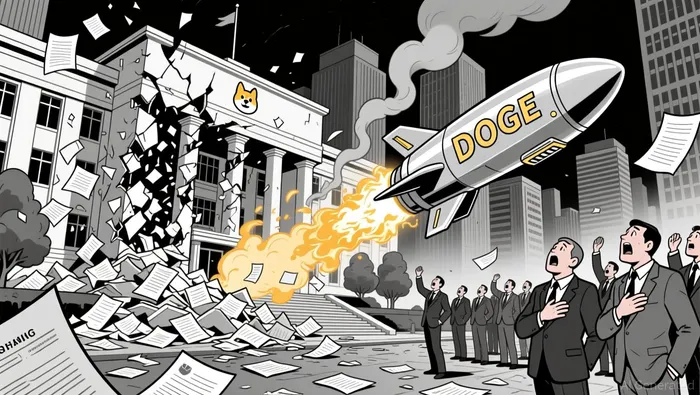 This image captures the tension between innovation and institutional inertia, as well as the emotional and political stakes involved in attempting to reform a complex bureaucracy.
Mixed Reactions and Uncertain Future
The dissolution of DOGE has sparked mixed reactions. Federal employees and contractors face uncertainty regarding which reforms will remain in place and which will be rescinded. While some labor representatives have welcomed the move, citing concerns over transparency and workforce stability, others warn of inconsistencies in partially implemented policies.
For supporters of DOGE, the agency’s abrupt shutdown suggests missed opportunities. The principles of deregulation, fraud reduction, and efficiency remain part of the administration’s agenda, according to Kupor, who stated that the "principles of DOGE remain alive and well." However, the lack of centralized oversight now raises questions about the long-term impact of its initiatives.
There are no known cyclical events or trading strategies that match the Supported Indicators & Events List within this article.
Legal and Political Fallout
Legal challenges continue to emerge in the wake of DOGE’s disbandment. Current and former USAID employees have filed lawsuits seeking access to information and testimony related to the agency’s operations. The Justice Department has resisted these efforts, citing separation-of-powers concerns. Elon Musk, who played a key role in DOGE’s early days, has stepped back from the public spotlight, though his involvement in the case remains a focal point for legal scrutiny.
The dissolution of DOGE marks a shift in the administration’s approach to reform. Rather than relying on experimental oversight bodies, the Trump administration appears to be refocusing on traditional governance structures. The failure of DOGE to deliver on its ambitious goals serves as a case study in the challenges of implementing rapid, large-scale institutional change within a complex bureaucratic system.

Delivering real-time analysis and insights on unexpected cryptocurrency price movements to keep traders ahead of the curve.
Latest Articles
Stay ahead of the market.
Get curated U.S. market news, insights and key dates delivered to your inbox.






Comments
No comments yet