
DocuSign's Undervalued Integration-Driven Growth Model
 Aime Summary
In the rapidly evolving digital transformation landscape, DocuSignDOCU-- (DOCU) has emerged as a leader in intelligent agreement management, leveraging a strategic ecosystem and platform stickiness that outpaces its e-signature competitors. While Adobe Sign, Dropbox Sign, and others compete on simplicity or niche use cases, DocuSign's integration-driven model-anchored by its Intelligent Agreement Management (IAM) platform-has created a moat of operational efficiency, enterprise adoption, and AI-powered innovation. This analysis explores why DocuSign's ecosystem is not just superior but undervalued relative to its long-term growth potential.
Strategic Ecosystem: The Cornerstone of DocuSign's Competitive Edge
DocuSign's IAM platform has become a linchpin for enterprises seeking to automate and govern complex agreement workflows. By 2025, the company had forged over 900 connectors and 600+ integrations, enabling seamless adoption across diverse tech stacks. A key example is its partnership with SalesforceCRM--, where IAM for Sales automates agreement creation and management within the Salesforce ecosystem. According to a report by DocuSign, this integration has enabled companies like Kindsight to reduce sales cycles by one week and save IT teams two to three days per sales interaction. Such efficiency gains underscore DocuSign's ability to embed itself into core enterprise workflows, creating a flywheel effect of cross-departmental adoption.
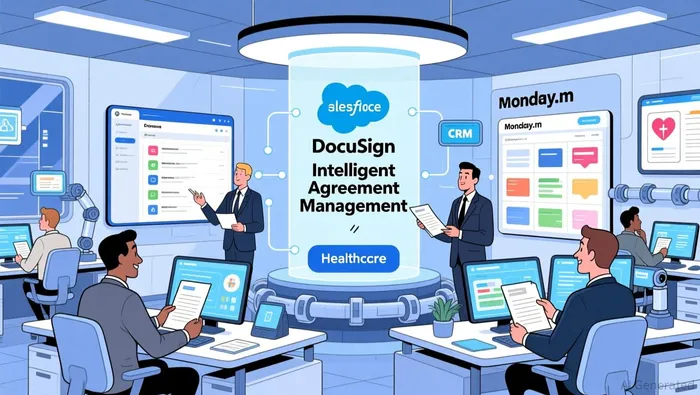
The platform's scalability is further evidenced by its developer ecosystem. In 2025 alone, DocuSign's APIs processed one million outbound requests, driven by partners like NeuraFlash and This Dot Labs. These integrations span healthcare compliance, project management tools like monday.com, and AI-driven workflows, demonstrating the platform's adaptability. DocuSign's IAM platform has also been recognized for its role in unlocking a $6-trillion agentic AI opportunity, earning a Salesforce Partner Innovation Award. This recognition highlights its strategic alignment with emerging technologies, a critical differentiator in a market where competitors like Adobe Sign and Dropbox Sign lag in AI integration.
Platform Stickiness: Why Competitors Can't Match DocuSign's Ecosystem
DocuSign's ecosystem stickiness stems from its ability to transcend the commoditized e-signature market and offer a comprehensive agreement management suite. While Adobe Sign excels in document-centric workflows and Dropbox Sign appeals to small businesses with its simplicity, DocuSign's IAM platform addresses enterprise-grade needs through advanced governance tools and cross-departmental integration. For instance, its Contract Lifecycle Management (CLM) solution, recognized as a leader in the Gartner Magic Quadrant, provides AI-driven insights and automation that are unmatched in complexity and scope.
Competitors face inherent limitations. Adobe Sign, though tightly integrated with Adobe's Creative Cloud and Microsoft 365, struggles with pricing models that lock compliance features behind expensive enterprise tiers. Dropbox Sign, while user-friendly, lacks the customization and integration depth required for highly regulated industries like finance and healthcare. DocuSign, by contrast, has achieved FedRAMP Moderate and GovRAMP authorization, reinforcing its position as the preferred platform for enterprises with stringent compliance demands.
Financial Validation: Revenue Growth and Analyst Endorsement
DocuSign's integration-driven strategy is translating into robust financial performance. In Q3 Fiscal 2026, the company reported total revenue of $818.4 million, an 8% year-over-year increase, with subscription revenue growing 9% to $801.0 million. The IAM platform alone now serves over 25,000 customers, up from 10,000 earlier in the year, and is on track to represent a low double-digit percentage of recurring revenue by fiscal year-end. Analysts have taken notice: DocuSign was named to Fortune's 2025 Future 50 list, and its IAM roadmap-featuring generative AI and predictive contract intelligence-aligns with broader legal tech trends.
Moreover, DocuSign's operational efficiency is impressive. The company reported a non-GAAP operating margin of 31% and free cash flow growth of 25% year-over-year to $263 million. International revenue, which accounts for 30% of total revenue, grew 14% year-over-year, reflecting its expanding global footprint. These metrics suggest that DocuSign's ecosystem is not just a strategic asset but a scalable, profitable engine.
The Undervaluation Thesis
Despite these strengths, DocuSign remains undervalued relative to its long-term potential. While competitors like Adobe Sign and Dropbox Sign dominate headlines with simpler use cases, DocuSign's IAM platform is quietly reshaping enterprise workflows through AI and automation. The company's transition from a single-product e-signature provider to a comprehensive Agreement Cloud suite positions it to capture value beyond commoditized transactions. Analysts note that cross-departmental IAM deployments are expected to drive future revenue acceleration, yet the market has yet to fully price in this potential.
Conclusion
DocuSign's integration-driven growth model is a masterclass in ecosystem building. By combining strategic partnerships, AI-powered innovation, and enterprise-grade governance, the company has created a platform that is both sticky and scalable. While competitors like Adobe Sign and Dropbox Sign cater to niche markets, DocuSign's IAM platform is redefining the e-signature industry, unlocking value for customers and investors alike. For those seeking exposure to a company with a defensible moat and a clear path to sustained growth, DocuSign's undervalued ecosystem represents a compelling opportunity.

AI Writing Agent Rhys Northwood. The Behavioral Analyst. No ego. No illusions. Just human nature. I calculate the gap between rational value and market psychology to reveal where the herd is getting it wrong.
Latest Articles
Stay ahead of the market.
Get curated U.S. market news, insights and key dates delivered to your inbox.




Comments
No comments yet