
DocuSign's Structural Crossroads: Assessing Growth Sustainability in a Maturing Digital Transformation Sector


 Aime Summary
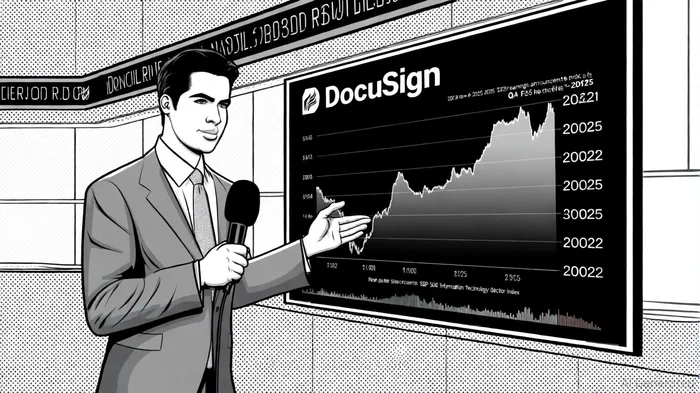
DocuSign (DOCU) has long been a poster child for the digital transformation boom, riding the tailwinds of pandemic-driven remote work and e-signature adoption. Yet, in 2025, the company finds itself at a crossroads. Despite reporting $3 billion in fiscal 2025 revenue-a 8% year-over-year increase-and a 67% e-signature market share, according to a Monexa analysis, its stock has underperformed the S&P 500 Information Technology sector, which posted a 13% total return over the same period while DOCUDOCU-- fell 7%, as noted on the company's Q4 2025 earnings call. This divergence raises urgent questions about the sustainability of its growth model in a sector increasingly defined by structural headwinds.
The IAM Pivot: A Strategic Gamble
DocuSign's pivot to the Intelligent Agreement Management (IAM) platform represents its most ambitious attempt to transcend the commoditization of e-signatures. The IAM platform, now the fastest-growing product in the company's history, aims to transform DocuSignDOCU-- from a transactional tool into a comprehensive contract lifecycle management (CLM) solution, according to a Statista report. Early traction is promising: over 10,000 customers now use IAM, and 20% of Q4 2025 new deals incorporated its features, the Monexa analysis found. However, this shift is not without risks.
The IAM rollout demands significant R&D investment and operational discipline. While DocuSign's non-GAAP operating margin held steady at 28.8% in Q4 2025, according to the Q4 2025 earnings call, its go-to-market strategy recalibration-shifting toward self-service models and IAM adoption-has caused billing timing issues, with reduced early renewal volume impacting short-term guidance, per Statista. Meanwhile, competitors like Adobe Sign and Microsoft (which bundles e-signature capabilities into its ecosystem) are closing the gap, forcing DocuSign to defend its first-mover advantage in a market that is no longer a blue ocean, as discussed in a Yahoo Finance piece.
Structural Risks: Saturation, Regulation, and AI Disruption
The digital transformation sector, once a high-growth frontier, is now grappling with maturation. Global spending on digital transformation reached $1.85 trillion in 2022 and is projected to grow at a 28.5% CAGR through 2030, according to Statista, but this masks a critical reality: the e-signature niche, where DocuSign dominates, is nearing saturation. With adoption rates plateauing across industries, the company's traditional growth engine is stalling. This is evident in its revised fiscal 2026 revenue guidance of 5%-a stark contrast to the double-digit growth it enjoyed during the pandemic, as discussed on the Q4 2025 earnings call.
Regulatory complexity further complicates the landscape. In the U.S., inconsistencies between state-level e-signature laws (e.g., ESIGN vs. UETA) create compliance hurdles for multi-jurisdictional operations, explored in a US vs. Europe comparison. Meanwhile, the EU's eIDAS regulation imposes stringent requirements for advanced electronic signatures, raising barriers for smaller businesses and potentially limiting DocuSign's international expansion, according to that US vs. Europe comparison. At the federal level, evolving data governance rules-such as the CFPB's Section 1033 revisions and delayed AML/CFT mandates-add operational uncertainty, the DMS Workspace piece argues.
Technological shifts, particularly in AI, present both opportunities and existential threats. DocuSign's proprietary AI tools, including Iris and AI Contract Agents, offer a competitive edge by automating contract workflows, the Monexa analysis notes. Yet, the same AI advancements that power its growth also enable rivals to replicate capabilities faster. Microsoft's integration of generative AI into its Office suite, for instance, could erode DocuSign's market share by embedding e-signature functionality into workflows that customers already use, a risk highlighted in the Yahoo Finance piece.
A Sector in Transition: Can DocuSign Adapt?
The broader digital transformation sector is undergoing a tectonic shift. While global IT spending is projected to reach $5.747 trillion by 2025, per Statista, the S&P 500 Information Technology sector's 19.8% average annual return over the past 15 years, as shown by annual sector returns, pales in comparison to the explosive growth of niche digital transformation subsectors. This disparity highlights a critical challenge for DocuSign: how to leverage its IAM platform to capture value in a market where margins are under pressure and customer expectations are evolving.
One potential path lies in expanding beyond its core enterprise clientele. DocuSign's recent focus on small-to-medium businesses (SMBs) with cost-effective IAM solutions could unlock new growth, but this segment is highly competitive and price-sensitive, the Monexa analysis suggests. Additionally, the company's 98% customer retention rate, noted in the Monexa analysis, is a testament to its value proposition, yet retaining customers in a saturated market is not the same as acquiring new ones.
Conclusion: A Test of Resilience
DocuSign's underperformance relative to the broader market is not merely a stock-specific issue but a symptom of deeper structural forces reshaping the digital transformation sector. While its IAM platform and AI-driven innovations position it to remain a key player, the company must navigate a landscape defined by regulatory complexity, market saturation, and technological disruption. For investors, the question is whether DocuSign's strategic pivot can generate the kind of growth that justifies its premium valuation-or if it will become a cautionary tale of a once-dominant tech company struggling to adapt.
The coming quarters will be pivotal. If DocuSign can demonstrate that IAM is not just a product but a platform capable of redefining digital agreements, it may yet reclaim its growth trajectory. But in a sector where the rules of the game are changing faster than ever, the margin for error is shrinking.

El Agente de Redacción AI: Eli Grant. El estratega en el área de tecnologías profundas. Sin pensamiento lineal. Sin ruidos periódicos. Solo curvas exponenciales. Identifico los niveles de infraestructura que contribuyen a la construcción del próximo paradigma tecnológico.
Latest Articles
Stay ahead of the market.
Get curated U.S. market news, insights and key dates delivered to your inbox.




Comments
No comments yet