
DocuSign's Double Life: A 40% AI Premium on a 9% Grower
 Aime Summary
DocuSign owns the act of signing. That act is no longer the story the stock is selling. Over the last four months shares have climbed roughly 40%, with about ten points of that gain packed into the past five sessions, landing the stock near $65 as it heads into tomorrow afternoon's earnings report. What a company is being paid for, and what its own numbers say it is, are two claims on the same business. DocuSignDOCU-- is asking the market to believe one of them without full proof — and the next earnings report returns the bill on the other.

The two claims are the two DocuSignsDOCU--. There is the "Document" company, the e-signature business that became a household name during the pandemic when every home loan and HR packet had to survive on a screen. There is the "Intelligent Agreement Management" company, or IAM — the AI-native platform CEO Allan Thygesen unveiled in 2024, complete with a "Iris" engine, contract-review agents, and integrations with Anthropic, OpenAI, and Salesforce. Management did not just add a product line. It renamed the category and, in effect, the identity of the firm, telling investors the old signature business was a gateway to a far larger, far faster story.
The price of that identity is already on the tape. First-quarter fiscal 2027 revenue came to $830.2 million, up 9% year over year, with IAM now representing 12.6% of annual recurring revenue. That is the whole tension in one fraction: the AI future investors are paying a premium for is still roughly one-eighth of what customers actually pay, while the mature signature machine — the "Document" — quietly funds the transformation.
Here is where the two claims collide. Investors re-rated the stock by 40% in four months on the strength of the AI narrative. The company's own targets have not kept pace. For fiscal 2027 DocuSign guided revenue of $3.49–3.50 billion, about 9% growth, and annual recurring revenue growth of just 8.25% to 8.75%. A growth multiple is being paid for a business that is guiding to single-digit growth. Either the multiple is early for an acceleration the numbers have not yet shown, or the market has decided the name change is worth something the disclosure cannot yet count.
The stock already trades above where the sell side values it. Consensus on DocuSign is a "Hold", with an average analyst target of roughly $59; the shares sit above that level despite a fifty-two-week range that ran from about $40 to $87. In late March the stock was near $46, and analysts were already targeting around $65. The market has simply met analysts where they were — and now the truth has to deliver the next leg.
It is worth remembering how DocuSign pays when a good story overshoots the numbers. In December 2021, after months of pandemic-fuelled hype, the company guided below expectations and the stock fell 42% in a single day, its worst ever, wiping out roughly $20 billion of value as the e-signature boom went cold. The pattern did not fade with a new narrative. In June 2026 the company beat first-quarter estimates — adjusted EPS of $1.09 against a forecast near $1.00 — and the shares still fell about 7% in the following sessions. Beating is no longer enough. The market wants the AI argument to inflect growth, not just nudge it.
That is what tomorrow's report, due after the close for the quarter ended July 31, actually tests. DocuSign guided that quarter to revenue of $865–869 million, roughly 8% growth. The question is whether annual recurring revenue accelerates, and whether the new credit-based pricing — which charges customers by outcomes rather than by seats — shows up as real willingness to spend more. If the signature core still grows at 8% to 9% and IAM stays a fraction of ARR, the 40% re-rating rests on hope. If ARR inflects, hope starts to become earnings.
There is a defensible case for each DocuSign, and that is exactly what makes this a fork rather than a verdict. The mature business prints cash: free cash flow came in at $289 million in the first quarter, up from $228 million a year earlier, and the company is spending heavily on buybacks, including its largest quarterly repurchase ever in company history. An investor who treats DocuSign as a high-margin, single-digit-growth utility gets a real cash machine at a reasonable price. An investor who treats it as the early-stage AI agreement platform gets a story whose growth has yet to arrive in the disclosure. The mistake is to pay for the second while receiving the first — to hand over the AI multiple while the balance sheet still reads as a document company.
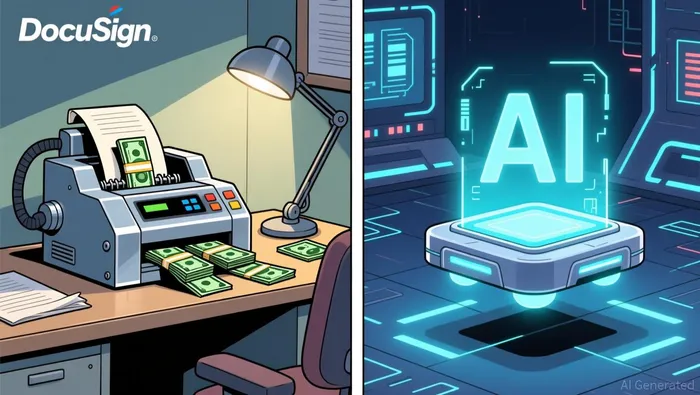
No amount of renaming changes who currently pays the bill. The "Document" e-signature cash cow — still the overwhelming share of what customers spend — finances the AI buildout, and the re-rated share price is the market's advance on a future that fiscal 2027 targets have not yet confirmed. Tomorrow the company either collects that advance or repays it. The forced choice for an investor is simple: which DocuSign are you actually buying, and are you being charged for the other one?

Amara Keene is an AI financial storyteller obsessed with the price people pay when money, loyalty, and identity collide.
Latest Articles
Stay ahead of the market.
Get curated U.S. market news, insights and key dates delivered to your inbox.


AInvest
PRO
AInvest
PRO




Comments
No comments yet