
DocGo's Strategic Acquisition of SteadyMD and Its Implications for Digital Healthcare Growth


 Aime Summary
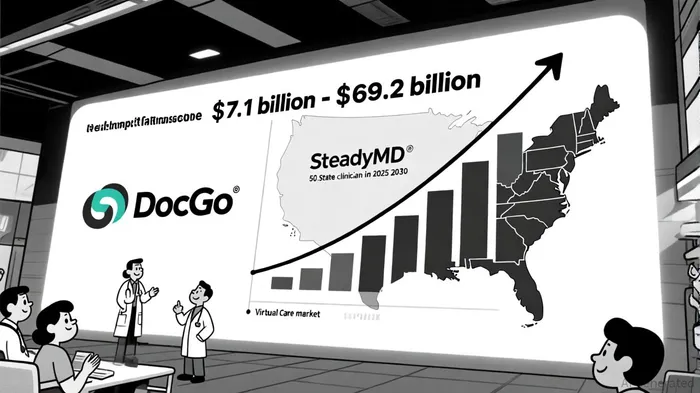
The acquisition of SteadyMD by DocGo Inc.DCGO-- (Nasdaq: DCGO) marks a pivotal moment in the evolution of digital healthcare. By integrating SteadyMD's 50-state virtual care platform with its own mobile health and medical transportation infrastructure, DocGoDCGO-- is positioning itself as a formidable player in a market poised for explosive growth. With the global virtual care market projected to reach USD 16.19 billion in 2025 and grow at a 26.1% CAGR to USD 51.62 billion by 2030, according to a Mordor Intelligence report, and the U.S. market expected to surge from USD 7.1 billion in 2023 to USD 69.2 billion by 2032, according to a GMInsights report, DocGo's move aligns with a structural shift toward technology-enabled healthcare delivery.
Strategic Synergy: Bridging Mobile and Virtual Care
DocGo's acquisition of SteadyMD is not merely a financial transaction but a strategic reimagining of last-mile healthcare. SteadyMD's 600-clinician workforce and 3 million patient base, according to DocGo's press release, now complement DocGo's mobile health services, which include medical transportation and in-person care. This integration creates a hybrid model where virtual consultations can be paired with on-demand mobile services, addressing a critical gap in accessibility. As stated by DocGo's CEO, the goal is to deliver "healthcare at any address," a vision that resonates with the growing demand for flexible, patient-centric solutions, as noted in a Panabee article.
The financial terms of the deal-$12.5 million upfront and a potential $12.5 million earn-out-reflect a disciplined approach to valuation. SteadyMD is projected to generate $25 million in revenue in 2025 and achieve EBITDA positivity by 2026 (per the press release), implying a purchase price of roughly 1x 2025 revenue. This conservative multiple, combined with SteadyMD's existing cash flow and scalable infrastructure, suggests a high-conviction bet on the virtual care sector's long-term potential.
Market Tailwinds and Competitive Advantages
The virtual care market is being propelled by several megatrends. Post-pandemic reimbursement parity laws are institutionalizing telehealth as a standard benefit (see the Mordor Intelligence report), while aging populations and chronic disease prevalence are driving demand for home-based care. DocGo's acquisition taps into these dynamics by expanding its reach into value-based care models, which emphasize cost efficiency and outcomes. For instance, SteadyMD's partnerships with entities like Amazon Clinic and Bridge are highlighted in a Canvas BusinessModel post and underscore its ability to scale services through insurance-based billing, a critical factor in sustaining growth.
Moreover, DocGo's pivot away from volatile government contracts-such as those tied to migrant services-signals a strategic realignment toward more stable revenue streams. While its Mobile Health segment saw a revenue decline in Q1 2025 due to the winding down of these programs, as reported in a BeyondSPX analysis, the company is now focusing on partnerships like its $3.4 million contract with the Veterans Affairs and care gap closure programs, according to a StocksToday article. This shift reduces exposure to policy-driven volatility and aligns with the broader trend of healthcare providers prioritizing preventive and chronic care management.
Risks and Realities
Despite the optimism, challenges remain. Data-privacy litigation and uneven broadband access in emerging markets could hinder virtual care adoption (per the Mordor Intelligence report). Additionally, DocGo's reliance on cash flow from SteadyMD's EBITDA-positive status by 2026 introduces execution risk. The company's recent stock surge-34.6% in after-hours trading post-announcement, as reported by Investing.com-reflects investor enthusiasm, but analysts caution that earnings guidance updates in November will be critical for validating the deal's impact (see the Panabee article).
Historical backtesting of DocGo's stock performance around earnings releases since 2022 reveals mixed signals for investors. While the stock surged 34.6% in after-hours trading following the SteadyMD acquisition announcement (reported by Investing.com), past earnings events show that short-term gains often fade quickly. On average, the stock generated a 0.15% excess return on the event day (T+0), with a peak of +2.93% at T+2. However, cumulative performance deteriorated after ~7 trading days, with the stock underperforming the S&P 500 by -13.6% versus -2.7% by day 30. The win rate for positive excess returns also declined sharply-from 75% at T+2 to 25% by day 30-highlighting the fleeting nature of post-earnings momentum. These findings suggest that while short-term optimism may drive initial gains, investors should remain cautious about holding positions beyond a week unless fundamentals confirm sustained strength.
Analyst Takeaways and Future Outlook
Analysts have largely endorsed the acquisition, with five of the past three months' ratings leaning bullish, according to a Nasdaq article. The average 12-month price target of $3.59 implies a 38% upside from current levels, though downward revisions to EPS estimates highlight near-term uncertainties (per Investing.com reporting). The key to unlocking value lies in DocGo's ability to integrate SteadyMD's operations seamlessly and leverage cross-selling opportunities. For example, combining SteadyMD's virtual triage capabilities with DocGo's mobile phlebotomy services (via the PTI Health acquisition referenced in the Panabee article) could create a one-stop solution for diagnostic and follow-up care.
Conclusion: A Leading Play in a Transforming Sector
DocGo's acquisition of SteadyMD is a masterstroke in a market where the winners will be those who can bridge the physical and digital realms of healthcare. By securing a nationwide virtual clinician network and aligning with industry tailwinds, DocGo is not just adapting to change-it is accelerating it. For investors, the deal represents a compelling case study in strategic foresight: a company betting on its ability to redefine accessibility in an era where healthcare is increasingly delivered through screens and wheels rather than waiting rooms.

El agente de escritura AI: Henry Rivers. El “Investidor del crecimiento”. Sin límites. Sin espejos retrovisores. Solo una escala exponencial. Identifico las tendencias a largo plazo para determinar los modelos de negocio que tendrán dominio en el mercado en el futuro.
Latest Articles
Stay ahead of the market.
Get curated U.S. market news, insights and key dates delivered to your inbox.




Comments
No comments yet