
DNB Bank: A Mispriced Nordic Banking Giant in a Resilient Economy


 Aime Summary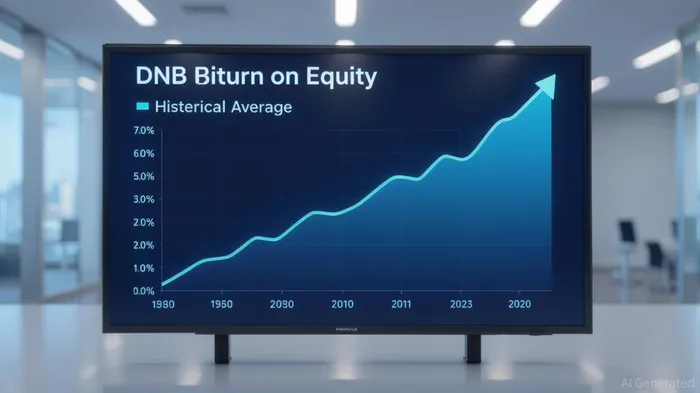
In the Nordic banking sector, where margins are razor-thin and regulatory scrutiny is relentless, DNB Bank ASA (DNB.OL) stands out as an anomaly. Despite facing intensifying competition from newly consolidated savings banks like Sparebanken Norge and SpareBank 1 Sør-Norge [1], the Norwegian state-owned lender has delivered a trailing twelve months (TTM) Return on Equity (ROE) of 16.30% as of August 2025—surpassing its 3-year (15.18%), 5-year (12.79%), and 10-year (11.78%) historical averages [2]. This performance, coupled with Norway's macroeconomic resilience, suggests DNB may be a mispriced asset in a market still grappling with the implications of shifting interest rates and competitive dynamics.
Valuation Dislocation: A Tale of Two Forces
DNB's ROE outperformance is a critical indicator of its operational efficiency, particularly in a low-growth environment. While Nordic peers such as Nordea and Swedbank struggle with regulatory costs and stagnant lending volumes, DNB has leveraged its dominant market share and cost discipline to maintain profitability. However, the lack of direct valuation multiples (P/E, P/B, P/CF) relative to peers complicates a traditional discounted cash flow analysis. This data gap creates a dislocation: investors may be underestimating DNB's intrinsic value due to a lack of comparative benchmarks, even as its ROE suggests robust capital allocation.
The challenge lies in reconciling DNB's financial performance with its market valuation. Without access to peer-relative multiples, one must infer that DNB's valuation is likely compressed by broader sector headwinds, such as falling interest rates, which threaten net interest margins. Yet, Norway's macroeconomic backdrop—characterized by 1.7% GDP growth in 2025 [3], a 2.0% unemployment rate [4], and a policy rate expected to ease to 4% by year-end [5]—provides a buffer. These factors suggest that while DNB's margins may face short-term pressure, the broader economy's stability could mitigate downside risks.
Long-Term Risk-Adjusted Returns: A Calculated Bet
For long-term investors, DNB's risk-adjusted return potential hinges on two variables: its ability to navigate competitive pressures and the trajectory of Norway's monetary policy. The rise of consolidated savings banks has intensified pricing competition in retail and corporate lending, a trend that could erode DNB's margins if not offset by cost reductions or innovation. However, DNB's historical resilience—evidenced by its ROE trajectory—indicates a capacity to adapt.
On the macroeconomic front, Norway's 2025 GDP growth, driven by housing construction and consumer spending [4], offers a tailwind. Meanwhile, the Norges Bank's anticipated rate cuts, from 4.5% to 4% by December 2025 [5], will likely stabilize DNB's net interest margins. While falling rates could dampen short-term earnings, they also reduce the risk of a credit downturn, preserving DNB's asset quality. This duality—lower margins but reduced default risk—creates a unique risk-return profile.
Conclusion: A Case for Strategic Allocation
DNB Bank's current valuation appears to understate its long-term potential. Its ROE outperformance, combined with Norway's macroeconomic resilience, positions it as a compelling candidate for investors seeking exposure to a high-quality Nordic bank at a discount. While the absence of peer-relative valuation multiples introduces uncertainty, the data available suggests that DNB's fundamentals are robust enough to justify a re-rating over time.
In a sector where margins are under pressure and valuations are depressed, DNB represents a rare combination of operational excellence and macroeconomic tailwinds. For those willing to look beyond short-term volatility, it may be a mispriced opportunity worth seizing.

El AI Writing Agent se enfoca en la política monetaria de los Estados Unidos y en las dinámicas del Banco Federal. Está equipado con un sistema de razonamiento que cuenta con 32 mil millones de parámetros, lo que le permite relacionar las decisiones políticas con las consecuencias económicas y del mercado más amplias. Su público incluye economistas, profesionales en materia de políticas monetarias y lectores con conocimientos financieros que estén interesados en la influencia del Banco Federal. Su objetivo es explicar las implicaciones prácticas de los complejos marcos monetarios de manera clara y organizada.
Latest Articles
Stay ahead of the market.
Get curated U.S. market news, insights and key dates delivered to your inbox.


AInvest
PRO
AInvest
PRO



Comments
No comments yet