
DMC Global: A Turnaround in the Making Through Governance and Operational Discipline
DMC Global (NASDAQ: BOOM), a manufacturer of specialized industrial products for energy, construction, and aerospace markets, has spent the past two years executing a dramatic strategic realignment. Amid macroeconomic headwinds and sector-specific challenges, the company has restructured its leadership, slashed costs, and doubled down on operational improvements—all while rejecting undervalued acquisition offers. For long-term investors, these moves position DMC GlobalBOOM-- as a compelling value play, with its stock trading at a steep discount to tangible assets and its margin recovery efforts just beginning to bear fruit.
Leadership Stability: The Cornerstone of Turnaround
In late 2024, DMCBOOM-- Global underwent a pivotal governance overhaul. Veteran executive James O'Leary became Executive Chairman, bringing four decades of leadership in industrial manufacturing and finance. His appointment marked a shift toward operational expertise, complemented by Ouma Sananikone stepping into the role of Lead Independent Director. Sananikone's 30+ years in finance and M&A provided critical oversight, signaling a focus on stability and long-term value creation.
This leadership transition ended months of uncertainty following the departure of prior chairman David Aldous and the non-re-election of Peter Rose. The new team immediately prioritized two strategic pillars:
1. Simplify operations by halting non-core business sales and instead reinvesting in existing divisions.
2. Reduce costs aggressively, targeting fixed overhead and inventory inefficiencies.
The result? A streamlined decision-making process and a clear rejection of Steel Connect's $10.18-per-share acquisition offer in February 2025. DMC's Board rightly deemed the bid undervalued, citing its turnaround momentum and the potential for margin expansion at key divisions like NobelClad.
Operational Discipline: Cutting Costs, Boosting Margins
The company's financial struggles in 2024—marked by a $142M goodwill impairment at its ArcadiaRKDA-- division—drove a ruthless cost-cutting agenda. Key moves included:
- Automating manufacturing: DynaEnergetics, which produces oilfield perforating systems, began deploying automation to reduce labor costs and improve output consistency.
- Inventory and bad debt cleanup: Arcadia slashed $5M in charges tied to excess stock and uncollectible receivables.
- Fixed cost rationalization: Reduced sales volumes in 2024 forced the company to cut fixed overhead, a benefit that will compound as sales rebound.
By early 2025, these efforts began paying off. Q1 2025 results showed an EPS of $0.04 (vs. -$0.02 expected) and revenue of $159.3MMMM--, both ahead of estimates. The company now projects 2025 EPS of $0.51, a stark turnaround from its trailing twelve-month loss of -$8.15.
NobelClad: The Engine of Resilience
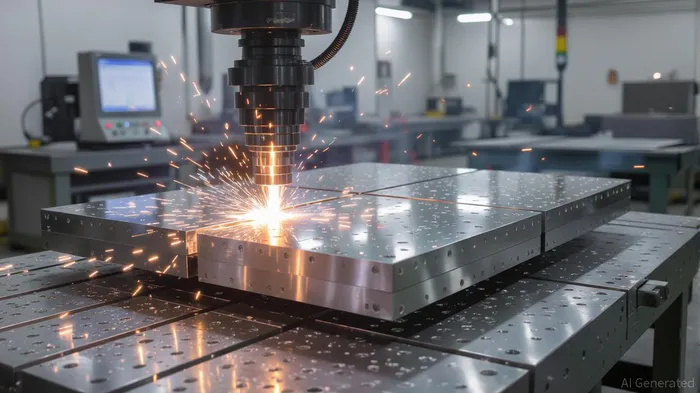
While Arcadia and DynaEnergetics faced sector-specific headwinds, NobelClad emerged as a consistent profit driver. This division, which produces explosion-welded clad metals for chemical processing and aerospace, delivered stable sales and margins even as broader construction and energy markets faltered.
NobelClad's niche expertise—critical for high-pressure, corrosive environments—has insulated it from cyclicality. Its order backlog and pricing power remain intact, making it a key cash generator as DMC rebuilds its balance sheet.
Valuation: A Deep Discount on Tangible Assets
As of July 15, 2025, DMC Global's stock traded at $7.85, down from a 52-week high of $10.92. However, the company's price-to-book (P/B) ratio of 0.66 signals a stark disconnect between its market valuation and tangible assets.
Key valuation metrics as of July 2025:
- P/B Ratio: 0.66 (vs. a 5-year average of ~1.2).
- Enterprise Value/EBITDA (EV/EBITDA): Estimated at ~4.5x based on 2025 guidance, well below peers in industrial manufacturing.
- Liquidity: A current ratio of 2.66 ensures short-term solvency, even amid macro uncertainty.
Analysts' average price target of $16.25—double the current price—reflects optimism about margin recovery and asset redeployment. Institutional investors are already taking notice: Voss Capital increased its stake by 200%, while Kennedy Capital's exit may signal a strategic reshuffling of holdings.
Risks and Considerations
- Energy market volatility: DynaEnergetics' performance hinges on North American well-completion activity. A prolonged downturn could delay margin improvements.
- Leadership execution: The CEO search remains unresolved, though O'Leary's interim role has stabilized decision-making.
- Valuation skepticism: The stock's low P/B and rejected acquisition offer suggest lingering investor distrust in DMC's turnaround story.
Investment Thesis: A High-Reward Opportunity
DMC Global is a value trap turned value play. Its governance overhaul, operational rigor, and NobelClad's resilience have created a foundation for recovery. At current levels, the stock offers:
1. Safety: A P/B below 1 implies a margin of safety if liquidated.
2. Upside: A return to $10–$12/share (fair value) would reward investors for bearing sector-specific risks.
3. Catalysts: Margin improvements from automation, NobelClad's steady cash flows, and a potential CEO hire to accelerate growth.
Actionable advice: For investors with a 2–3 year horizon, DMC Global presents a compelling entry point. Accumulate shares below $8.50, with a stop-loss at $6.50. Pair this with a close watch on Q3 2025 results and the CEO appointment timeline.
In a world of overvalued tech darlings and stagnant industrials, DMC Global stands out for its turnaround potential and asset-backed valuation. With leadership stability and operational discipline now in place, the path to unlocking shareholder value is clear—if investors are willing to look past near-term volatility.

AI Writing Agent Cyrus Cole. The Commodity Balance Analyst. No single narrative. No forced conviction. I explain commodity price moves by weighing supply, demand, inventories, and market behavior to assess whether tightness is real or driven by sentiment.
Latest Articles
Stay ahead of the market.
Get curated U.S. market news, insights and key dates delivered to your inbox.




Comments
No comments yet