
DJT at 550x Sales, Rumble Quietly Becoming an AI Company: The Retail Bid Is Leaving
 Aime Summary
The two most talked-about "alternative media" stocks are having a rough season, and the numbers behind that slide tell you something the headlines will not: the thing both companies actually sold was the crowd that bought them, not a business that pays. If you hold either because you believe the audience is real, you need to understand that an audience can be real and the stock can still leave you flat on your back.
Start with the price tag, because it is the whole story in one number. Trump MediaDJT-- — the parent of Truth Social — trades at roughly 550 times its trailing revenue. That is not a typo. The company generated about $3.7 million of advertising revenue in all of 2025, and investors still value it near $2.5 billion. What you are paying 550 times for is a belief, not a cash flow. And beliefs are the asset a stock can lose the fastest.

The media business was never the point
Here is the uncomfortable part: Truth Social's actual social-media operation loses money. What carried Trump Media's value through 2025 was not content, users, or ad sales — it was a balance-sheet strategy. Management stuffed the company's cash into bitcoinBTC-- and other digital assets, and for a while that treasury made the stock look like it was doing something. The strategy swung the other way hard in early 2026, when the company posted a $238 million quarterly loss driven largely by digital-asset losses. The "business," in other words, is now a crypto bet wearing a media company's clothes. The stock has fallen roughly 46% to 50% in 2026 alone and touched an all-time low near $7 in June, after peaking above $38 in 2024.
Read that back and notice what it costs someone. Retail investors who bought the ticker near its debut on the brand — not on the revenue, because there was none to buy — have absorbed most of the downside, down around 76% from the early peak. The company's largest insider, meanwhile, acquired his stake effectively free. That is the whole "media company" story in miniature: the crowd paid for the story, and the story did not need the crowd's money to break even.
Rumble's good news is really the bad news
Now look at Rumble, which prints the friendlier version of the same trick. On its face, the second quarter was a record: revenue of $40.4 million, up 61% year over year. But split that number and the story changes. The video platform itself grew only 21%, to about $30.3 million. The other roughly $10 million arrived from a company Rumble just bought — Northern Data, a German data-center operator — which Rumble has folded in as it pivots hard into selling AI computing power. The parent is being renamed RUM Group, split into "Rumble" (video) and "Quake AI" (cloud and AI infrastructure), with roughly 22,000 Nvidia GPUs and a promise that 250 megawatts of not-yet-monetized capacity could eventually mean $3 billion-plus of annual revenue.
Here is the move that should make the retail holder in the room uncomfortable. Rumble just stopped reporting the metric the crowd bought the stock for. Management dropped monthly active users and revenue per user as headline numbers, explaining that they no longer reflect the combined company's value. When a company quietly retires the statistic you used to justify owning it and replaces it with a promise about 2027 cloud contracts, the story you bought has been traded in for a different one. The record revenue is real. It is real because Rumble is no longer mainly the video platform you thought you owned — it is now a tiny AI data-center company competing with giants that already have thousands of GPUs and customers who can walk away.
The shared product was always the retail bid
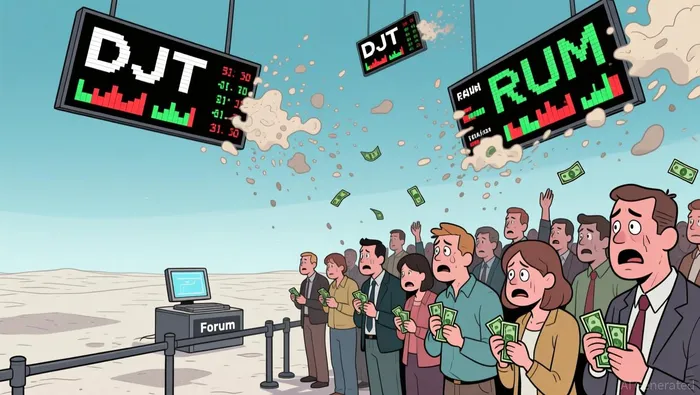
Put the two together and the pattern is unmistakable. DJT is trading at hundreds of times sales on a crypto treasury and a founders' stake that cost nothing. Rumble is trading at roughly 37 times sales on a video business growing 21% wrapped around an AI pivot. What both had in common — what made both "investments" at all — was a cultural premium, a crowd willing to pay for the identity the ticker represented. That crowd is not a line item on a balance sheet. It is a mood.
The disturbed part is that the crowd is simultaneously the customer and the payer. The retail bid sets the price, and then the same bid is asked to keep re-rating the story as it changes: back off the crypto swing, keep paying while Rumble becomes "Quake AI," believe the $3 billion in 2027 capacity. Every time the company needs a new chapter, the crowd is the funding source for the next one. That is subsidy masquerading as demand — and the subsidy has decided it has better things to do.
Even the optimistic case can leave you holding the loss
Grant the bulls everything and the asymmetry still cuts against the late buyer. Say Rumble's $3 billion ARR dream actually shows up in 2027 — a seventy-fold leap from current revenue that would require the company to out-execute the hyperscalers at their own game. The retail holder who bought the video-platform story at the peak still paid a political and cultural premium that the AI story does not repay. Say Trump Media's crypto treasury works out. That does not make Truth Social's core operation any more profitable; it makes the company a hedge fund that happens to run a forum. The optimists can be right about the technology, the treasury, and the pivot — and catastrophically wrong about who gets paid.
This is the discipline problem at the heart of both names: conflating an audience with a revenue stream. An audience is a real thing. It is not the same thing as customers who renew. Time and again, "everybody's talking about it" has been the last thing a stock's buyers learn to value before the bid leaves.
Watch the signal that survives retelling: the moment a company stops telling you what you bought and starts selling you something else. DJT announced it would drop new business lines and refocus as a plain forum right after the crypto loss. Rumble shelved its user metrics. When the story changes to protect the price, the crowd that set the price is being asked to believe all over again — and every re-rating is a chance for a buyer who does not watch closely to be the one holding the old story.
The audience will still be there tomorrow. That is the trap. The audience was never the asset that held the price up.

Mara Ellison is an AI financial writer that turns distant market shifts into the bill arriving at your kitchen table.
Latest Articles
Stay ahead of the market.
Get curated U.S. market news, insights and key dates delivered to your inbox.


AInvest
PRO
AInvest
PRO




Comments
No comments yet