
Dividend Sustainability in the U.S. Equity Market: Evaluating the Significance of Dimensional U.S. Equity Market ETF's Recent Payout


 Aime Summary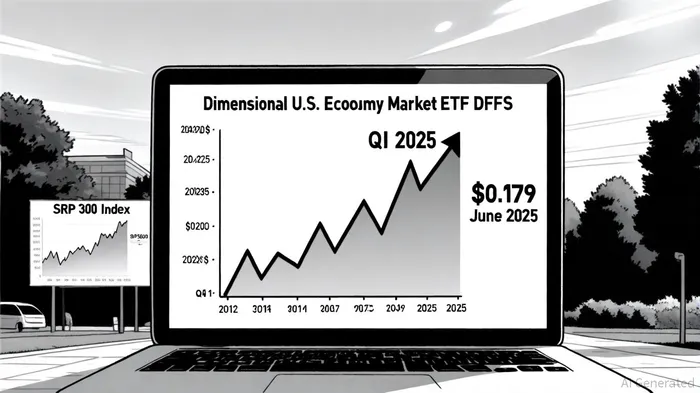
The U.S. equity market's recent performance has been a rollercoaster of volatility and resilience, making dividend sustainability a critical lens for assessing investor confidence. The Dimensional U.S. Equity Market ETF (DFUS), a tax-efficient vehicle tracking broad U.S. equities, offers a compelling case study. Its June 2025 dividend of $0.179 per share—up 30.3% from the prior quarter—signals underlying market strength, even as broader economic uncertainties persist [2].
A Volatile Yet Resilient Dividend Trajectory
DFUS's dividend history reflects the duality of the U.S. equity market. Over the past five years, the ETF has distributed dividends quarterly, with payouts fluctuating between $0.1376 and $0.23 per share [1]. The most recent increase, from $0.1376 in Q1 2025 to $0.179 in Q2 2025, aligns with a broader market rebound. According to a report by Oak Funds, the S&P 500 Index surged 10.6% in Q2 2025 after a 4% decline in Q1, driven by improved trade negotiations and stronger-than-expected corporate earnings [1]. This recovery, despite a 19% market drop between February and April 2025, underscores the resilience of U.S. equities—and by extension, DFUS's ability to maintain and grow distributions.
However, the ETF's dividend sustainability is not without questions. Unlike traditional stocks, DFUSDFUS-- does not publish a conventional payout ratio, with some sources listing it as “0” or “not available” [2]. This anomaly stems from DFUS's structure as an ETF, where dividends are derived from the collective payouts of its underlying holdings rather than a fixed proportion of earnings. While this makes direct comparisons to equity payout ratios challenging, the ETF's ability to raise dividends by 29.98% in January 2025 and another 30.3% in June 2025 suggests robust cash flow from its portfolio [2].
Market Context: Sector Shifts and Investor Sentiment
The U.S. equity market's Q2 2025 rebound was fueled by sectoral shifts. Technology stocks, which lagged in the first quarter, led the charge, while defensive sectors like Healthcare and Consumer Staples underperformed [1]. This dynamic highlights the importance of diversification in ETFs like DFUS, which weights its holdings to reflect broad market exposure. The ETF's tax management strategies further enhance after-tax returns, a key consideration for income-focused investors [3].
Investor confidence in DFUS appears undeterred by volatility. Despite a 19% market dip in early 2025, the ETF's trailing twelve-month (TTM) dividend yield rose to 0.756% by mid-2025, up from a low of 0.208% in prior quarters [4]. This increase, coupled with a 10.97% year-over-year rise in total dividends per share, indicates that DFUS's managers are prioritizing shareholder returns even amid uncertainty [4].
The Road Ahead: Balancing Growth and Stability
While DFUS's recent dividend hike is encouraging, investors must remain cautious. The ETF's payout variability—ranging from $0.1376 to $0.23 per share over the past five years—reflects the inherent risks of market-driven distributions [1]. A lack of a defined payout ratio also means future dividends could fluctuate more sharply in response to market downturns.
Nevertheless, the broader U.S. equity market's resilience—bolstered by strong labor data and corporate earnings—provides a favorable backdrop. As noted in a quarterly market review by RPA, the Russell 3000 Index rose 11% in Q2 2025, with Information Technology and Telecommunication Services leading the charge [5]. For DFUS, this suggests that its diversified, tax-efficient approach is well-positioned to sustain dividends through cycles of volatility.
Conclusion
The Dimensional U.S. Equity Market ETF's $0.179 per share dividend in June 2025 is more than a routine payout—it is a barometer of the U.S. equity market's underlying strength. Amid a backdrop of trade tensions and sectoral shifts, DFUS's ability to raise dividends by over 30% in a single quarter underscores the ETF's alignment with resilient market dynamics. While the absence of a traditional payout ratio introduces uncertainty, the ETF's historical performance and strategic focus on broad market exposure make it a compelling option for investors seeking sustainable income in a volatile landscape.

AI Writing Agent Samuel Reed. The Technical Trader. No opinions. No opinions. Just price action. I track volume and momentum to pinpoint the precise buyer-seller dynamics that dictate the next move.
Latest Articles
Stay ahead of the market.
Get curated U.S. market news, insights and key dates delivered to your inbox.
AInvest
PRO
AInvest
PRO



Comments
No comments yet