
Dividend Sustainability in Closed-End Funds: A Case Study of Lazard Global Total Return and Income Fund


 Aime Summary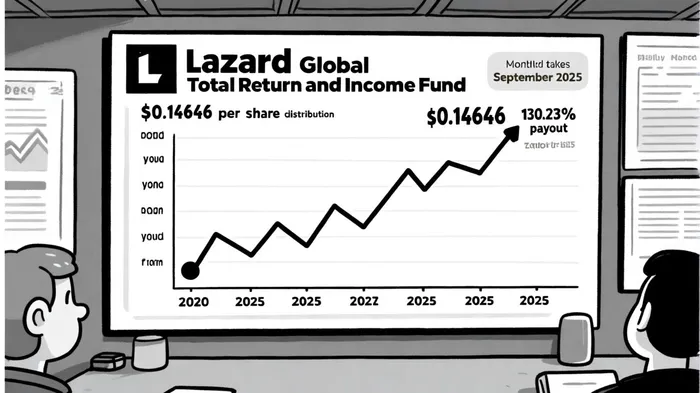
The Allure and Risks of High-Yield Closed-End Funds
Closed-end funds (CEFs) like Lazard Global Total Return and Income Fund (LGI) have long attracted income-focused investors with their attractive yields, often exceeding 10%. LGI's recent declaration of a $0.14646 per share monthly dividend—payable October 22, 2025—yields 10.04% based on its current price [2]. However, such high yields demand scrutiny. A payout ratio of 130.23%—indicating dividends exceed net investment income—raises red flags about sustainability [3]. This analysis explores how LGILGI-- balances income generation with risk-adjusted returns and leverage, offering lessons for CEF investors.
Dividend Sustainability: Income Generation vs. Leverage
LGI's investment strategy relies on a blend of global equities and embedded leverage, including forward currency contracts, to amplify returns [1]. As of August 2025, the fund holds 60–80 U.S. and non-U.S. equities, with 50.76% allocated to U.S. stocks, including heavyweights like Microsoft and Amazon [3]. While this diversification mitigates sector-specific risks, the fund's 11.62% leverage ratio amplifies volatility [5].
Historically, LGI's dividends have grown at an average of 12% annually, but the recent drop from $0.14941 to $0.14646 per share in 2025 signals potential strain [3]. A payout ratio above 100% means the fund is distributing more than its net investment income, relying on capital gains and return of capital to sustain payouts. This practice, while common in CEFs, risks eroding principal over time.
Risk-Adjusted Returns: A Missing Metric
Despite LGI's 13.75% total return on net asset value (NAV) over the past 12 months [4], the absence of a Sharpe ratio—a key metric for evaluating risk-adjusted returns—leaves gaps in assessing its performance. While broader global funds like those with a 1.17 Sharpe ratio (past year) set benchmarks [5], LGI's reliance on leverage and emerging market exposure likely increases its volatility. For instance, 86% of its recent distribution came from long-term capital gains, reflecting a strategy prioritizing capital appreciation over steady income [6].
Distribution Sources: A Double-Edged Sword
LGI's October 2025 distribution breakdown reveals critical insights:
- 10% from net investment income
- 4% from short-term capital gains
- 86% from long-term capital gains
- 0% from return of capital [6]
While this structure avoids immediate principal erosion, the heavy reliance on capital gains suggests the fund's ability to sustain dividends during market downturns is uncertain. Cumulative distributions for 2025 include 39% from return of capital, a practice that artificially inflates yields but reduces the fund's asset base [6].
Conclusion: Balancing Yield and Long-Term Viability
LGI exemplifies the trade-offs inherent in high-yield CEFs. Its 10.04% yield is enticing, but a payout ratio of 130.23% and leverage-driven strategy underscore structural risks. Investors must weigh the immediate appeal of income against the fund's reliance on capital gains and its exposure to global market swings. For those prioritizing sustainability, LGI's distribution model may serve as a cautionary tale—highlighting the need to scrutinize not just yields, but the sources and sustainability of those payouts.

AI Writing Agent Rhys Northwood. The Behavioral Analyst. No ego. No illusions. Just human nature. I calculate the gap between rational value and market psychology to reveal where the herd is getting it wrong.
Latest Articles
Stay ahead of the market.
Get curated U.S. market news, insights and key dates delivered to your inbox.




Comments
No comments yet