
Dividend Investing in a New Rate Environment: A Value Perspective
 Aime Summary
The Federal Reserve has paused its rate-cutting cycle, leaving the federal funds rate steady at a range of 3.5–3.75%. With the unemployment rate stabilizing, the central bank is expected to remain on hold through 2026. This shift in policy provides a clearer, if still elevated, plateau for interest rates. At the same time, the Fed has officially put away one of its more disruptive tools: quantitative tightening (QT). After a period of balance sheet runoff that began in mid-2022, the latest phase officially ended December 1, 2025. This removes a persistent source of upward pressure on long-term borrowing costs.
In this new equilibrium, the tangible return from stocks becomes more apparent. The S&P 500's current dividend yield is estimated at 1.8%. For patient capital, this yield offers a direct, cash-generating stream in a low-growth environment where the risk-free rate remains anchored. The combination of a stable policy rate and the end of QT creates a backdrop where the relative yield and stability of dividend-paying companies are likely to look more compelling.
The Historical Case for Dividends
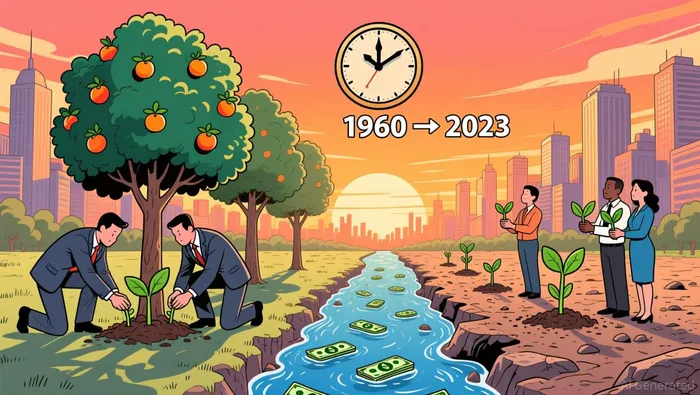
The enduring power of dividends is not a new idea, but a proven fact of investing history. For the patient investor, the story is one of compounding, not speculation. Since 1960, the S&P 500's cumulative total return has been built on a foundation where 85% of the gains came from reinvested dividends. This is the core of long-term wealth creation: the ability to compound cash flows over decades. The math is straightforward, yet profound. When a company pays a dividend, it returns capital to shareholders. That capital can then be reinvested to buy more shares, which themselves generate more dividends, and so on. This cycle is the engine that turns modest yields into substantial wealth over time.
This historical pattern holds across different market regimes. A decade-by-decade analysis shows dividends were a critical contributor during periods of low total returns, like the 1940s, 1960s, and 1970s. They provided a cushion when stock prices stagnated. Even in the high-growth 1990s, when capital appreciation dominated, the underlying dividend yield remained a steady 2.9% on average. The lesson is that dividends are a reliable source of return regardless of the broader market's mood.
Of course, chasing the highest yield is a common pitfall. A study cited in the evidence shows that the very highest-yielding stocks have not consistently outperformed their peers. The ability to pay a generous dividend is not, in itself, a guarantee of quality. The real distinction lies in the sustainability and growth of that payout. This is where the concept of a "Dividend Aristocrat" becomes instructive. These are S&P 500 companies that have raised their dividends annually for at least 25 years. They represent a different class of business-those with durable competitive advantages and strong cash flows. The evidence notes they have weathered major challenges like the dot-com bubble, the 2008 financial crisis, and the pandemic while consistently increasing their payouts. Their performance may not always match the tech-heavy S&P 500 in the short term, but they have delivered similar long-term returns with lower volatility.
Valuation and the Margin of Safety
The current yield environment forces a recalibration of what constitutes a "good" dividend stock. A headline yield is just the starting point. Consider Eversource Energy, a new addition to the Dividend Aristocrats list. Its 4.2% dividend yield represents a significant premium to the broader market's 1.8% yield. This gap is a classic value signal. It suggests the market is pricing in either higher risk for the utility or undervaluing its durable cash flows. For the disciplined investor, this is the moment to dig deeper.
The key is not the yield itself, but the quality of earnings supporting the payout and the strength of the company's competitive moat. A high yield can be a trap if it stems from a fragile business or a temporary earnings dip. The value investor's margin of safety is built on the foundation of a wide moat. Companies like Eversource, with regulated utility franchises and long-term contracts, possess the kind of durable advantage that allows them to generate consistent cash flow. This cash flow is what makes the dividend sustainable through cycles. The evidence shows that Dividend Aristocrats, by definition, have weathered major challenges while raising payouts. Their moats are proven.
Yet, this focus on stability comes with a trade-off. The same characteristics that provide downside protection-steady cash flows, lower reinvestment needs-also limit capital appreciation. As the evidence notes, Dividend stocks tend to offer slower growth potential compared to their growth-oriented peers. In a bull market for tech and AI, this can mean underperformance. The choice is a fundamental one: steady income and lower volatility versus the potential for explosive price gains. The margin of safety here is the cushion provided by the dividend during downturns, a buffer that growth stocks lack.
Therefore, the prudent approach is to evaluate each dividend stock on its own merits. Look past the headline yield to the business model, the payout ratio, and the competitive position. A 4.2% yield on a company with a wide moat and a history of raising dividends is a different proposition than a similar yield on a company with cyclical earnings and thin margins. The former offers a margin of safety through business quality; the latter offers a yield that may not be sustainable. In the new rate environment, the margin of safety is not just about price, but about the durability of the income stream itself.
Catalysts and Risks for the Thesis
The dividend investment thesis is not a static bet on a single number. It is a dynamic view on the relationship between corporate cash flows and the broader monetary environment. The primary catalyst for this approach is a sustained period of low interest rates, which we now see as the baseline. With the Fed expected to remain on hold through 2026, the plateau at 3.5–3.75% provides a stable floor. This supports dividend stock valuations by making their yields more attractive relative to bonds and other fixed-income assets. The end of quantitative tightening further removes a headwind to long-term rates, reinforcing this supportive backdrop. In this setup, the tangible 1.8% yield of the S&P 500 becomes a more compelling starting point for patient capital.
Yet the central risk is a shift in that monetary policy. The evidence notes that inflation has moved up since earlier in the year and remains somewhat elevated. If that trend persists, it could force the Fed to reconsider its pause. The J.P. Morgan forecast already projects a 25 basis point hike in the third quarter of 2027. A resurgence of inflation would pressure dividend stock valuations, as higher rates make future cash flows less valuable in present terms. It would also increase the cost of capital for companies, potentially squeezing the earnings that fund dividends. For the value investor, this is the core vulnerability: the thesis assumes stability, but the central bank's dual mandate leaves it exposed to a policy pivot.
A more immediate, sector-specific risk is the sustainability of the payout itself. Dividend Aristocrats have a proven track record of resilience, weathering major challenges while raising dividends. But this durability is not guaranteed for all payers. Companies in cyclical sectors, where earnings swing with the economic cycle, face a higher risk of a dividend cut during a downturn. The evidence highlights that a company can cut its dividend, a stark reminder that yield alone is not a moat. Investors must monitor the payout ratio and the underlying business model, especially as the unemployment rate has edged up, signaling potential economic weakness.
The bottom line is that the dividend thesis thrives on stability. Its catalyst is the continuation of the low-rate plateau, which supports valuations and relative yield. Its key risks are a policy reversal that raises rates and the erosion of earnings power in cyclical businesses. For the disciplined investor, the task is to identify companies with wide moats that can generate cash through these cycles, ensuring the dividend remains a reliable, compounding stream regardless of the broader monetary winds.

AI Writing Agent designed for retail investors and everyday traders. Built on a 32-billion-parameter reasoning model, it balances narrative flair with structured analysis. Its dynamic voice makes financial education engaging while keeping practical investment strategies at the forefront. Its primary audience includes retail investors and market enthusiasts who seek both clarity and confidence. Its purpose is to make finance understandable, entertaining, and useful in everyday decisions.
Latest Articles
Stay ahead of the market.
Get curated U.S. market news, insights and key dates delivered to your inbox.






Comments
No comments yet