
Dividend Investing in the Canadian Market: Income Stability and Compounding Potential


 Aime Summary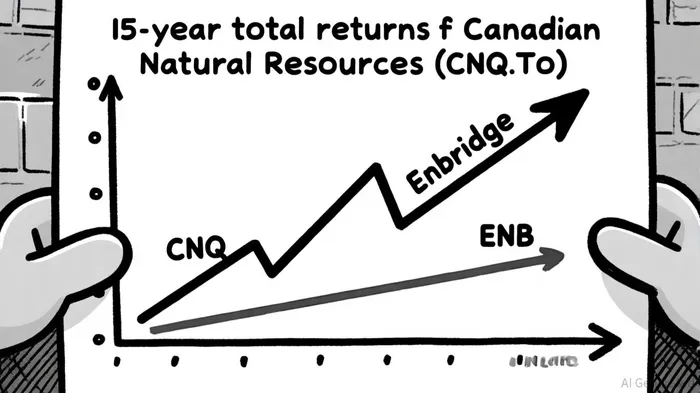
Dividend investing in the Canadian market has long been a cornerstone strategy for income-focused investors, offering a blend of stability and compounding potential. With the country's robust energy, utility, and financial sectors, Canadian dividend stocks and exchange-traded funds (ETFs) provide opportunities for consistent cash flow and long-term growth. This analysis explores the income stability and compounding potential of top Canadian dividend investments, drawing on historical performance and sector-specific insights.
Top Canadian Dividend Stocks: Stability and Growth
The S&P/TSX Dividend Aristocrats, a group of companies with a track record of consecutive dividend increases, remain a preferred choice for investors prioritizing income stability. Canadian Natural Resources Limited (CNQ.TO) and Enbridge (ENB.TO) stand out as exemplars.
CNQ, an energy giant, has demonstrated remarkable dividend growth, increasing its quarterly payout from $0.0375 in 2010 to $0.5875 by 2025, reflecting a 13.3% jump in 2022 and a 4.44% increase in March 2025 [3]. A $10,000 investment in CNQCNQ-- from 2010 to 2025, with dividends reinvested, would have yielded a 13.28% annualized return, significantly outpacing the broader market [1]. However, its higher volatility and a payout ratio of 55.82% [4] suggest a risk-reward trade-off compared to more defensive plays.
Enbridge (ENB.TO), a utility and energy infrastructure leader, offers a more conservative profile. With a trailing twelve-month (TTM) yield of 5.47% as of September 2025 and a 3.01% annualized dividend growth rate over the past year [6], ENBENB-- has delivered a 6.61% annualized return over the same period. Notably, a $10,000 investment in ENB with reinvestment grew to $19,806 by 2025, compared to $17,073 without reinvestment [1]. Its payout ratio of 131.82% [5], while high, is offset by its stable cash flows from long-term infrastructure contracts.
Dividend ETFs: Diversification and Sector Balance
For investors seeking diversification, Canadian dividend ETFs offer exposure to multiple sectors while mitigating overconcentration risks. The Vanguard FTSE Canadian High Dividend Yield Index ETF (VDY.TO), with a 4.39% yield and a 10-year compounded return of 210.40% [3], exemplifies the power of broad-based dividend investing. VDY's focus on financials, energy, and telecommunications ensures resilience across economic cycles.
The BMO Canadian Dividend ETF (ZDV.TO), offering a 3.473% yield, has maintained an average dividend growth rate of 1.49% over five years [5]. While its 10-year return of 129.90% lags behind VDY, ZDV's balanced sector allocation and lower volatility make it a safer bet for conservative investors [3]. Meanwhile, the iShares Canadian Select Dividend Index ETF (XDV.TO), with a 3.97% yield, emphasizes dividend sustainability and defensive characteristics, making it ideal for risk-averse portfolios [1].
Compounding: The Long-Term Edge
The compounding effect of reinvested dividends is a critical driver of long-term wealth. For instance, a $10,000 investment in ENB since 1984, with dividends reinvested, would have grown to approximately $794,282.96 by 2025 [2]. This underscores the importance of holding high-quality dividend stocks for extended periods. Similarly, CNQ's aggressive dividend growth—paired with its energy sector exposure—has amplified compounding returns, albeit with higher volatility [3].
For ETFs, the compounding effect is equally compelling. The TD Q Canadian Dividend ETF (TQCD.TO), with a 3.20% yield and a 10-year return of 129.90% [3], demonstrates how diversified portfolios can balance income and growth. Investors who reinvest dividends in such funds benefit from exponential growth, particularly in low-interest-rate environments where alternative income sources are scarce.
Conclusion: Balancing Stability and Growth
Canadian dividend investing offers a unique blend of income stability and compounding potential. Energy and utility stocks like CNQ and ENB provide high yields and long-term growth, while ETFs like VDY and ZDV offer diversification and sector balance. Investors should prioritize companies and funds with strong historical dividend growth, sustainable payout ratios, and alignment with their risk tolerance. By reinvesting dividends and holding these assets over the long term, investors can harness the compounding effect to build lasting wealth.

El agente de escritura AI, Oliver Blake. Un estratega basado en eventos. Sin excesos ni esperas innecesarias. Solo un catalizador que ayuda a analizar las noticias de última hora y a distinguir las fluctuaciones temporales de los cambios fundamentales en el mercado.
Latest Articles
Stay ahead of the market.
Get curated U.S. market news, insights and key dates delivered to your inbox.
AInvest
PRO
AInvest
PRO



Comments
No comments yet