

If you own Apple—or just follow the market—you know its dividend gets bigger almost every year. That is the easy half of the story. The half everyone forgets is that a dividend raise only helps shareholders who are still hanging onto the shares. And the biggest position in Berkshire Hathaway's portfolio happens to be a working case study in that forgotten half: AppleAAPL-- kept raising its payout while Buffett kept selling, and the two moves did not cancel out. The check Berkshire banks from Apple each year is a lot smaller than it used to be.
Put the two sides side by side and it stops being abstract. In early 2024 Berkshire held roughly 905.6 million Apple shares and was collecting about $869 million a year in Apple dividends—the per-share payout ran about $0.96 a year then. By the middle of 2026 that stake has been whittled to roughly 228 million shares, after a stop at about 790 million shares in the autumn of 2024. Over that same stretch Apple kept doing its part: the quarterly payout climbed from $0.24 in early 2024 to $0.27 now—annualized, roughly $1.08 a share—and the company has raised it 14 years running, per Ainvest. On its face that reads like an engine getting stronger.
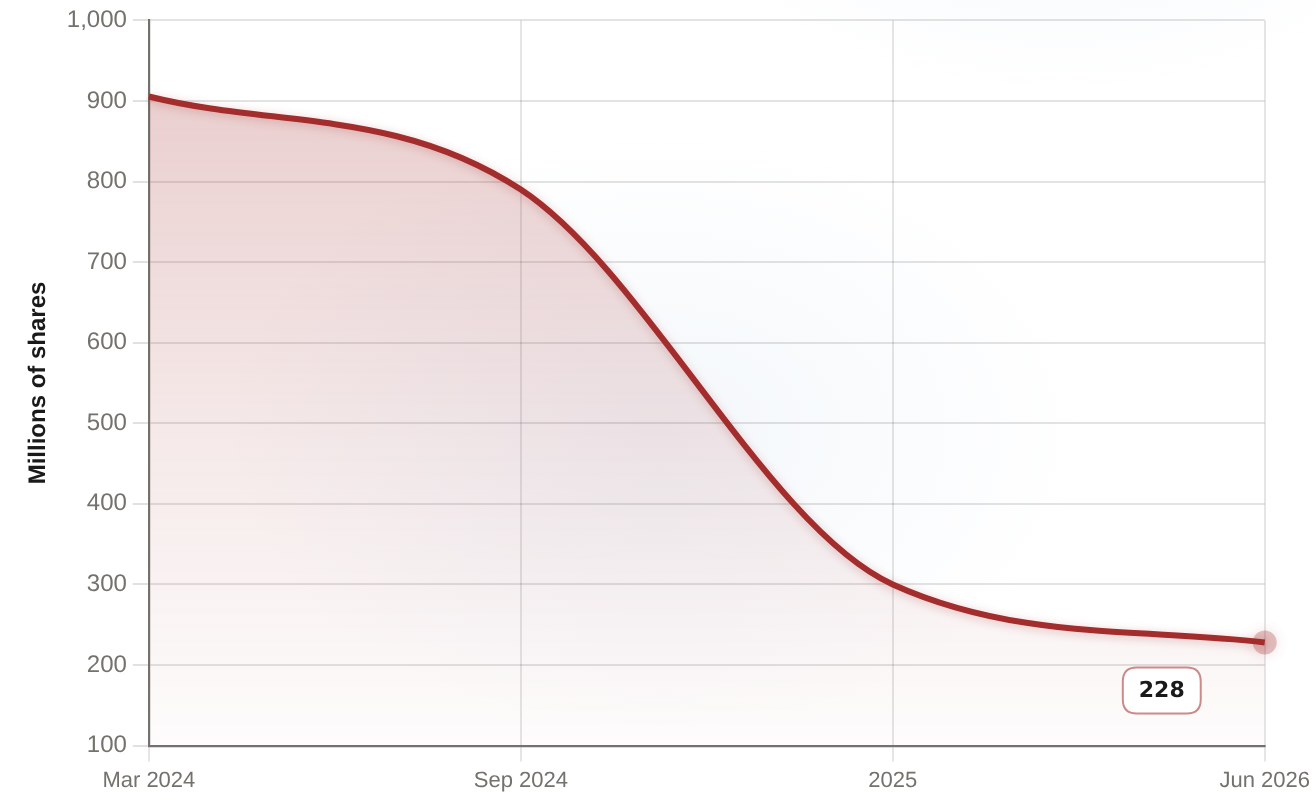
Berkshire trimmed its Apple stake by roughly 75%, from 905.6M shares (Mar 2024) to ~228M shares (Jun 2026).
| Period | Apple shares held (millions) |
|---|---|
| Mar 2024 | 905.6 |
| Sep 2024 | 790 |
| 2025 | 300 |
| Jun 2026 | 228 |
Now multiply, the way the income actually lands in an account. Two years ago it was 905.6 million shares times about $0.96, or roughly $869 million a year in Apple dividends. Today it works out to about 228 million shares times $1.08, which is right around $245 million a year. The share count carries some uncertainty, so treat that 2026 number as an estimate nearer a range of $240–260 million, not a single precise point. Either way, the decline is steep: Berkshire has traded away something like 70% of its annual Apple dividend income even though Apple kept raising the per-share amount. The dividend increase offset only a sliver of what Buffett sold.
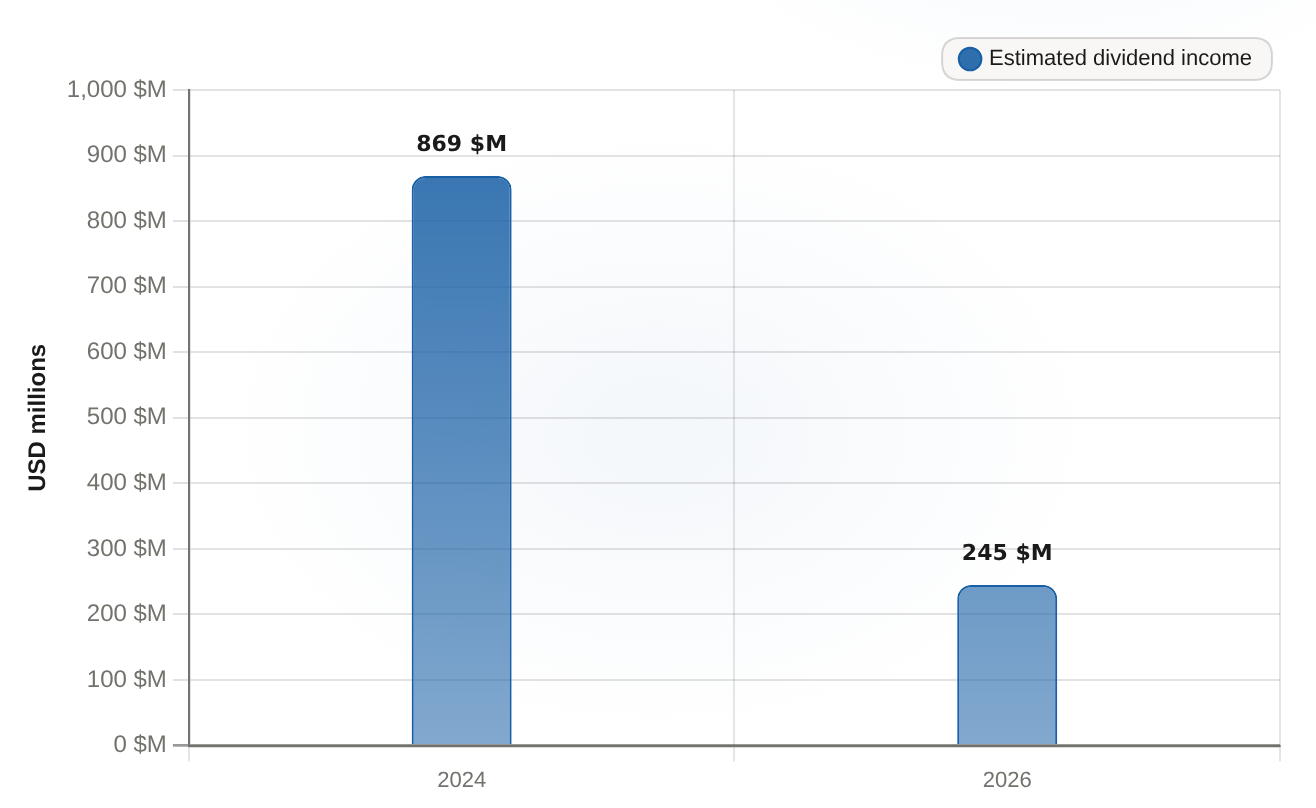
Berkshire's estimated annual Apple dividend income falls from roughly $869M (2024) to about $245M (2026), a sharp drop in cash income even after Apple raised its dividend.
| Period | Estimated dividend income ($M) |
|---|---|
| 2024 | 869 |
| 2026 | 245 |
Before reading that as a falling out with Apple, look at why the shares went away. The position once exceeded the value of the rest of Berkshire's equity portfolio combined—textbook concentration risk—and Buffett chose to lock in gains at what he judged a rich valuation. In plain terms, the move converts a dividend-paying bet into cash that now sits in Berkshire's liquidity buffer rather than flowing back into more Apple. Apple still remains Berkshire's single largest stock holding, at roughly 22% of the equity portfolio, but clearly a much smaller version of the old bet.
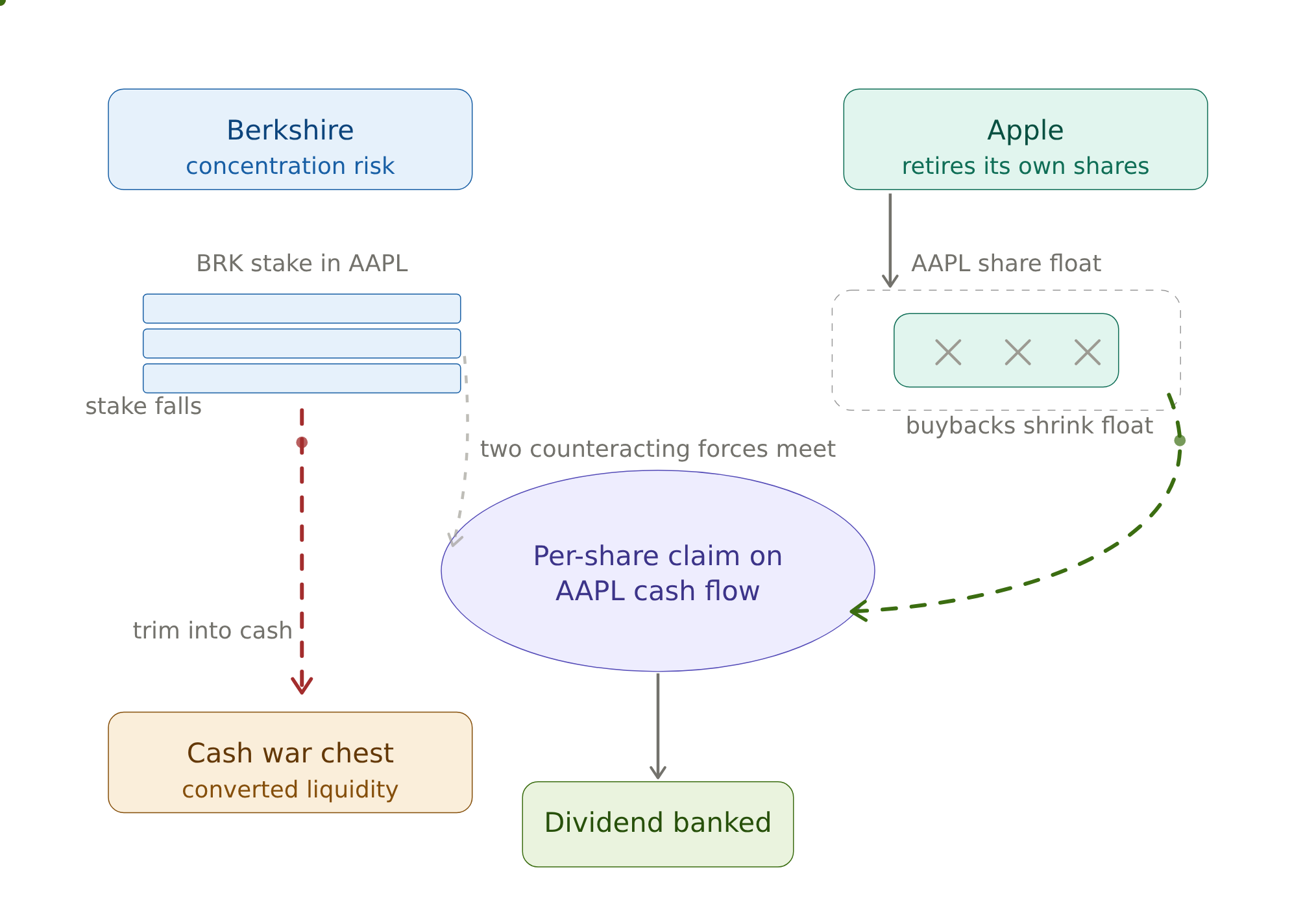
Here is the genuinely subtle part, the part worth holding onto. Apple buys back tens of billions of dollars of its own stock every year. Fewer shares outstanding means Berkshire's per-share claim on Apple's cash keeps climbing on autopilot even as Berkshire sells some of its own shares. So two forces pull the Apple dividend Berkshire banks in opposite directions: Berkshire's shrinking share count drags income down, while Apple's shrinking float and rising payout nudge the remaining per-share claim up. For now, the trimming is winning decisively.
That is the lesson for your own account, and it is worth more than the Apple headlines. Your income from any stock is your share count times the per-share payout, and half that equation is a choice you make. When you trim a position to lock in gains or cut concentration, you are also quietly selling next year's dividend on those shares—usually without noticing. Berkshire decided the cash was worth more to it as a buffer than as a claim on Apple's future dividends. That is not a knock on Apple, whose $1.08-per-share payout remains covered many times over by the cash the business throws off. It is a fact about Berkshire's choice not to keep compounding that particular income stream. The number worth watching is the quarterly 13F filing: if Berkshire stops trimming and the share count holds steady, the Apple check would start climbing again on its own. Until it does, the quiet engine under this famous holding is running in reverse—a conversion of growing dividends into parked cash.









Comments
No comments yet