
Diversifying Trade Alliances in a Turbulent Global Market: Canada and Germany's Strategic Partnership as a Model for Resilience


 Aime Summary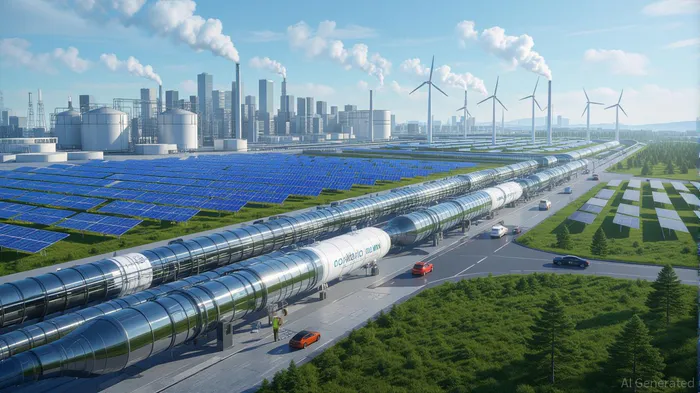
In an era marked by U.S. protectionism, Chinese dominance in critical supply chains, and the urgent need for decarbonization, Canada and Germany have emerged as unlikely yet strategic allies. Their partnership in critical minerals and clean energy infrastructure is not merely a geopolitical pivot—it is a blueprint for economic resilience. For investors, this realignment presents a unique window to capitalize on high-growth opportunities in sectors poised to redefine global trade dynamics.
The Strategic Foundation: Hydrogen, Minerals, and Geopolitical Realignment
Canada and Germany's collaboration is anchored in two pillars: the Canada-Germany Hydrogen Alliance and the Critical Minerals Strategy. The Hydrogen Alliance, launched in 2022, aims to establish a transatlantic hydrogen corridor, leveraging Canada's abundant renewable energy and Germany's industrial demand. By 2025, the alliance has crystallized into actionable plans, including port-to-port logistics, global carbon intensity standards, and joint investments in hydrogen infrastructure.
Simultaneously, Canada's $4-billion Critical Minerals Strategy—backed by Export Development Canada (EDC)—is transforming the nation into a secure supplier of lithium, cobalt, nickel, and rare earth elements. Germany, as the EU's largest economy, has prioritized Canada as a key partner to reduce its reliance on China for materials critical to electric vehicles (EVs), semiconductors, and defense systems. This alignment is further reinforced by the EU-Canada Comprehensive Economic and Trade Agreement (CETA), which has already boosted bilateral trade to $30.5 billion in 2024.
High-Growth Sectors: Critical Minerals and Clean Energy Infrastructure
The partnership's focus on critical minerals and clean energy infrastructure is creating a fertile ground for innovation and investment. Canadian companies are securing supply agreements with German automakers and energy firms, while German infrastructure developers are financing hydrogen projects in Canada. Below are the key players and their strategic roles:
1. Rock Tech Lithium (TSXV:LEM)
Rock Tech Lithium, a Canadian-German joint venture, is at the forefront of lithium processing. Its Georgia Lake lithium project in Ontario is set to supply battery-grade lithium hydroxide to Mercedes-Benz via a converter facility in Brandenburg, Germany. This vertical integration model—mining in Canada, refining in Germany—ensures supply chain resilience and aligns with ESG standards.
2. Ucore Rare Metals (TSXV:UCU)
Ucore's RapidSX separation technology is revolutionizing rare earth processing, a sector critical to EVs and green tech. With a 173.97% gain in 2025, Ucore has secured $500,000 from Ontario's Critical Minerals Innovation Fund to expand its commercial demonstration facility. Germany's push for rare earth independence makes Ucore a strategic asset.
3. Mkango Resources (TSXV:MKA)
Mkango's Pulawy rare earths separation project in Poland has been designated a Strategic Project under the EU's Critical Raw Materials Act. With a 87.5% gain in 2025, Mkango is positioning itself as a leader in recycling rare earth magnets, a sector Germany is aggressively scaling for its defense and clean energy sectors.
4. Everwind Fuels (Private)
While not publicly traded, Everwind's ammonia export agreements with Uniper and EON highlight the potential of hydrogen infrastructure. Its Point Tupper facility in Nova Scotia is a cornerstone of Canada's clean hydrogen exports to Germany, with construction set to begin in 2025.
Investment Rationale: Why This Partnership Matters
The Canada-Germany collaboration is more than a trade agreement—it is a geopolitical insurance policy. By diversifying supply chains away from China and the U.S., both nations are creating a “friendshoring” model that prioritizes security and sustainability. For investors, this means:
- Supply Chain Resilience: Companies like Rock Tech and Ucore are insulated from U.S. tariff risks and Chinese market volatility.
- Policy Tailwinds: Canada's Critical Minerals Strategy and Germany's Net-Zero Industry Act provide regulatory and financial support.
- Scalability: Projects like World Energy's Nujio'qonik hydrogen plant and Volkswagen's Ontario gigafactory demonstrate the scalability of transatlantic partnerships.
Risks and Considerations
While the outlook is bullish, investors must remain cautious. Regulatory delays, environmental concerns, and geopolitical shifts (e.g., U.S. policy changes) could disrupt timelines. However, the long-term trajectory of decarbonization and supply chain diversification remains intact.
Conclusion: A Model for the Future
Canada and Germany's partnership exemplifies how strategic alliances can mitigate global risks while unlocking value. For investors, the key is to focus on companies with vertical integration, EU strategic designations, and proven German partnerships. As the transatlantic hydrogen corridor takes shape and critical minerals become the new oil, the stocks of Rock Tech, Ucore, and Mkango are not just bets on growth—they are investments in a resilient, green future.

Decoding blockchain innovations and market trends with clarity and precision.
Latest Articles
Stay ahead of the market.
Get curated U.S. market news, insights and key dates delivered to your inbox.


AInvest
PRO
AInvest
PRO



Comments
No comments yet