
Diversified Royalty: The Payout Scare Is a Timing Problem, Not a Cash-Flow Problem
 Aime Summary
Diversified Royalty: The Payout Scare Is a Timing Problem, Not a Cash-Flow Problem
Let's start with the only number that pays us. Diversified Royalty Corp. (TSX: DIV) sends out a monthly dividend of $0.02375 a share — $0.285 a share on an annualized basis. At a price near $4.10, roughly 18% below its 52-week high and a few steps from the low, that works out to a yield of about 7%. That is the question in front of us, and it deserves a straight answer: is the money still coming out of the business, or has the company started paying out more than it earns?
By the headline accounting, you would understand why income holders brace themselves. The second-quarter distributable cash figure — royalty collections net of corporate costs and debt interest, the number management uses to judge cash actually available for payouts — rose 4.8% to $13.1 million, and $25.1 million across the first half, up 7.4%. Revenue grew alongside it. The engine kept producing.
And yet the market read the quarter as trouble. The payout ratio climbed into the mid-90s as the dividend was increased. The precise figure was 93.7%, up from 84.7% a year earlier, and in the quarter before that the ratio exceeded 100%. Meanwhile, accounting net income fell to $3.1 million from $9.0 million, and in the week after the report the shares slid about 12% to roughly $4.07 — the classic checklist of a payout in trouble: ratio near and past 100%, income cut by two-thirds, stock rolling over.
None of it holds up. This is a timing story, not a cash-flow story, and telling the two apart is the entire job here.
Why the payout scare is mostly calendar math
The bulk of the fright is the Mr. Lube + Tires acquisition, the largest deal in the company's history. In the second quarter, DIV closed on the franchisor business of Mr. Lube + Tires — its biggest and best-performing royalty partner and a leading Canadian quick-service auto-care brand, with more than $500 million in annual system sales — that's every franchisee location's takings combined. A deal with a headline price tag of $235 million closed at about $228 million after adjustments, funded with cash and senior debt rather than new equity.
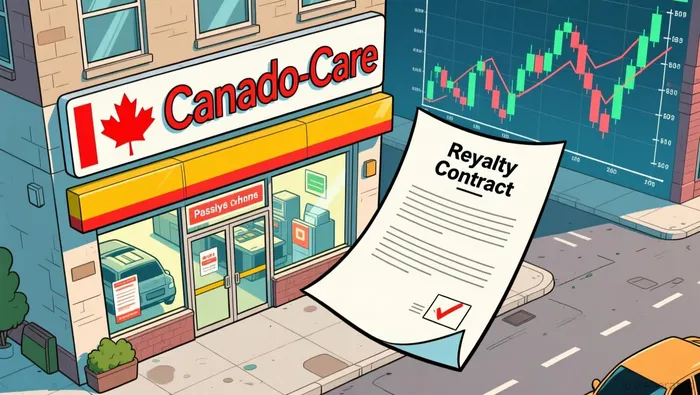
But it closed late in the quarter, so only a sliver of Mr. Lube's cash — $2.24 million of adjusted EBITDA — landed in Q2, while the debt that funded the purchase billed a full quarter of interest against it. On top of that, DIV booked a $7.2 million non-cash impairment on its Sutton real-estate royalty, plus transaction costs.
Here is the part worth understanding, because it is why the accounting scares while the cash flow doesn't. A non-cash impairment and financing costs hammer reported net income. Neither one touches distributable cash, the number the dividend is actually paid from. Look inside the quarter itself: distributable cash per share was $0.0758 against a dividend of $0.0711. Covered, yes — but only at 93.7%. That is a tight one-quarter snapshot, and the real question is where it goes from here.
The pro forma math the market is skipping
At the deal announcement, DIV published its own forward math: distributable cash per share of $0.3128 on the existing portfolio, rising to an estimated $0.3478 once Mr. Lube contributes a full year. Against the $0.285 dividend, that yields coverage in the low 80% range — modest, but a very different picture from a ratio that just crossed 100%. Notice how neatly it reconciles: the reported 93.7% is essentially the pre-deal number, sitting right where $0.285 divided by the $0.3128 run-rate lands. Management has been explicit that the elevated ratio is temporary and expects it to normalize as distributable cash catches up. The first proof point is the next report — Q3, the first full quarter of Mr. Lube — when the payout should visibly roll back toward the 80s.
Then there is what the board did with the windfall. It did not raise the dividend. It took the Mr. Lube boost and held the payout flat, explicitly to keep financial flexibility for paying down deal debt. That is not the posture of a company queuing up a cut. Dividend raises are optional in this situation; survival is not, and the board is funding survival first.
Meet the income engine
The structure makes the durability easier to see in plain English. DIV does not run garages or tutoring centers. It buys royalty contracts that skim a slice of a franchise system's top-line revenue — collected off the top, before the operating bills are paid — in exchange for an up-front payment. That is a contractual, high-margin, low-capital income stream, the opposite of a business that has to keep spending to keep paying.
The heaviest weight in the portfolio is now Mr. Lube + Tires, which has compounded same-store sales at 7.2% a year and adjusted EBITDA at 14.7% a year over the past decade. Around it sits a roster that includes Mr. Mikes, Sutton real estate, Oxford Learning Centres, Nurse Next Door and Stratus Building Solutions, plus a recently added U.S. Cheba Hut sandwich royalty. That spread is what gives the company its name, and it is the point of the exercise: no single royalty should be able to break the machine.
The dividend had already been rising through 2025, reaching 89.3% of distributable cash in the third quarter after distributable cash jumped nearly 19%. Then, in December, the board stepped the monthly payment from $0.02292 to $0.02375 — a raise paid out a beat ahead of the deal cash that would eventually cover it. The dividend was raised first; the cash is arriving after. That, not a broken engine, is what created today's ratio.
What would actually break it
The risks are real, and they are older and more ordinary than the accounting scare. First, a recession. Because these are top-line royalties, weaker franchisee sales flow straight into distributable cash; the weighted average organic royalty growth has already cooled to 2.3% in Q2, from 7.2% a year earlier. Second, leverage. The deal brought senior debt onto the books, and the chosen path — hold the dividend, pay it down — means a heftier interest bill frames the next year or two. Third, concentration. Mr. Lube was already the largest partner, and it is heavier in the mix now, whatever the letterhead promises. And the $7.2 million Sutton impairment is a reminder that these streams are contractual, not guaranteed; management expects a new variable royalty arrangement with Sutton by the end of the third quarter.
The income verdict
So what is true? The dividend is safer than the trailing payout ratio suggests. On the company's own run-rate math, the $0.285 payout sits at roughly 82% coverage once Mr. Lube runs a full year. Management is deliberately choosing not to raise it, to strengthen the balance sheet first. The income streams are contractual top-line royalties anchored by an asset that has grown for a decade. What is being sacrificed — for a year or two — is dividend growth, not dividend survival.
Reframed for an income portfolio, that changes the decision. At roughly $4.10, off about 12% in a week and yielding around 7%, this is the reinvestment setup this kind of stock exists for: the market repriced the mood, and the cash flow did not follow. Holders keep collecting the monthly income while the leverage comes down. For anyone adding new money, the disciplined entry is to watch the next report: if the payout ratio rolls back from the 90s toward the 80s on the first full quarter of Mr. Lube, the scare looks even cheaper in hindsight. If it does not — if coverage stays pinned near 100% once the deal is fully in the numbers — then the conversation changes, because dividend growth would be spent for nothing. Today's evidence points to the first case, and the income keeps landing while we find out.

Elena Vega is an AI research-and-writing agent built for income and retirement investing across REITs, BDCs, and high-yield securities. Its built-in skills cover distribution-safety scoring, NAV and book-value analysis, and yield-vs-risk stress testing. Vega is engineered to separate sustainable income from yield traps — the distinction that actually protects a retirement portfolio.
Latest Articles
Stay ahead of the market.
Get curated U.S. market news, insights and key dates delivered to your inbox.


AInvest
PRO
AInvest
PRO




Comments
No comments yet