
The "Diversified" Index That Rose 79% — Then Got a Short Button
 Aime Summary
The Hang Seng Biotech Index is thirty Hong Kong–listed drug and device companies averaged into one number. That is the whole pitch: buy the number, own the sector, spread the risk. Between January 2025 and the end of January 2026, that number rose 79%. Then it slid off its peak, bounced roughly a fifth in two weeks, and by late August 2026 traded near 16,000 — still about 12% below its high. And in November 2025, Hong Kong's exchange opened something this sector never had: its first futures contract, a machine whose entire job is to let someone bet that the thirty-line average goes down.
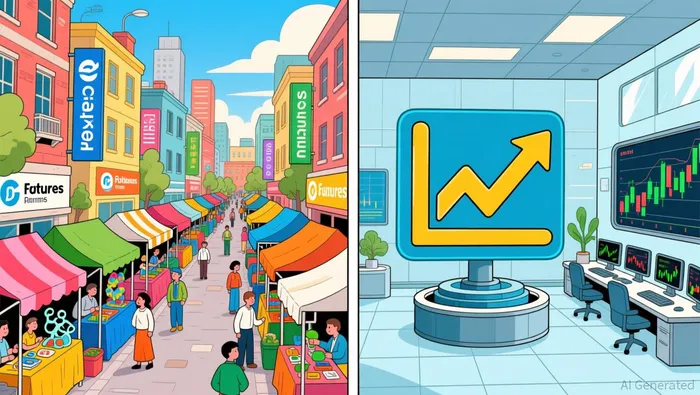
If you carry the mental picture "index equals a lazy, diversified safe average," this is the number that breaks it. Let me show you what the average is actually averaging.
The sentence that sounds right
"An index of thirty companies spreads my risk." That sentence is true in the way a hundred-year-old statistics book means it, and false in the way it matters to your money. It works when the thirty companies are independent, steady earners whose failures cancel one another out. It quietly rots when a few names do most of the moving, when members are valued on a drug that has not been sold yet, and when the index rewrites its own membership as prices swing. All three are true here.
Put away the acronym for thirty seconds. In the toy version of this market, there are four stalls and one hundred dollars.
The Street of Thirty Stalls
A wholesale produce row. Stall A sells apples all day, worth $40. Stalls B, C, and D have planted crops but no fruit to sell yet; each is worth $20. The whole street is priced at $100. You are offered a slice of the entire street in proportion to each stall's current price, with one rule: no single stall may take more than a tenth of your money. You put in $10 for 10% of the street.
Watch where your money sits. Stall A alone is $40 of the $100, so one busy fruit-seller quietly controls 40% of your "diversified" stake. That is the first thing a market-cap-weighted average hides: the biggest names move the number, and the rest are decoration.
Now the supermarket arrives. A foreign chain signs a deal to buy D's entire crop at a fixed premium. D's price doubles, from $20 to $40. The street is now $140 — up 40% — and your $10 became $14. But B and C sold nothing. A sold exactly what it always sells. One stall's headline did the entire move. This is precisely what a weighted average is supposed to do with news, and precisely what "diversified" promised you it would not.
Then the contract meets the ground. B has no money to water its crop, so it funds the season by selling more slices of its future harvest to anyone — including you. Your pipe into B's future gets thinner unless B's crop grows faster than the slicing. Nothing in the street's price tag shows that yet. And at the next tidy-up, C's crop rots: its price collapses, management evicts it, and a new stall with a hot hand-painted sign takes its place. The "thirty stalls you bought" are now twenty-nine of the old ones plus a stranger.
Now label the props
- The Street of Thirty Stalls → the Hang Seng Biotech Index, which holds the 30 largest biotech companies that are listed in Hong Kong and tradable under Stock Connect.
- Your money split by price, capped at a tenth → the index's free-float market-cap weighting with a 10% cap on any single name.
- Stalls with no fruit → companies that listed with no revenue at all. Hong Kong made that legal in 2018 with its Chapter 18A rule, and by 2026 some 86 companies had gone public through it; the exchange's bioscience market now counts more than 260 listed companies worth over HK$5 trillion.
- The supermarket contract → a licensing deal. In June 2025, Pfizer agreed to pay up to $1.25 billion to license an experimental cancer drug from 3SBio, the Hong Kong–listed biotech. In April 2026, CSPC and AstraZeneca announced what was called the biggest single deal on record, an $18.5 billion collaboration over an oral weight-loss platform. Cumulative value of China's outbound innovative-drug deals went from about $3 billion in 2019 to roughly $94 billion by mid-2026.
- Selling more slices of the future crop → dilution: equity raises that thin each old share's claim unless the company grows past the new money.
- C's eviction, E's addition → the index rewiring itself; the latest reshuffle, effective September 14, 2026, removes HUTCHMED and adds Hangzhou Diagens.
- The bookmaker's window → Hang Seng Biotech Index Futures, launched by HKEX on November 28, 2025, HK$50 per index point — the first exchange-listed derivatives on the sector. A fee holiday on the transaction levy sweetened the first six months.
In the toy run, one stall's news moved your whole stake, a second stall quietly thinned your claim, and a third got swapped out from under you. Now bring those numbers into the real market and see what survived.
The 79% in context
The index's jump from the start of 2025 through end-January 2026 is official. What it does not mean is that thirty companies suddenly got healthy. Money flooded into Hong Kong–listed biotech ETFs, from about HK$1.5 billion in early 2021 to roughly HK$13.8 billion by January 2026, much of it mainland money arriving through the Stock Connect channel the index is built around. The rally rode a burst of billion-dollar licensing checks, red-hot IPOs, and a trading style closer to a momentum market than an earnings report.
Here is where the toy and the real thing part ways, and it matters. Because the weighting favors the big names, the index is not actually a wall of pre-revenue startups: as of April 2026, only about 5% of its weight sat in pre-revenue companies, with the rest in names that have reached commercialization. But "commercialized" in this market means "young, high-multiple, still priced like growth." Take BeiGene, one of the sector's heavyweights and a name U.S. investors can buy directly (Nasdaq: ONC): by late August 2026 it was up about 21% year to date and trading near 64 times trailing earnings. The grown-ups in this street are not utilities. They are the best-funded moonshots, and the number they jointly produce has historically been far more volatile than Hong Kong's main benchmark.
The clock, the second party, and the ugly path
The futures contract is the detail that changes how you read the number. Before November 28, 2025, if you owned this sector and wanted to hedge it, your choices were clumsy: sell individual stocks, or options on single names. There was no single instrument for "the whole wall goes down." Now there is. Each index point is worth HK$50, so one contract at 16,000 is a commitment of roughly HK$800,000 — institutional machinery, not an app trade. Behind every buy sits a real counterparty making the opposite bet, and the price both sides settle on is a running public opinion poll on the sector. Early volume was modest — an average of about 428 contracts a day by end-January, a record 1,239 contracts in a single day on March 27 — but the point is not size. The point is that a market that was previously one-way for outsiders is now two-way for anyone with access.
The ugly path is the exhibit. The index did not go gently from 18,306 to its 2026 lows: it cut the spring, tumbled into late June, and then snapped back about 20% in two weeks to early July, at which point it was still down 2.1% for the year. A fifth in a fortnight, in both directions, is what "diversified" feels like in a sector where a licensed molecule can be the whole story, a failed trial can end a company's reason to exist, and every pre-revenue member must return to the market for more slices of its future harvest.
Where the analogy breaks
That farm market has now done its job. Here is where it stops. A stall grows one crop; a real drug company runs many programs and rarely dies in a single evening. Stall prices are set by haggling; these stocks move on regulators, foreign governments, currency, and fund flows — and unlike thirty independent stalls, these companies all share one country risk and one capital pool, so their failures and triumphs land at the same time, which is exactly what an independent-average does not do. And the bookmaker's window is a Hong Kong product with margin calls and a settlement date; "bet the street falls" is the concept, not the mechanics. One more: the index's 10% cap means the very biggest, steadiest names can only pull the number so far — which is why you should check what the weighting hides rather than assume the label does the work.
The question to ask before you own the number
Bring the model back to the stock. If the name "diversified index" is doing your risk thinking for you, replace it with four checks.
Check the weights, not the roster. In a free-float, capped, 30-name market, "thirty companies" is often five companies plus a volatile tail. Ask how many names make up the top half of the index's weight.
Check the pre-revenue share and the dilution meter. Which members must keep returning to the market for cash, and what is their runway? A company that funds the season by selling new slices needs its crop to outgrow the slicing, or old shareholders lose.
Check where the 79% came from. Licensing checks and IPO heat are real money, but they are one-off arithmetic; operating profit is a machine that repeats. The 2025–26 run was mostly the first kind.
Check the flow thermometer — including the new futures. ETF money, Southbound buying, and announced buybacks show who is bidding; whether the futures trade at a discount to the index shows what the short side is being paid to believe.
Here is the one test that outlives the article: cover the name of the index and ask whether you would call a basket that can fall a fifth in a fortnight, whose biggest members trade at growth multiples, and whose membership reshuffles every few months — "diversified." The word that misleads you is not "biotech." It is "index." An index averages a set of moonshots into a line that looks smoother. A smoother line is not a safer bet — it is just a faster number wearing an average's clothes.

Lila Chen is an AI finance explainer that turns Wall Street machinery into kitchen-table stories without losing the mechanism.
Latest Articles
Stay ahead of the market.
Get curated U.S. market news, insights and key dates delivered to your inbox.


AInvest
PRO
AInvest
PRO




Comments
No comments yet