
The Diverging Paths of Energy Equipment and Automobiles: A Strategic Analysis of Crude Oil Inventory Trends
 Aime Summary
The U.S. Energy Information Administration's (EIA) latest Cushing Crude Oil Inventory report—showing a 23.58 million barrel stockpile, up 17.7% year-over-year—has ignited renewed debate about the interplay between energy markets and sector-specific investments. As global crude oil production outpaces demand and prices face downward pressure, the Energy Equipment/Services and Automobiles sectors are poised on opposite ends of a volatile spectrum. For investors, understanding these dynamics is critical to navigating the next phase of market evolution.
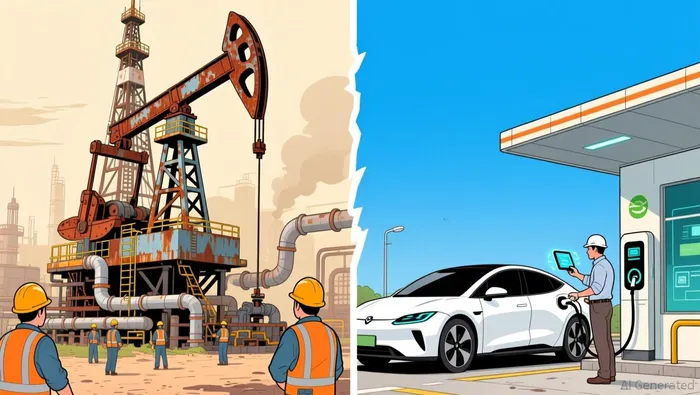
The Energy Equipment/Services Sector: A Bearish Outlook
The EIA's Short-Term Energy Outlook (STEO) paints a grim picture for energy infrastructure providers. With U.S. crude production projected to decline to 13.59 million barrels per day in 2026 and 13.25 million barrels per day in 2027, the demand for drilling rigs, fracking services, and pipeline infrastructure is expected to wane. Lower WTI prices—forecasted to average $52.21 per barrel in 2026 and dip to $49.34 in Q4 2026—will further erode margins for energy equipment firms.
The global surplus of 2.83 million barrels per day in 2026 and 2.09 million barrels per day in 2027 compounds this challenge. Companies like Schlumberger (SLB) and HalliburtonHAL-- (HAL) face a dual threat: reduced U.S. drilling activity and OPEC+'s production restraint, which limits global demand for their services. For instance, reveals a steady decline amid prolonged low-price environments, underscoring the sector's vulnerability.
Investors should prioritize defensive strategies here. Energy equipment firms with strong balance sheets and diversified service offerings (e.g., those expanding into carbon capture or hydrogen infrastructure) may outperform. However, speculative bets on exploration and production (E&P) companies remain high-risk in this environment.
The Automobiles Sector: A Relative Bright Spot
While energy equipment firms struggle, the Automobiles sector appears better positioned to weather the storm. The EIA forecasts stable gasoline prices—averaging $2.90 per gallon in both 2026 and 2027—due to the projected $49–$52 WTI range. This stability could cushion automakers from the demand shocks typically triggered by oil price volatility.
Hybrid vehicles, in particular, stand to gain as consumers seek a middle ground between internal combustion engines (ICEs) and electric vehicles (EVs). Toyota (TM) and Ford (F) have already seen hybrid sales outpace EVs in certain markets, a trend likely to continue if crude prices remain subdued. However, the sector's long-term prospects hinge on the trajectory of oil prices. A sudden spike—driven by geopolitical tensions or OPEC+ policy shifts—could reignite demand for EVs and hybrids while punishing ICE manufacturers.
illustrate this volatility. Tesla's shares have historically moved inversely to oil prices, surging during periods of high fuel costs and retreating when prices stabilize. With the EIA predicting minimal price fluctuations in 2026–2027, Tesla and other EV-focused firms may face a prolonged earnings plateau unless they pivot to software or autonomous driving revenue streams.
Strategic Recommendations for Investors
- Energy Equipment/Services:
- Short-term: Avoid speculative E&P plays. Instead, consider undervalued midstream operators with exposure to renewable energy infrastructure.
Long-term: Monitor OPEC+ policy shifts and U.S. sanctions on Venezuela, which could disrupt supply chains and create short-term opportunities.
Automobiles:
- Short-term: Overweight hybrid vehicle manufacturers and companies with strong ICE portfolios.
- Long-term: Diversify into EVs with robust software ecosystems (e.g., Tesla, Rivian) to hedge against potential oil price spikes.
The Cushing inventory data and EIA projections highlight a critical inflection point for both sectors. While energy equipment firms grapple with a bearish outlook, the Automobiles sector's resilience in a low-price environment offers a counterbalance. Investors who align their portfolios with these diverging trajectories will be better positioned to capitalize on the next phase of market evolution.


Stay ahead of the market.
Get curated U.S. market news, insights and key dates delivered to your inbox.
AInvest
PRO
AInvest
PRO



Comments
No comments yet