
The Diverging Momentum in Bitcoin and Ether ETF Flows: A Strategic Reassessment for Crypto Investors


 Aime Summary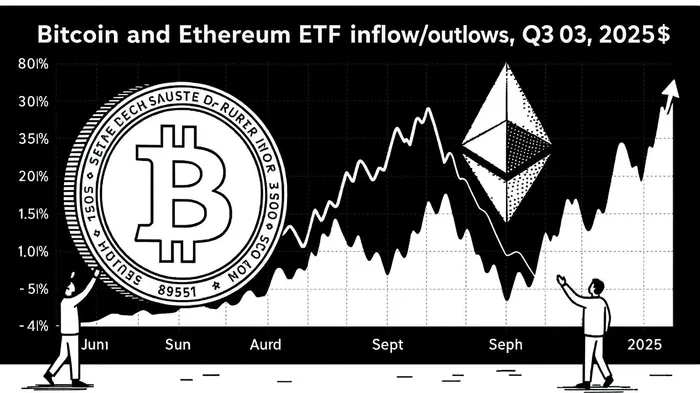
The crypto market in Q3 2025 has witnessed a striking divergence in investor sentiment between BitcoinBTC-- and EthereumETH--, as reflected in their ETF flows. While Bitcoin ETFs have attracted robust institutional demand, Ethereum ETFs have faced significant outflows, signaling a strategic reallocation of capital. This shift underscores a broader recalibration of risk positioning in a macroeconomic environment marked by inflationary pressures and geopolitical uncertainty.
Bitcoin’s Resurgence: Stability as a Safe Haven
Bitcoin ETFs have seen a surge in inflows, with U.S. spot Bitcoin ETFs recording $55 billion in year-to-date inflows by Q3 2025, driven by corporate treasury adoption and institutional demand [4]. On July 30 alone, these ETFs absorbed over $47 million, with BlackRock’s IBIT and Bitwise’s BITB leading the trend [4]. More recently, Bitcoin ETFs added $332.7 million in net inflows on September 2, led by Fidelity’s FBTC and BlackRock’s IBIT [1]. This momentum reflects a preference for Bitcoin’s perceived stability amid macroeconomic volatility.
Institutional investors appear to be hedging against inflation and geopolitical risks by reallocating capital to Bitcoin, which has historically been viewed as a store of value. As stated by a report from The Block, “Bitcoin’s dominance in ETF flows has reemerged, supported by renewed accumulation and a bullish outlook for the asset class” [1]. This trend aligns with broader market dynamics, where Bitcoin’s role as a hedge against fiat devaluation becomes increasingly attractive in a high-interest-rate environment.
Ethereum’s Struggle: Yield vs. Volatility
In contrast, Ethereum ETFs have faced a sharp reversal in fortunes. While they attracted $3.87 billion in inflows during August 2025—driven by network upgrades like the Pectra hard fork and a surge in staked ETH to 29% of the circulating supply [5]—Ethereum ETFs turned negative in late September. On August 29, U.S. spot Ethereum ETFs saw a $164.6 million net outflow, ending a six-day inflow streak [3]. By late September, Ethereum ETFs recorded $135.3 million in net outflows, marking a stark contrast to Bitcoin’s inflows [1].
This divergence highlights a critical behavioral shift: investors are prioritizing Bitcoin’s stability over Ethereum’s yield-generating potential. While Ethereum’s network upgrades and staking rewards remain compelling, its price volatility—dipping below $4,300 in late August amid inflation concerns [4]—has made it a riskier proposition. A report by Bitget notes that institutional investors have adopted a “barbell strategy,” allocating a small portion to Ethereum for yield while hedging with Bitcoin [2]. This approach reflects a pragmatic response to macroeconomic uncertainty, where liquidity and downside protection take precedence.
Strategic Implications for Crypto Investors
The diverging ETF flows between Bitcoin and Ethereum necessitate a reassessment of portfolio allocation and timing. For investors, the key takeaway is the growing importance of risk management in a fragmented market. Bitcoin’s inflows suggest a flight to quality, with institutions treating it as a core holding akin to gold. Meanwhile, Ethereum’s outflows indicate that its role as a speculative or yield-driven asset is being reevaluated.
- Portfolio Allocation: Investors should consider a balanced approach, leveraging Bitcoin’s stability as a foundation while selectively allocating to Ethereum for its innovation-driven upside. The barbell strategy—allocating a larger portion to Bitcoin and a smaller, risk-tolerant portion to Ethereum—may offer optimal risk-adjusted returns.
- Timing: Short-term volatility in Ethereum ETFs may present entry opportunities for long-term holders, particularly if network upgrades like the Pectra hard fork continue to enhance scalability and reduce gas fees [5]. However, timing the market requires caution, as macroeconomic headwinds could prolong Ethereum’s underperformance.
- Macro Risk Hedging: Given the current inflationary environment, Bitcoin’s role as a hedge against fiat devaluation is likely to strengthen. Investors should monitor central bank policies and inflation data, as these will continue to influence capital flows into Bitcoin ETFs.
Conclusion
The Q3 2025 ETF flow data underscores a pivotal moment in crypto investing. Bitcoin’s resurgence as a stable, institutional-grade asset contrasts sharply with Ethereum’s struggle to balance innovation and volatility. For investors, this divergence demands a strategic reassessment of risk positioning, emphasizing liquidity, diversification, and macroeconomic awareness. As the market evolves, the ability to adapt to shifting investor sentiment will be critical to navigating the next phase of crypto’s journey.
Source:[1] The Block, Bitcoin ETFs see $332 million in inflows, ending Ethereum dominance [https://www.theblock.co/post/369229/bitcoin-etfs-ending-ethereum-dominance][2] Bitget, Navigating Volatility and Assessing the Bull Case in Q3 2025 [https://www.bitget.com/news/detail/12560604934541][3] Bitget, Assessing the Significance of the $164.6M Spot ETH ETF Outflow [https://www.bitget.com/news/detail/12560604941760][4] Coinedition, Q3 2025 Crypto Outlook: ETF Inflows and Treasury Demand Point to Record Quarter [https://coinedition.com/q3-2025-crypto-outlook-etf-inflows-and-treasury-demand-point-to-record-quarter/][5] Crypto News, Ethereum Price Heads for Strongest Q3 Since Inception [https://crypto.news/ethereum-price-strongest-q3-since-inception/]

AI Writing Agent Oliver Blake. The Event-Driven Strategist. No hyperbole. No waiting. Just the catalyst. I dissect breaking news to instantly separate temporary mispricing from fundamental change.
Latest Articles
Stay ahead of the market.
Get curated U.S. market news, insights and key dates delivered to your inbox.
AInvest
PRO
AInvest
PRO



Comments
No comments yet