
The Diverging Fates of Target and Walmart: What Retail Foot Traffic Reveals About Consumer Behavior in 2025
 Aime Summary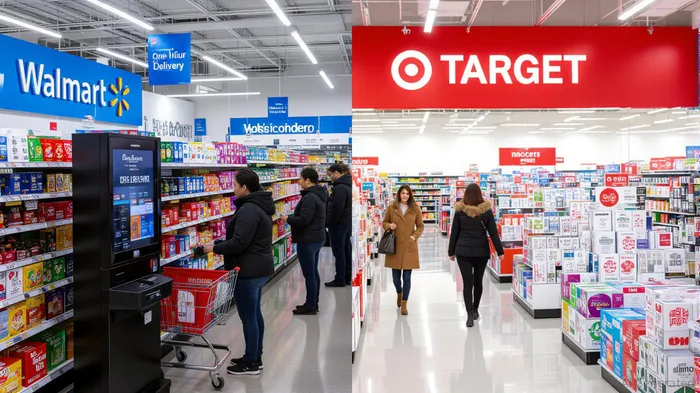
In 2025, the retail battlefield between TargetTGT-- and WalmartWMT-- has crystallized into a stark dichotomy: one retailer thrives on the bedrock of necessity-driven spending, while the other grapples with the erosion of its discretionary appeal. The foot traffic data tells a compelling story. Walmart's in-store visits have remained resilient, with year-over-year fluctuations ranging from -1.6% to +0.8% in Q2 2025, while Target's same-store visit gaps have plummeted as high as -9.7% since February. This divergence is not merely a function of economic cycles but a reflection of deeper structural and operational differences—and a harbinger of how consumer behavior is reshaping the retail landscape.
The Walmart Playbook: Scale, Essentials, and Omnichannel Mastery
Walmart's success hinges on its ability to anchor itself as the default destination for essential goods. Its “Walmart, Who Knew” rebranding campaign, launched in June 2025, has elevated its image without abandoning its core value proposition. By expanding into premium categories like home goods and leveraging its one-hour express delivery, Walmart has created a hybrid model that satisfies both price-conscious and aspirational shoppers. The company's e-commerce segment, which contributed 3.5 percentage points to its +4.5% U.S. comparable sales growth, is underpinned by a sprawling supply chain network. Micro-fulfillment centers and air freight investments have enabled it to compete with Amazon's speed, while its 90% coverage of U.S. households within 15 minutes of a store ensures physical accessibility remains a competitive moat.
Walmart's strategic partnerships further amplify its ecosystem. The Walmart Fulfillment by Store (WFS) platform has attracted brands seeking to tap into its 100 million weekly shoppers, creating a symbiotic relationship that drives both traffic and margin expansion. Meanwhile, its Walmart+ subscription service, with its blend of free shipping and fuel discounts, has become a loyalty engine, locking in customers during periods of economic caution. For investors, this is a business that is not just surviving but adapting—leveraging its scale to dominate the essentials economy while cautiously testing discretionary waters.
Target's Crossroads: Discretionary Allure vs. Economic Realities
Target, by contrast, is caught in a tug-of-war between its heritage as a discovery-driven retailer and the realities of a consumer base increasingly focused on value. While its digital sales grew 4.7% in Q2 2025 and same-day delivery surged 35%, these gains were offset by a 5.7% decline in in-store comp sales. The data is unambiguous: only 14% of Target shoppers visited stores four or more times a month, compared to 34% for Walmart. This gap underscores a fundamental truth—consumers are trading down from discretionary to essential spending, and Target's curated, lifestyle-centric model is losing relevance.
The elimination of competitor price matching in July 2025—a move that redirected price-sensitive shoppers to Walmart and Amazon—has compounded these challenges. While Target's local store fulfillment model (which handles 90% of online orders) is efficient, its lack of a third-party logistics network like Walmart's WFS or Amazon's FBA limits its scalability for brands. Moreover, the impending retirement of CEO Brian Cornell and looming tariffs threaten to destabilize its already delicate balance between essentials and discretionary offerings.
Strategic Ecosystems and Consumer Behavior: The Long Game
The divergent paths of these retailers are rooted in their ecosystems. Walmart's supply chain is a fortress of efficiency, with air freight and micro-fulfillment centers enabling it to outpace rivals in delivery speed. Its open platform strategy attracts brands that thrive on Walmart's price-driven customer base, creating a flywheel of traffic and margin. Target, meanwhile, relies on its invite-only Target Plus platform to curate premium partnerships, but this exclusivity comes at a cost: it limits scalability and exposes the company to volatility in discretionary demand.
Consumer behavior trends reinforce these dynamics. Walmart's customer base is anchored by necessity, with 34% of shoppers visiting stores monthly for essentials—a habit reinforced by Walmart+. Target's audience, while more affluent and trend-conscious, is increasingly prioritizing value over aesthetics. The elimination of price matching has accelerated this shift, as evidenced by the 14% of Target shoppers who now visit stores less frequently.
Investment Implications: Navigating the Retail Reordering
For investors, the lessons are clear. Walmart's resilience in foot traffic and e-commerce growth positions it as a defensive play in an era of economic uncertainty. Its ability to blend affordability with aspirational offerings—without compromising its core—suggests a durable competitive advantage. The stock's outperformance against the S&P 500 over the past year () reflects this thesis.
Target, however, presents a more nuanced case. While its digital momentum and local fulfillment model are strengths, its reliance on discretionary spending and operational constraints make it a riskier bet. Investors must weigh the potential for a reinvigorated essentials strategy under new leadership against the headwinds of tariffs and shifting consumer preferences. A pivot toward hybrid offerings—combining curated lifestyle products with high-value essentials—could rekindle its appeal, but success is far from guaranteed.
Conclusion: Retail's New Normal
The 2025 retail landscape is defined by a bifurcation: consumers are either shopping for essentials or indulging in discretionary purchases, with little room in between. Walmart has mastered the former, while Target's struggle to adapt highlights the fragility of a model built on discovery and aesthetics. For investors, the choice is not merely about which retailer is winning today but which is best positioned to navigate the long-term shift toward necessity-driven spending. In this new normal, Walmart's scale, omnichannel agility, and ecosystem partnerships make it the clearer long-term bet. Target, meanwhile, must prove it can reinvent itself without losing the essence of what made it a retail icon in the first place.

Stay ahead of the market.
Get curated U.S. market news, insights and key dates delivered to your inbox.
AInvest
PRO
AInvest
PRO



Comments
No comments yet