
The Divergent Paths of Capital Markets and Consumer Durables: Navigating U.S. Jobless Claims and Sector Rotation
 Aime Summary
The U.S. labor market, as measured by initial jobless claims, is a barometer of economic health—and a powerful driver of sector rotation in capital markets. Historically, shifts in this data point have revealed starkly different fortunes for financial institutionsFISI-- and consumer durables companies. A stronger labor market, while broadly seen as a positive for the economy, often creates a tug-of-war between these sectors, with capital markets benefiting from accommodative monetary policy and consumer durables suffering from tighter consumer budgets. Understanding this dynamic is critical for investors seeking to position portfolios ahead of macroeconomic trends.
The Financial Sector: A Love Affair with Weakness
When jobless claims rise, signaling a weakening labor market, financial institutions often find themselves in an unexpected sweet spot. The Federal Reserve's response—typically rate cuts to stimulate borrowing and lending—directly benefits banks and insurers. Lower interest rates reduce the cost of capital, expand net interest margins, and boost demand for mortgages and consumer loans. For example, during the 2008–2009 Great Recession, as jobless claims surged to record levels, the Fed slashed rates to near zero. This not only stabilized the financial system but also propelled bank stocks to multiyear highs. A similar pattern emerged in 2020, when pandemic-driven job losses triggered a 90-basis-point rate cut, fueling a 40% rebound in the KBW Bank Index by mid-2021.
However, this relationship is not linear. When unemployment falls and jobless claims decline, the Fed's focus shifts to inflation control. Rate hikes, while good for the broader economy, squeeze financial margins. In 2022, despite low unemployment, the Fed's aggressive rate hikes to combat inflation led to a 15% drop in the KBW Bank Index. The lesson is clear: financials thrive in a low-rate environment but falter when tightening begins.
Consumer Durables: The Casualty of Uncertainty
For consumer durables—automobiles, appliances, and furniture—the story is the inverse. These sectors are highly sensitive to employment trends and consumer confidence. Rising jobless claims typically trigger a sharp decline in demand for big-ticket items, as households prioritize liquidity over discretionary spending. During the 2008–2009 downturn, auto sales plummeted by 40%, and appliance manufacturers saw revenue drop by 30%. Even in 2020, when jobless claims hit 9 million per week, consumer durables revenue fell by 25%—until stimulus checks and low rates reignited demand.
Conversely, a strong labor market and low jobless claims create a tailwind for durables. In 2021, as unemployment fell to 5%, the sector surged by 35%, driven by pent-up demand and historically low interest rates. Yet this recovery was fragile. When the Fed began hiking rates in 2022, the sector's gains reversed, with consumer durables underperforming the S&P 500 by 10 percentage points. The key takeaway: consumer durables are a barometer of economic optimism, but their performance is contingent on the Fed's stance.
Strategic Implications for Investors
The divergent responses of these sectors to jobless claims and monetary policy suggest a clear framework for sector rotation:
- Rising Jobless Claims (Weaker Labor Market):
- Overweight Financials: Position in banks, insurers, and mortgage lenders, which benefit from rate cuts and increased lending activity.
- Underweight Durables: Avoid exposure to auto, appliance, and furniture stocks, which face demand headwinds.
Monitor Fed Policy: Look for signals of rate easing, which often precede a rebound in financials.
Falling Jobless Claims (Stronger Labor Market):
- Overweight Durables: Capitalize on rising consumer spending and pent-up demand for big-ticket items.
- Underweight Financials: Be cautious as rate hikes loom, squeezing margins.
Hedge Against Inflation: Consider defensive plays in utilities or consumer staples if inflationary pressures emerge.
Ambiguous Signals (Low Unemployment + Inflation):
- Balance Exposure: In scenarios like 2022, where low unemployment coexists with high inflation, adopt a neutral stance. Allocate to sectors with pricing power (e.g., healthcare) and short-duration bonds to mitigate rate risk.
The Broader Macro Picture
While jobless claims are a leading indicator, they must be interpreted alongside other data. For instance, the 2022 experience showed that even with low unemployment, aggressive rate hikes can derail markets. Investors must also watch wage growth, inflation, and global supply chains. A strong labor market that fuels inflation may prompt the Fed to tighten, creating headwinds for both sectors. Conversely, a soft landing scenario—where unemployment rises modestly without triggering a recession—could allow for a gradual rotation into durables as confidence returns.
Conclusion: Positioning for the Next Cycle
The interplay between jobless claims, monetary policy, and sector performance is a masterclass in market dynamics. As the U.S. economy navigates the post-pandemic landscape, investors who recognize these patterns can gain a strategic edge. In the coming months, watch for shifts in jobless claims and Fed rhetoric. If claims rise and rate cuts are on the horizon, tilt toward financials. If claims fall and inflation remains subdued, durables may offer compelling growth. In either case, the key is to stay agile, leveraging macroeconomic signals to rotate capital with precision.
By aligning sector allocations with the rhythm of the labor market and central bank actions, investors can not only weather volatility but also capitalize on the inevitable shifts in capital markets and consumer behavior.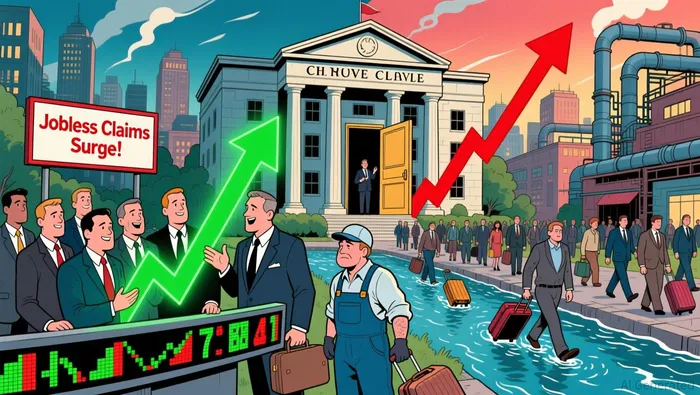

Stay ahead of the market.
Get curated U.S. market news, insights and key dates delivered to your inbox.
AInvest
PRO
AInvest
PRO



Comments
No comments yet