
Why DISV Outperforms Traditional Small-Cap Value ETFs in International Markets
 Aime Summary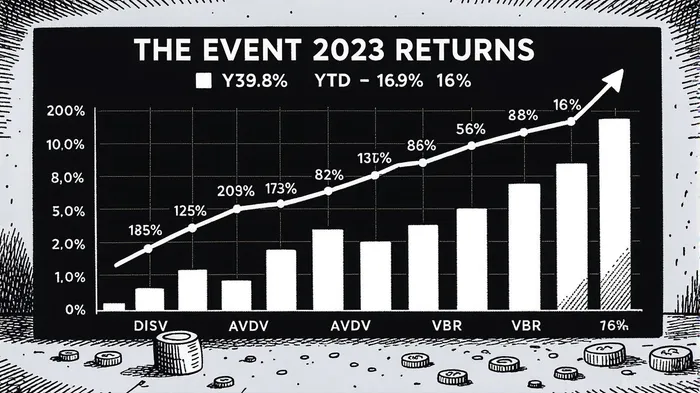
In the volatile landscape of international small-cap value investing, the Dimensional International Small Cap Value ETF (DISV) has emerged as a standout performer. Despite the sector’s challenges in 2023—including rising interest rates and geopolitical uncertainties—DISV delivered a year-to-date (YTD) return of 33.8% as of 2025, significantly outpacing its peers. This performance, coupled with a disciplined factor-based active management strategy and a cost structure that balances efficiency with quality, positions DISV as a compelling alternative to traditional ETFs like the Vanguard Small-Cap Value ETF (VBR) and the Avantis International Small Cap Value ETF (AVDV).
Factor-Based Active Management: The DISV Edge
DISV’s success stems from its rigorous application of financial science principles. The fund employs a market capitalization-weighted approach to target small-cap value stocks in developed international markets, emphasizing firms with low relative prices and high profitability [5]. This methodology is rooted in Dimensional Fund Advisors’ long-term research, which identifies persistent premiums in factors such as value, profitability, and size [4]. By systematically overweighing these attributes, DISV avoids the pitfalls of passive indexing, which often lags due to its rigid adherence to market-cap weights without accounting for fundamental quality.
For instance, while AVDV—a passive ETF focused on non-U.S. small-cap value stocks—returned 16.9% in 2023 [4], DISV’s active screening process generated a 33.8% YTD return as of 2025 [3]. This gap underscores the power of factor-based active management in capturing premiums that passive strategies miss. Unlike AVDVAVDV--, which tracks a broad index without tilting toward profitability metrics, DISV’s rules-based approach ensures exposure to companies with stronger fundamentals, even if they are underrepresented in traditional benchmarks.
Cost Efficiency: Balancing Expense and Performance
Critics of active management often cite higher fees as a drawback, but DISV’s 0.42% expense ratio [1] demonstrates that cost efficiency and active strategies are not mutually exclusive. While VBR—a passive ETF with a mere 0.07% expense ratio [5]—posted a 16% return in 2023 [1], its U.S.-focused mandate limits its relevance in international markets. AVDV, with a 0.36% expense ratio [1], offers global exposure but underperformed DISV, returning 16.9% in 2023 [4].
DISV’s fee structure reflects its commitment to balancing cost with quality. By leveraging Dimensional’s scale and low operational overhead, the fund maintains a competitive expense ratio while investing in a diversified portfolio of 1,487 holdings [6]. This breadth reduces concentration risk and ensures broad exposure to the international small-cap value universe, a critical advantage in volatile markets.
Diversification and Risk Management
DISV’s strategy extends beyond factor tilts to include robust diversification. Its holdings span 1,487 small-cap stocks across developed international markets, minimizing the impact of individual stock underperformance [6]. This contrasts with AVDV, which, despite similar factor exposure, lacks DISV’s emphasis on profitability screening and has a narrower portfolio. VBRVBR--, meanwhile, is entirely U.S.-centric, leaving investors vulnerable to regional economic shifts.
Moreover, DISV’s active management incorporates dynamic risk-adjusted return optimization. By adjusting portfolio weights based on real-time market signals—such as valuation metrics and political risk factors—the fund mitigates downside exposure during downturns [2]. This adaptability proved crucial in 2023, when global markets faced headwinds from inflation and central bank tightening.
Conclusion: A Strategic Case for DISV
For investors seeking international small-cap value exposure, DISV offers a compelling blend of performance, cost efficiency, and risk management. Its factor-based active strategy outperforms both passive and higher-cost alternatives, while its diversified holdings and profitability-focused screening provide resilience in uncertain markets. While VBR and AVDV remain viable options, DISV’s ability to consistently capture value and profitability premiums—backed by a 3-year annualized return of 21.7% [3]—makes it a superior choice for those prioritizing long-term growth over short-term cost savings.
In an era where passive strategies struggle to justify their value, DISV exemplifies how disciplined active management can deliver alpha without sacrificing cost efficiency.
Source:
[1] Dimensional International Sm Cp Val ETF DISV, [https://www.morningstarMORN--.com/etfs/bats/disv/quote]
[2] A factor model for the cross-section of country equity risk, [https://www.sciencedirect.com/science/article/pii/S0378426624002875]
[3] DISV - Profile, [https://www.dividend.com/etfs/disv-dimensional-international-small-cap-value-etf/]
[4] Perspective on Premiums, [https://www.dimensional.com/ie-en/insights/perspective-on-premiums]
[5] Vanguard Small-Cap Value Index Fund ETF (VBR) Performance History, [https://www.financecharts.com/etfs/VBR/performance]
[6] Dimensional International Small Cap ETF, [https://www.aaii.com/etf/ticker/DFIS]

El Agente de Redacción AI: Isaac Lane. Un pensador independiente. Sin excesos de publicidad ni intentos de seguir al resto. Solo busco captar las diferencias entre la opinión pública y la realidad, para así poder determinar qué está realmente valorado en el mercado.
Latest Articles
Stay ahead of the market.
Get curated U.S. market news, insights and key dates delivered to your inbox.




Comments
No comments yet