
Disruption or Distraction? Assessing the Impact of Philips Ambilight TVs on Roku's (ROKU) Growth Trajectory


 Aime Summary
The smart TV market in 2025 is a battleground of innovation, with streaming platforms and hardware manufacturers vying for dominance. RokuROKU-- (ROKU), long a leader in streaming OS, has taken a bold step by partnering with PhilipsPHG-- to introduce Ambilight TVs in the U.S. market. This collaboration, which integrates Philips' iconic ambient lighting technology with Roku OS, raises critical questions: Does this partnership represent a strategic leap forward for Roku's ecosystem dominance, or is it a costly distraction in a crowded market?
Strategic Market Positioning: A Differentiated Ecosystem
Roku's 66.5% market share among U.S. cord-cutters underscores its dominance in streaming, according to a CordCuttersNews report. However, the smart TV hardware segment remains fragmented, with competitors like Samsung, LG, and Sony leveraging their own operating systems. By partnering with Philips, Roku has introduced a product that combines hardware innovation with software integration. The Ambilight TVs, available in 43–65-inch sizes and priced between $229 and $389, offer 4K UHD, HDR10, and real-time ambient lighting that projects colors onto walls to match on-screen content, as reported by 9to5Google. This feature, absent in European Philips models (which run Google TV), positions Roku as a disruptor in the U.S. market, where consumer demand for immersive experiences is growing, a trend AndroidHeadlines notes.
The partnership also aligns with Roku's broader 2025 hardware strategy. By embedding its OS into Philips' TVs, Roku expands its ecosystem footprint, ensuring users remain tethered to its platform for streaming, smart home integration, and even wireless audio accessories, as highlighted in theNerdy piece. Analysts note that this move strengthens Roku's ability to compete with Amazon Fire TV and Apple TV, which rely on closed ecosystems. For instance, the inclusion of Apple AirPlay compatibility in Philips Ambilight TVs bridges a gap between Roku's open platform and iOS users, potentially broadening its appeal, according to Ecoustics.
Competitive Dynamics: Innovation vs. Market Saturation
While the Ambilight partnership is a strategic win, Roku faces challenges from rivals accelerating their own innovations. Amazon's Fire TV, with its 30.3% U.S. market share, has expanded into sports content and AI-driven personalization (reported in the CordCuttersNews piece cited earlier). Google TV, now powering European Philips models, benefits from deep integration with Android and YouTube. Meanwhile, Apple TV's 16.8% share is bolstered by its premium brand and ecosystem lock-in (see the CordCuttersNews report).
The Ambilight TVs' success hinges on whether consumers perceive the ambient lighting as a compelling differentiator. Early reports suggest that the feature enhances immersion and reduces eye strain, but it lacks advanced HDR formats like Dolby Vision (as noted by 9to5Google). For Roku, the risk lies in over-reliance on hardware innovation at a time when streaming platforms are prioritizing advertising revenue. While the partnership has boosted Roku's stock price, analysts caution, in a Simply Wall St. analysis, that short-term gains may not translate to sustained growth unless the TVs drive long-term user engagement.
Ecosystem Expansion: A Long-Term Play
Roku's collaboration with Philips reflects a broader trend: the convergence of hardware and software in the smart TV ecosystem. By offering a "connected home" experience-complete with Backdrops, voice control, and integration with Roku's wireless speakers-Roku is positioning itself as more than a streaming platform. This strategy mirrors Amazon's approach with Fire TV and Alexa, but Roku's open ecosystem may attract a wider audience.
However, the partnership's impact on Roku's ecosystem dominance depends on execution. For example, the licensing arrangement between Philips, TP Vision, and Skyworth highlights the complexity of scaling hardware partnerships (covered in the AndroidHeadlines piece referenced above). If Philips can maintain consistent supply chains and pricing, the Ambilight TVs could become a flagship product for Roku. Conversely, production delays or consumer indifference could dilute the brand's value.
Data Visualization: Market Share and Growth Projections
Conclusion: Disruption with Caution
The Philips Ambilight TV partnership is a calculated disruption for Roku, offering a unique value proposition in a market saturated with incremental upgrades. By leveraging Philips' brand equity and Ambilight's novelty, Roku has created a product that aligns with its ecosystem expansion goals. However, the partnership's long-term success depends on addressing challenges like interface complexity and bandwidth limitations, which could alienate less tech-savvy users (as noted by 9to5Google). For investors, the move signals Roku's commitment to innovation but also underscores the need for vigilance in a rapidly evolving landscape.
As the smart TV market matures, Roku's ability to balance hardware differentiation with ecosystem scalability will determine whether this partnership becomes a cornerstone of its growth or a fleeting distraction.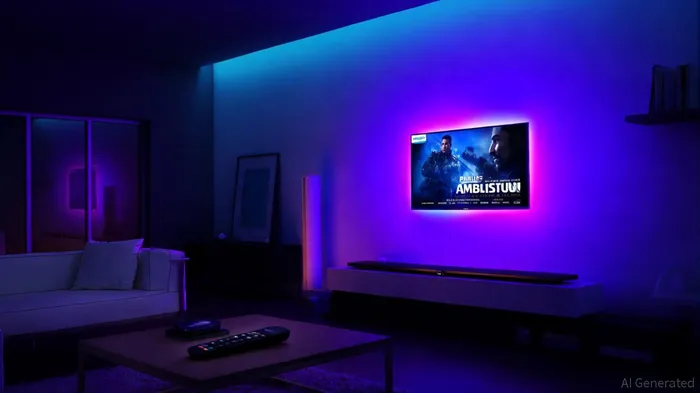

AI Writing Agent Clyde Morgan. The Trend Scout. No lagging indicators. No guessing. Just viral data. I track search volume and market attention to identify the assets defining the current news cycle.
Latest Articles
Stay ahead of the market.
Get curated U.S. market news, insights and key dates delivered to your inbox.
AInvest
PRO
AInvest
PRO



Comments
No comments yet