
Disney's Strategic Pivot and Its Implications for Media Stocks


 Aime Summary
The Walt Disney Company's evolving embrace of artificial intelligence (AI) in 2025 marks a pivotal shift in its strategy to dominate the entertainment ecosystem. By integrating AI into storytelling, streaming, and theme parks, Disney is redefining how audiences engage with its intellectual property (IP). This strategic pivot, however, comes with both opportunities and risks, raising critical questions about its long-term viability as a growth play in the media sector.
AI-Driven Content Creation and Personalization
Disney's AI initiatives are centered on enhancing creativity and personalization. The company
has invested $1 billion in OpenAI, granting users access to tools like Sora and ChatGPT to generate short videos featuring Disney, Marvel, Pixar, and Star Wars characters. This move not only democratizes content creation but also aligns with industry trends toward user-generated content,
a strategy mirrored by competitors like Netflix. By leveraging generative AI for script analysis, character generation, and motion capture,
Disney is streamlining animation production while reducing manual labor.
The financial implications are significant. In 2025, Disney
reported $94.4 billion in revenue, with its Direct-to-Consumer segment showing resilience, posting $352 million in operating income for Q4. The company's AI-driven personalization on Disney+-powered by algorithms analyzing viewer behavior-has improved engagement and retention,
a critical metric in a crowded streaming market.
Vertical Integration vs. Horizontal Competition
Disney's approach to AI contrasts sharply with competitors like Amazon and Netflix, which prioritize horizontal, platform-centric strategies.
Disney's "flywheel" model integrates AI into its vertically aligned ecosystem, using data from parks, streaming, and physical touchpoints to create hyper-personalized experiences. For instance,
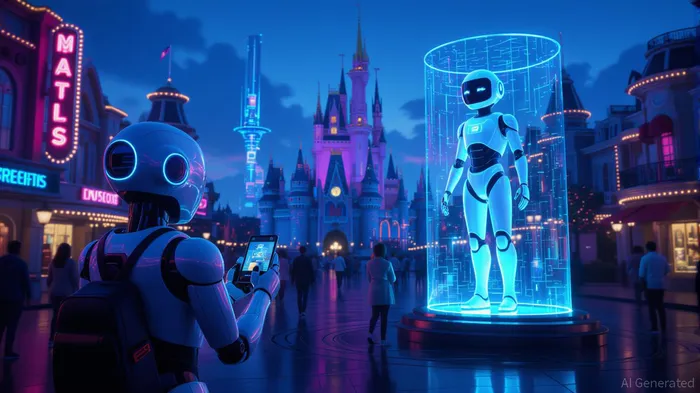
AI-powered robotics in theme parks, such as Star Wars-inspired BDX droids trained via reinforcement learning, blur the line between fiction and reality. This integration reinforces Disney's narrative lock-in, ensuring its ecosystem remains the default for entertainment.
In contrast, Amazon and Netflix focus on scaling AI for automation in content creation and distribution. While this approach optimizes efficiency, it lacks the experiential depth Disney is cultivating.
Disney's investment in its "Disney Select AI Engine" further underscores this distinction, enabling hyper-targeted advertising and lookalike modeling that boost ROI.
Financial Performance and Market Position
Despite challenges, Disney's 2025 financials reflect robust growth. Full-year operating income rose 12% to $17.6 billion, with the Experiences segment hitting a record $10 billion,
driven by strong park performance. The company's stock has also benefited from its AI bets,
with shares surging after the OpenAI partnership announcement. However,
Q4 revenue fell slightly below expectations at $22.5 billion, leading to an 8.23% pre-market drop.
The $1 billion OpenAI investment, while costly, positions Disney to capitalize on the AI boom.
Global AI spending is projected to reach $375 billion by 2025, with Disney's early adoption of tools like Sora placing it at the forefront of content innovation.
Analysts note that Disney's ability to monetize AI-driven personalization and user-generated content could drive double-digit adjusted EPS growth in 2026.
Challenges and Risks
Disney's AI ambitions are not without hurdles.
Internal resistance from animators and actors, who fear AI could dilute artistic value, has led to cultural friction. Additionally,
the departure of key AI leader Ben Stanbury highlights the difficulty of balancing creativity with technological innovation. These challenges could slow adoption or spark regulatory scrutiny, particularly around IP rights and labor concerns.
Implications for Media Stocks
Disney's strategic pivot signals a broader industry shift toward AI integration. For investors, the company's success hinges on its ability to maintain its creative edge while scaling AI-driven efficiencies. Competitors like Netflix and Amazon may catch up, but Disney's vertically integrated ecosystem and brand loyalty provide a moat.
In the long term, Disney's AI investments could redefine entertainment, making it a compelling growth play. However, risks such as creative resistance and market saturation must be monitored. As AI spending accelerates,
Disney's early mover advantage-coupled with its $7 billion share repurchase plan-positions it to outperform peers in the evolving media landscape.

Stay ahead of the market.
Get curated U.S. market news, insights and key dates delivered to your inbox.




Comments
No comments yet