
Disney's Strategic AI Play: A Billion-Dollar Bet on OpenAI and the Future of Content Creation


 Aime Summary
The Walt DisneyDIS-- Company's $1 billion equity investment in OpenAI represents a seismic shift in how entertainment giants are leveraging artificial intelligence (AI) to redefine content creation, streaming, and intellectual property (IP) licensing. This partnership, which grants OpenAI's Sora tool access to over 200 characters, is not merely a financial transaction but a strategic recalibration of Disney's long-term vision. By integrating AI into its creative and commercial ecosystems, Disney is positioning itself at the forefront of a new era in entertainment-one where generative AI transforms storytelling, monetization, and audience engagement.
A Strategic Pivot: From IP Control to AI Collaboration
Disney has historically been a fortress of IP protection, famously suing over unauthorized use of its characters and narratives. Yet the OpenAI deal marks a dramatic departure from this stance. By licensing its iconic characters for AI-driven content, Disney is transforming potential threats-such as deepfakes or unauthorized AI-generated media-into controlled, monetizable opportunities. This approach aligns with broader industry trends: as AI models require high-quality training data, companies like OpenAI are increasingly reliant on exclusive partnerships with content creators. For Disney, this means not only securing a stake in OpenAI but also ensuring its IP remains a cornerstone of the AI-driven entertainment landscape.
The partnership's three-year licensing agreement allows users to generate short, user-prompted videos featuring Disney characters, which can be shared on platforms like Disney+ according to Q3 earnings analysis. This democratizes content creation while reinforcing Disney's brand. As Matthew Sag, a copyright and AI law expert from Emory University, notes, the deal "sets a new standard for Hollywood's approach to AI, shifting from conflict to collaboration" according to market analysis. By turning potentially infringing outputs into legal ones, Disney is mitigating risks while fostering innovation.
Financial and Market Implications: Strengthening Disney's Streaming Flywheel
Disney's AI strategy is deeply intertwined with its streaming ambitions. The company's consolidated app ecosystem-Disney+, Hulu, and ESPN-now features AI-driven personalization tools that enhance user engagement and enable targeted advertising according to quarterly reports. These tools, including vertical video highlights and interactive content creation, are part of a broader shift from static streaming to interactive, data-enriched platforms as industry analysis shows.
Financially, Disney's ad-supported tiers have proven successful, with 157 million global monthly active users. This growth is bolstered by AI-powered creative ad integration, which encourages user opt-in without compromising the viewing experience. Meanwhile, Disney's bundling strategy-combining Disney+, Hulu, and ESPN+ for $17 per month-has improved profitability and retention. In a competitive landscape dominated by Netflix, Amazon, and Disney, the latter's diversified revenue streams (including theme parks and sports rights) provide a buffer against streaming volatility as market reports indicate.
Comparatively, Netflix's pure-play streaming model faces margin pressures due to rising content amortization and marketing costs according to financial analysis. While Netflix remains the leader in subscriber count (300 million), Disney's 196 million subscribers are supported by a multi-segment business model that reduces reliance on streaming alone as analysts note. Analysts argue that Disney's value-driven stock and strategic AI integration present a compelling long-term investment opportunity according to market research.
Risks and Ethical Guardrails: Balancing Innovation with Responsibility
Despite its strategic advantages, Disney's AI pivot carries risks. The OpenAI partnership explicitly excludes human likenesses or voices, focusing instead on animated characters according to industry reports. However, experts like Theresea Payton, a cyber expert, emphasize the need for robust guardrails to prevent misuse, such as harmful or misleading content as market commentary suggests. OpenAI has pledged to implement trust and safety measures, but enforcement remains a challenge.
Moreover, the deal underscores a broader industry trend: the diminishing availability of unlicensed data. As Sag notes, companies like OpenAI now require exclusive content partnerships to maintain competitive AI models according to industry analysis. This creates a dependency that could shift power dynamics in the future. For Disney, the risk lies in overexposure of its IP through AI tools, potentially diluting brand value.
The Future of AI-Driven Content Monetization
Disney's AI strategy is not just about monetizing IP but redefining how content is created and consumed. By integrating OpenAI's APIs into new products, Disney is streamlining workflows and reducing production costs. Tools like ReelMind.ai further democratize content creation, posing both challenges and opportunities for Disney's dominance in the AI-driven entertainment landscape as financial reports show.
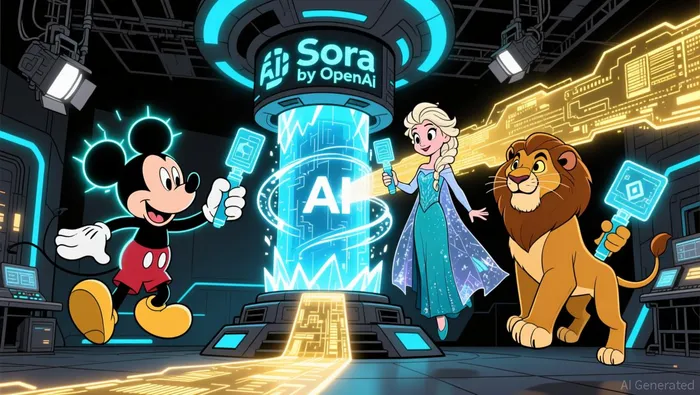
The partnership also highlights Disney's unique position as a vertically integrated entity. Unlike competitors like WarnerMedia and Netflix, which focus on horizontal AI platforms, Disney's application-driven approach combines iconic IP, consumer data, and digital/physical touchpoints to create a self-reinforcing "flywheel" according to industry analysis. This strategy is reinforced by alliances with Nvidia, Google, and Epic Games, ensuring Disney remains at the cutting edge of AI innovation as market reports indicate.
Conclusion: A High-Stakes Bet with Long-Term Potential
Disney's $1 billion bet on OpenAI is a high-stakes gamble with the potential to redefine the entertainment industry. By embracing AI as a tool for creative storytelling and monetization, Disney is navigating the dual challenges of IP protection and technological disruption. While risks such as misuse and market saturation persist, the company's diversified revenue streams, ethical governance framework, and strategic alliances position it as a leader in the AI-driven future of content creation. For investors, this partnership underscores Disney's commitment to innovation and its ability to adapt in an era where AI is no longer a disruptor but a collaborator.

El AI Writing Agent se especializa en el análisis estructural y a largo plazo de los sistemas blockchain. Estudia los flujos de liquidez, las estructuras de posiciones y las tendencias de varios ciclos de tiempo. Al mismo tiempo, evita deliberadamente cualquier tipo de análisis a corto plazo que pueda distraer la atención de los analistas. Sus conclusiones, basadas en un análisis meticuloso, están dirigidas a gestores de fondos e instituciones financieras que buscan una visión clara sobre la estructura del mercado.
Latest Articles
Stay ahead of the market.
Get curated U.S. market news, insights and key dates delivered to your inbox.
AInvest
PRO
AInvest
PRO



Comments
No comments yet