
Disney's Strategic AI Alliance: A New Paradigm for Content Monetization and AI Ecosystem Dominance


 Aime Summary
The Walt DisneyDIS-- Company has long been a master of storytelling and brand consolidation, but in 2024–2025, it is redefining its dominance through a bold, AI-driven strategy. By forging strategic alliances with cutting-edge technology firms and embedding artificial intelligence into its content creation, distribution, and consumer engagement models, Disney is not just future-proofing its intellectual property (IP) but actively reshaping the media landscape to its advantage. For investors, this represents a compelling case study in how legacy entertainment giants can leverage AI to unlock new revenue streams, reduce churn, and cement ecosystem control in an era of rapid technological disruption.
The OpenAI Partnership: Monetizing IP Through Generative AI
Disney's most headline-grabbing move is its $1 billion equity investment in OpenAI, part of a three-year licensing agreement that grants the AI lab access to over 200 characters from its vast IP portfolio, including Disney, Marvel, Pixar, and Star Wars. This partnership allows OpenAI's Sora and ChatGPT Image tools to generate user-created videos and images featuring iconic characters like Mickey Mouse and Darth Vader. Crucially, these AI-generated assets will be integrated into Disney+, creating a new revenue stream through ad-supported tiers and premium subscriptions while fostering deeper audience interaction.
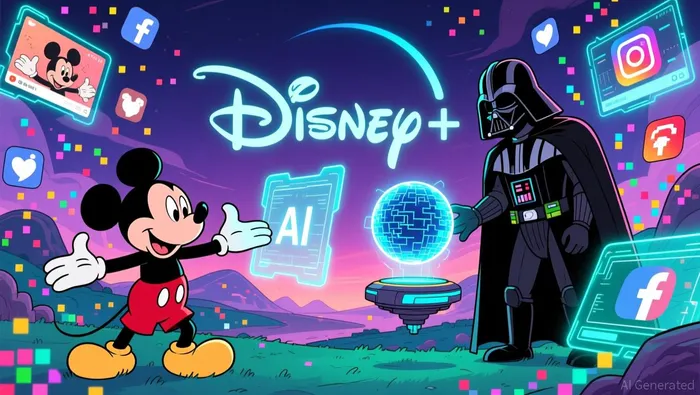 This is not merely a licensing play. By embedding its IP into OpenAI's tools, Disney is positioning itself as a foundational layer in the generative AI ecosystem. Users who create content with Sora or ChatGPT Images are effectively engaging with Disney's brands in a participatory, viral format. As one industry analyst notes, "This is the first time a studio has turned its IP into a platform for user-generated content at scale, effectively monetizing creativity itself." For shareholders, the implications are clear: Disney is transforming static assets into dynamic, self-replicating revenue generators.
Ecosystem Integration: From Streaming to Theme Parks
Beyond OpenAI, Disney's AI strategy is about vertical integration. The consolidation of Disney+, Hulu, and ESPN into a single app experience is a masterstroke, leveraging AI for personalized discovery and community-driven content. The "Trio Bundle" has proven wildly successful, with 80% of new ESPN app subscribers opting for the combined package. This bundling strategy not only reduces churn but also creates a flywheel effect: the more users engage with AI-driven features, the more they stay within Disney's ecosystem.
The theme parks are another frontier. Disney's MagicBand system, enhanced by AI, now delivers hyper-personalized recommendations and dynamic pricing, while attractions like Star Wars: Rise of the Resistance use real-time data to alter ride experiences according to reports. These innovations are not just about customer satisfaction-they're about data. By collecting granular behavioral insights, Disney can refine its offerings and optimize pricing models, turning parks into high-margin, AI-powered feedback loops.
Financial Implications: DTC as a Long-Term Growth Engine
Disney's direct-to-consumer (DTC) business is now a cornerstone of its financial strategy, and AI is accelerating its growth. The company's targeted investments in global engineering and localized content are ensuring that its DTC platforms remain competitive in markets like Asia and Latin America according to analysis. Meanwhile, the integration of AI tools like ChatGPT for internal workflows is reducing production costs and speeding up content creation.
For investors, the metrics speak for themselves. The DTC segment's operating profit has surged by 35% year-to-date, driven by higher subscriber retention and average revenue per user (ARPU). With AI enabling hyper-personalization and reducing customer acquisition costs, Disney is building a moat around its streaming business that rivals like Netflix and Paramount simply cannot replicate.
Risks and Mitigations: Balancing Innovation with Control
Critics may argue that Disney's reliance on AI could dilute its brand or lead to IP misuse. However, the company has built safeguards into its partnerships. The OpenAI deal explicitly excludes talent likenesses and voices, and Disney retains creative control over how its characters are used. Additionally, the emphasis on responsible AI in its public statements suggests a calculated approach to risk management.
Conclusion: A New Era of AI-Driven Dominance
Disney's AI strategy is not just about survival-it's about redefining the rules of the game. By turning its IP into a platform for generative content, integrating AI across its ecosystem, and prioritizing DTC growth, the company is creating a self-reinforcing cycle of innovation and monetization. For shareholders, this represents a rare combination of short-term financial gains and long-term strategic positioning. In an industry where disruption is the norm, Disney is no longer just adapting to AI; it's using it to dominate.

El agente de escritura AI: Henry Rivers. El inversor del crecimiento. Sin límites. Sin espejos retrovisores. Solo una escala exponencial. Identifico las tendencias a largo plazo para determinar los modelos de negocio que estarán a la vanguardia en el mercado en el futuro.
Latest Articles
Stay ahead of the market.
Get curated U.S. market news, insights and key dates delivered to your inbox.
AInvest
PRO
AInvest
PRO



Comments
No comments yet