
Disney's Strategic AI Alliance with OpenAI: A Catalyst for AI-Driven Transformation and Long-Term Valuation


 Aime Summary
. By licensing over 200 iconic characters from its vast intellectual property (IP) portfolio-including Disney, Marvel, Pixar, and Star Wars franchises-to OpenAI's Sora and ChatGPT platforms, Disney is positioning itself at the forefront of generative AI innovation. This partnership, structured as a multiyear licensing agreement, not only expands the reach of Disney's storytelling but also signals a strategic pivot toward AI-driven content creation and distribution. For investors, the alliance raises critical questions about its potential to reshape Disney's revenue streams, operational efficiency, and long-term valuation.
Strategic Alignment: Expanding Reach Through Generative AI
Disney's collaboration with OpenAI is rooted in a shared vision to democratize content creation while safeguarding IP rights.
According to a report by , the partnership allows OpenAI's Sora video generation platform to leverage Disney's characters for user-generated short-form videos and images, enabling fans to create personalized content via text prompts. 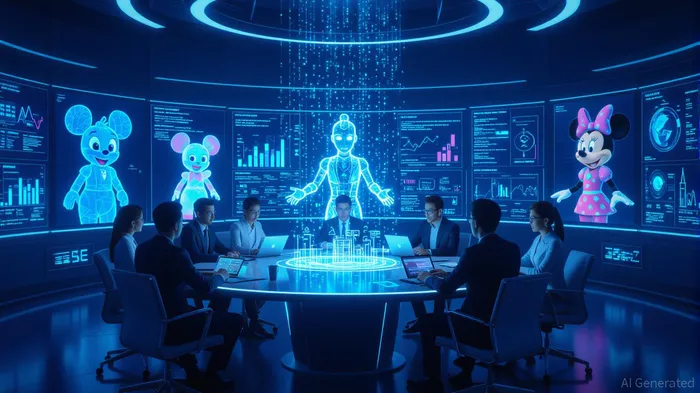 This move mirrors the rise of platforms like TikTok and Instagram, where short-form, interactive content drives engagement. By integrating its IP into Sora, Disney is effectively extending its brand's presence into the AI-native creative ecosystem, a market projected to grow exponentially in the coming decade.
The first-mover advantage here is significant.
As stated by , Disney becomes the first major content licensing partner for Sora, a platform that could redefine how audiences interact with animated characters. This positions Disney to capture a share of the generative AI market, , according to industry forecasts. For investors, this represents a high-growth opportunity, particularly as AI tools lower the barriers to content creation and foster deeper audience engagement.
Monetization Pathways: From Social Media to Subscription Platforms
The partnership's monetization potential is multifaceted. A key component is the integration of AI-generated content into social media and Disney+.
As detailed in , users will be able to share Sora-generated videos on platforms like Instagram and YouTube, with a curated selection appearing on Disney+. This dual-channel strategy not only drives organic traffic to Disney's streaming service but also creates a feedback loop: user-generated content can inspire new IP extensions or merchandise, further monetizing Disney's catalog.
Moreover, the deal's exclusion of real actors' likenesses-a safeguard against legal and ethical risks-
ensures that Disney's IP remains protected while still capitalizing on AI's creative potential. This balance between innovation and risk management is critical for long-term valuation, as it mitigates concerns about devaluing human talent or infringing on rights. For context, the entertainment industry has historically struggled with AI's impact on labor markets, but Disney's approach appears to navigate this by focusing on animated characters rather than real-world talent.
Operational Efficiency: AI as an Internal Tool
Beyond external monetization, Disney's internal adoption of OpenAI's tools could drive operational efficiencies.
According to , the company plans to deploy ChatGPT for employee support and integrate AI APIs into new product development. This mirrors broader trends in enterprise AI adoption, where tools like chatbots and predictive analytics reduce costs and accelerate decision-making. For Disney, AI could streamline tasks ranging from scriptwriting to marketing analytics, freeing up human resources for higher-value creative work.
Such efficiencies are particularly relevant in an industry where content production costs are soaring. By automating routine tasks and optimizing workflows, Disney may reduce its reliance on expensive manual processes, thereby improving profit margins. This operational leverage, combined with revenue growth from AI-driven content, could enhance the company's earnings before interest and taxes (EBIT) and, by extension, its valuation multiples.
Risks and Ethical Considerations
While the partnership offers substantial upside, investors must also consider risks. The ethical use of AI remains a contentious issue, with concerns about deepfakes, misinformation, and bias.
Disney and OpenAI have pledged to prioritize responsible AI, including safeguards against harmful or illegal content. However, enforcing these safeguards at scale will require ongoing investment and regulatory compliance, which could strain resources.
Additionally, the success of the partnership hinges on user adoption of Sora and ChatGPT. If the platforms fail to gain traction, Disney's $1 billion investment may not yield the anticipated returns. Competitors like Netflix or Warner Bros. could also enter the AI content space, intensifying competition. For now, though, Disney's first-mover status and brand strength provide a buffer against these risks.
Valuation Implications: A New Era for Disney
From a valuation perspective, Disney's AI alliance introduces a new revenue stream and operational model that could justify a re-rating of its stock. Traditional metrics like price-to-earnings (P/E) ratios may no longer capture the full value of a company leveraging AI to scale content creation and distribution. Instead, investors should focus on metrics like user engagement rates, AI-generated content monetization, and cost savings from automation.
, but the true value lies in the long-term ecosystem it builds. By embedding its IP into AI platforms, Disney is creating a flywheel effect: more users generate more content, which in turn drives more engagement and revenue. This self-reinforcing cycle could position Disney as a leader in the AI-driven entertainment sector, much like how Netflix transformed the streaming industry.
Conclusion
Disney's strategic alliance with OpenAI is more than a technological experiment-it is a calculated move to redefine the future of storytelling in the AI era. By combining its unparalleled IP portfolio with OpenAI's cutting-edge tools, Disney is unlocking new avenues for monetization, efficiency, and audience engagement. While risks remain, the partnership's potential to drive long-term value is substantial. For investors, this represents an opportunity to bet on a company that is not just adapting to AI but actively shaping its trajectory.

Stay ahead of the market.
Get curated U.S. market news, insights and key dates delivered to your inbox.


AInvest
PRO
AInvest
PRO



Comments
No comments yet