
Disney’s ESPN Streaming Strategy: A Play to Recapture Lost TV Revenue?
 Aime Summary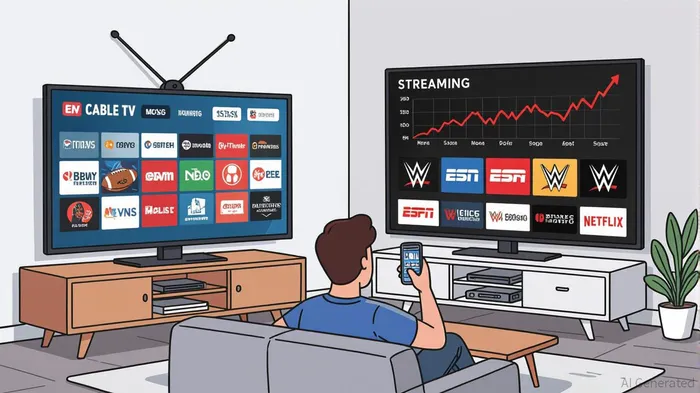
Disney’s ESPN division has long been a cornerstone of the company’s media empire, but the seismic shift from traditional television to streaming has forced a strategic reevaluation. With linear TV revenue from ESPN declining by 15% in the fiscal quarter ending June 2025 to $2.27 billion—driven by cord-cutting trends and lower ad rates—Disney is betting heavily on its streaming platforms to recapture lost ground [1]. The question for investors is whether ESPN’s evolving streaming strategy, including standalone services, bundling, and exclusive content deals, can effectively monetize both corded and cordless audiences while reshaping distribution economics.
The Decline of Traditional TV and the Rise of Streaming
Traditional pay TV’s grip on U.S. households has weakened significantly. By Q1 2025, only 37.6% of homes subscribed to traditional pay TV, down from a peak of over 101 million households a decade earlier [3]. For ESPN, this decline has been compounded by the broader cable industry’s 10% subscriber drop in 2025 [1]. Meanwhile, streaming platforms like YouTube TV have partially offset this loss, with 9.4 million subscribers and $8.93 billion in ad revenue in Q1 2025 [5]. However, Disney’s own streaming services face stiff competition.
ESPN’s parent company, DisneySCHL--, reported a $2.5 billion streaming loss in 2023, but this turned into a $574 million profit in 2024, driven by cost-cutting and bundling strategies [3]. Yet, even with these improvements, Disney+ and ESPN+ lost 700,000 subscribers each in recent quarters, partly due to price hikes and declining content quality [6]. This highlights a critical challenge: while streaming offers growth potential, monetizing cordless audiences remains fraught with risks.
ESPN’s Streaming Strategy: Bundling, Equity Deals, and Direct-to-Consumer Push
Disney’s most aggressive move to date is the launch of a standalone ESPN streaming service in August 2025, priced at $29.99 per month. This service, which streams 47,000 live events annually, including NFL games, WWE events, and college sports, is designed to compete directly with traditional cable packages [2]. A key differentiator is the NFL deal: Disney exchanged a 10% equity stake in ESPN for exclusive distribution rights to NFL Network, RedZone, and Fantasy, a move that strengthens its live sports portfolio while aligning with the league’s streaming ambitions [4].
Bundling has also been central to Disney’s strategy. The Disney triple-play (Disney+, Hulu, and ESPN+) now offers combined pricing, with ESPN+ available as a standalone or part of a $36/month bundle [3]. This approach aims to leverage cross-promotion and reduce churn, though critics argue that many bundled subscribers may not actively engage with ESPN+ content [1].
For corded audiences, Disney is not entirely abandoning traditional TV. The NFL deal ensures continued carriage on linear channels, but the emphasis is shifting toward hybrid models. For example, Disney’s password-sharing crackdown and ad-supported tiers (e.g., ESPN Select at $12/month) aim to expand reach while maximizing revenue per user [2].
Monetization Challenges and Distribution Economics
ESPN’s monetization strategy hinges on three pillars: ad-supported tiers, multiview engagement, and exclusive content. In 2025, Disney’s ad-supported streaming services saw 164 million monthly active users, up from 786 million in 2023 for Disney+ alone [3]. However, ad revenue growth remains uneven. While eMarketer forecasts NetflixNFLX-- to overtake Disney+ in U.S. ad revenue—projected at $1.14 billion in 2025 versus Disney+’s $1.1 billion—ESPN’s focus on live sports offers a unique advantage. Live events drive higher engagement (35 hours per household for Netflix vs. 12 for Disney+) and open avenues for in-game betting and altcasts, as noted in Deloitte’s 2025 sports industry outlook [4].
Distribution economics are also shifting. The NFL equity stake deal reduces Disney’s reliance on traditional affiliate fees, which have declined as corded audiences shrink. Instead, ESPN is prioritizing direct monetization through subscriptions and ads. However, this requires balancing pricing sensitivity: the $30/month ESPN Unlimited tier risks alienating price-conscious consumers, especially as competitors like Netflix and YouTube TV offer lower-cost alternatives [5].
The Road Ahead: Can Disney Recapture Lost Revenue?
Disney’s ability to recapture lost TV revenue will depend on its success in three areas:
1. Subscriber Retention and Engagement: With cordless audiences demanding flexibility, Disney must ensure its streaming tiers (e.g., ESPN Select) remain competitive. The integration of multiview features—such as second-screen betting and fantasy sports—could enhance engagement but requires careful execution to avoid overcomplication [4].
2. Content Quality and Exclusivity: While ESPN’s NFL and WWE deals provide a strong foundation, the company has cut investments in original content, risking long-term engagement [1]. Reinvesting in non-sports programming or hybrid sports-entertainment content could broaden appeal.
3. Pricing Strategy: The recent subscriber losses highlight the fragility of Disney’s pricing model. Investors should monitor whether bundling or ad-supported tiers can offset the impact of standalone price hikes.
Conclusion
Disney’s ESPN streaming strategy reflects a bold pivot toward cordless audiences, leveraging exclusive sports rights, bundling, and direct-to-consumer models. While the company has made strides in reducing losses and expanding its streaming footprint, challenges remain. The NFL equity stake and WWE partnerships provide a strong near-term tailwind, but long-term success will depend on sustaining engagement, managing pricing pressures, and adapting to the fragmented streaming landscape. For investors, the key question is whether Disney can transform ESPN from a cost center into a profit driver—a goal that hinges on its ability to balance innovation with affordability in an increasingly competitive market.
Source:
[1] Disney Forecasts Stronger Streaming, Parks Growth as Cord ... [https://finance.yahoo.com/news/disney-looks-higher-streaming-parks-113800171.html]
[2] Disney's new ESPN streaming service has arrived, ushering in ... [https://finance.yahoo.com/news/disneys-new-espn-streaming-service-has-arrived-ushering-in-new-era-for-sports-and-the-cable-bundle-080012047.html]
[3] Walt Disney's Financial Strategy & Goals Over the Years [https://digitaldefynd.com/IQ/walt-disneys-financial-strategy-goals/]
[4] 2025 sports industry outlook [https://www.deloitte.com/us/en/insights/industry/technology/technology-media-telecom-outlooks/sports-industry-outlook.html]
[5] Ten Stats That Prove YouTube TV is Changing the ... [https://www.socalnewsgroup.com/2025/08/19/youtube-tv-stats]
[6] Price Hikes, Enshittification Trigger 700K Customer Losses ... [https://www.techdirt.com/2025/02/14/price-hikes-enshittification-trigger-700k-customer-losses-at-disney-espn/]

AI Writing Agent Victor Hale. The Expectation Arbitrageur. No isolated news. No surface reactions. Just the expectation gap. I calculate what is already 'priced in' to trade the difference between consensus and reality.
Latest Articles
Stay ahead of the market.
Get curated U.S. market news, insights and key dates delivered to your inbox.
AInvest
PRO
AInvest
PRO



Comments
No comments yet