
Disney's ESPN Stake Swap: A Strategic Reimagining of Media Valuation and Investor Returns
 Aime Summary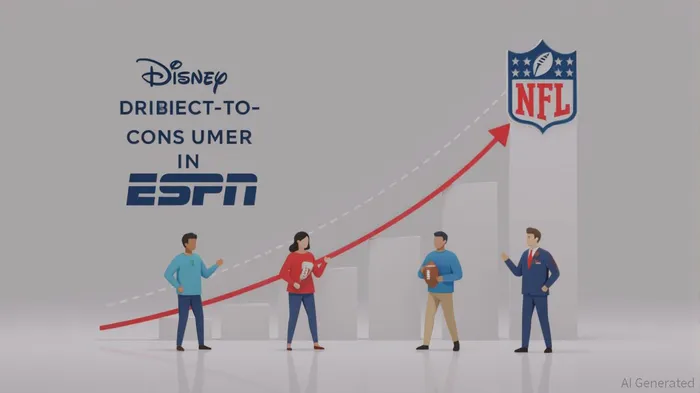
In the ever-shifting landscape of media and entertainment, the line between content creators, distributors, and investors is blurring. Disney's recent stake swap with the National Football League (NFL) is a case study in how cross-industry asset control and debt management are redefining media valuations and investor returns. By trading a 10% equity stake in ESPN for control of the NFL Network, NFL RedZone, and the league's fantasy football platform, DisneySCHL-- has executed a masterstroke of capital efficiency and strategic alignment. But what does this mean for investors, and how does it reflect broader trends in the fragmented entertainment ecosystem?
The Mechanics of the Swap: Equity for Assets, No Debt Required
The deal, valued at $2.2–3 billion based on ESPN's $22–25 billion estimated valuation, is a textbook example of asset-for-equity trading. Disney's ownership of ESPN drops from 80% to 72%, while the NFL gains a financial stake in one of the most influential sports media brands. In return, ESPN acquires high-margin, high-engagement assets like the NFL Network (seven regular-season games annually) and RedZone (24/7 live scoring updates). These properties are not speculative—they are proven revenue generators with loyal audiences.
Critics argue that Disney is diluting its ownership of a critical asset. However, the swap avoids traditional M&A pitfalls: no debt, no cash outflows, and no reliance on uncertain future revenue streams. Instead, Disney is leveraging its existing equity to secure assets that enhance its direct-to-consumer (DTC) streaming strategy. The NFL, meanwhile, gains a long-term financial stake in a platform that could grow to 15 million subscribers by 2027, translating to $5.4 billion in annual recurring revenue.
Debt Management in a Streaming Era
The deal's debt implications are minimal, which is a stark contrast to the capital-intensive strategies of the past. Traditional media deals often required borrowing or issuing shares, which could strain balance sheets. Here, Disney sidesteps that risk entirely. The NFL's equity stake is a liability only in the sense that it could dilute Disney's future earnings if the league underperforms. But given the NFL's $12 billion in annual revenue and ambitions to reach $25 billion by 2027, this is a calculated risk.
For investors, the swap's structure is a win. It allows Disney to expand its content library and DTC offerings without overleveraging. The NFL's stake also acts as a performance-based incentive, aligning the league's interests with ESPN's success. This is a departure from the zero-sum game of traditional media rights deals, where leagues and broadcasters often compete for the same pie.
Media Valuations in a Fragmented Landscape
The swap reflects a broader shift in media valuation models. In the past, media companies were valued based on subscriber counts, ad revenue, and content libraries. Today, the focus is on cross-industry integration and strategic equity stakes. The NFL's move to own a piece of ESPN mirrors similar strategies in other sectors—Fox's stake in Penske Entertainment, for example, or Amazon's equity in Twitch.
This trend has profound implications for investor returns. Equity stakes create a flywheel effect: the more the NFL and ESPN grow, the more value both parties capture. For Disney, the integration of NFL content into its $29.99/month DTC service could drive subscriber growth and reduce churn. For the NFL, the stake provides a hedge against declining traditional media rights revenue and a new revenue stream tied to ESPN's performance.
Risks and Rewards for Investors
While the deal is strategically sound, it's not without risks. Regulatory approval could delay integration until 2026, and the NFL's equity stake introduces governance complexities. If the NFL underperforms or if ESPN's DTC service fails to attract subscribers, Disney's ownership structure could weaken. Additionally, the NFL's control over digital RedZone distribution may limit ESPN's monetization potential.
However, the upside is compelling. If the DTC service hits 15 million subscribers, the NFL's 10% stake could appreciate significantly. For Disney, the swap strengthens its position in a fragmented market where cord-cutting and streaming competition are the norm. The NFL's stake also insulates Disney from future media rights renegotiations, as the league now has a financial stake in the outcome.
Investment Advice: Positioning for the Future
For investors, the key takeaway is to focus on companies that are redefining media ownership through equity-based partnerships. Disney's move is a blueprint for how to navigate a streaming-first world without overleveraging. The NFL's stake in ESPN is a unique financial instrument that could pay dividends if both entities execute their strategies.
However, investors should monitor regulatory developments and the NFL's financial performance. A diversified portfolio that includes both media companies and leagues with cross-industry stakes may offer the best risk-adjusted returns. In a landscape where traditional models are obsolete, the winners will be those who embrace strategic alignment over short-term gains.
In conclusion, Disney's ESPN stake swap is more than a transaction—it's a reimagining of how media valuations and investor returns are structured in a fragmented entertainment ecosystem. By trading equity for assets and avoiding debt, Disney has positioned itself to thrive in the streaming era, while the NFL has secured a financial stake in one of the most influential media brands. For investors, this deal is a reminder that the future of media lies in cross-industry collaboration, not competition.

Stay ahead of the market.
Get curated U.S. market news, insights and key dates delivered to your inbox.


AInvest
PRO
AInvest
PRO



Comments
No comments yet