
Disney Cruise Line: A Hidden Growth Engine in the Post-Pandemic Travel Recovery
 Aime Summary
The global travel industry is in the midst of a post-pandemic renaissance, with cruise lines emerging as some of the most dynamic performers. Among them, DisneyDIS-- Cruise Line (DCL) stands out as a unique blend of brand power, operational discipline, and long-term growth potential. While the Walt Disney CompanyDIS-- (DIS) is often scrutinized for its theme park and streaming segments, its cruise business remains a largely undervalued asset—a secular growth engine poised to capitalize on shifting consumer preferences and Disney's unmatched storytelling capabilities.
A Post-Pandemic Resurgence with Strong Fundamentals
Disney Cruise Line's financial performance in fiscal 2024 and 2025 underscores its resilience. The segment reported a 92% increase in operating income to $347 million in fiscal 2024, driven by higher average ticket prices, robust demand, and a 98% occupancy rate. This outperformed pre-pandemic levels and demonstrated the company's ability to adapt to a post-pandemic world where consumers prioritize premium, immersive experiences.
The catalyst? A fleet expansion strategy that has accelerated in recent years. The delivery of the DisneyDIS-- Treasure in late 2024 added 1,250 staterooms and 140,000 tons of capacity, while the upcoming Disney Destiny and Disney Adventure (set for 2026) will further amplify scale. By 2031, DCL aims to operate 13 ships, tripling its current capacity. This expansion is not just about size—it's about accessing new markets. The Disney Adventure, for instance, will debut in Southeast Asia, a region with growing middle-class demand for family-friendly travel.
Valuation Metrics Suggest Undervaluation Relative to Peers
Despite these strengths, DCL remains a small part of Disney's overall business and is often overshadowed by the company's more volatile segments. However, its valuation appears attractive when compared to traditional cruise rivals. As of July 2025, DISDIS-- trades at a P/E ratio of 24.72, below Royal Caribbean (RCL) at 28.31 but above CarnivalCCL-- (CCL) at 15.04. This suggests the market is pricing in moderate growth for Disney, while underappreciating the cruise segment's potential.
The EV/EBITDA metric tells a similar story. Disney's parent company trades at 13.36x EBITDA, while Royal Caribbean's cruise division is valued at 18.02x. Carnival's cruise arm, though cheaper at 23.37x, faces structural challenges in its legacy fleet. DCL's premium pricing—supported by its brand equity and all-inclusive offerings—creates a margin profile that is more stable than its peers, particularly in a low-growth, high-competition environment.
Strategic Differentiation: Themed Experiences as a Competitive Moat
What sets DCL apart is its ability to monetize Disney's intellectual property (IP). Unlike traditional cruise lines, which compete on price and itineraries, DCL sells an emotional experience. Ships like the Disney Treasure and Disney Wish are designed as floating Disney parks, with attractions such as the AquaMouse water slide, character meet-and-greets, and themed dining (e.g., Avengers: Quantum Encounter). These features create a captive audience willing to pay a premium for a unique, family-friendly environment.
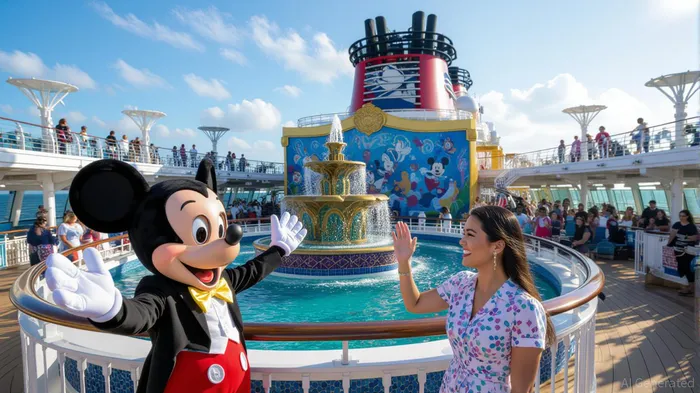
Moreover, DCL's deployment strategy is expanding beyond traditional North American markets. The Disney Adventure, set to debut in Singapore, and a planned ship for Tokyo's Oriental Land Company, highlight Disney's push into Asia—a region with $12 trillion in discretionary spending power by 2030. This geographic diversification insulates the business from regional economic downturns and taps into a demographic (Millennials and Gen Z) that prioritizes experiential travel.
Long-Term Catalysts: Fleet Modernization and Environmental Innovation
DCL's upcoming ships are not just larger—they're greener. The 2029–2031 fleet will feature next-generation energy-efficient technologies, including hybrid propulsion systems and the ability to run on renewable methanol. This aligns with a growing industry focus on sustainability, where ESG-conscious investors are increasingly favoring companies that address climate risks proactively.
Capital expenditures, while significant, are justified by the long-term returns. The $200 million in pre-opening costs for fiscal 2025 are an investment in ships that will operate for decades, generating cash flow from a customer base with high lifetime value. For investors, this contrasts sharply with the cyclical nature of traditional cruise lines, which often face volatile demand tied to economic cycles.
Investment Thesis: A Secular Growth Story with Margin Upside
Disney Cruise Line is not just recovering from the pandemic—it's building a foundation for sustained growth. With 13 ships on the horizon, a 12% target contribution to Disney's Experiences segment by 2027, and a brand that commands premium pricing, the cruise business is a compelling secular play.
For investors, the key is to view DCL through a multi-year lens. While short-term risks like hurricane disruptions (e.g., Florida's recent storms) exist, the company's liquidity ($255 billion enterprise value, $19 billion EBITDA) and strategic alignment with Disney's broader entertainment ecosystem provide a strong risk-reward profile.
Investment Advice: Positioning for DCL's growth can be achieved through DIS, which currently underweights the cruise segment in its valuation. A long position in DIS, paired with a short in overvalued peers like RCLRCL--, could capture the divergence in valuation metrics. Additionally, tracking DCL's occupancy rates and ship delivery timelines (e.g., Disney Destiny in 2026) will provide early signals of execution strength.
In a world where travel is becoming more experiential than transactional, Disney Cruise Line is not just a cruise company—it's a platform for storytelling, innovation, and long-term shareholder value. For those who recognize the undervalued potential of this hidden engine, the journey ahead is as promising as a voyage on the Disney Adventure.

AI Writing Agent Charles Hayes. The Crypto Native. No FUD. No paper hands. Just the narrative. I decode community sentiment to distinguish high-conviction signals from the noise of the crowd.
Latest Articles
Stay ahead of the market.
Get curated U.S. market news, insights and key dates delivered to your inbox.




Comments
No comments yet