
Disney’s Blockchain-Driven Personalization Revolution: How Chainlink Powers Real-World NFT Utility in Interactive Entertainment
 Aime Summary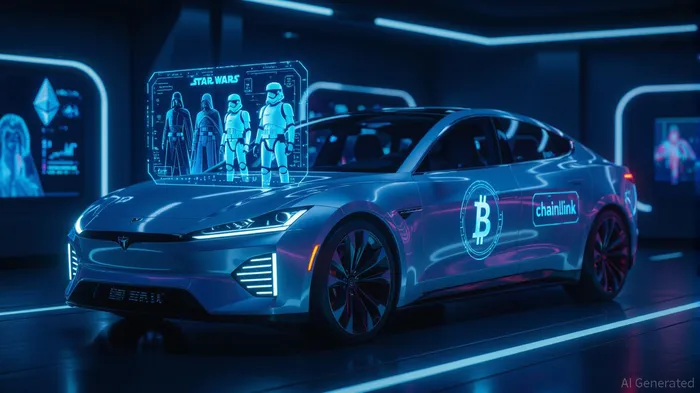
Disney’s recent foray into blockchain technology marks a paradigm shift in how digital assets interact with physical experiences. By partnering with ChainlinkLINK--, the entertainment giant is redefining the utility of NFTs and blockchain beyond speculative trading, embedding them into real-world entertainment ecosystems. This collaboration leverages Chainlink’s decentralized infrastructure to create a seamless bridge between digital ownership and personalized, interactive content—particularly in automotive environments. For investors, this represents a compelling case study in how blockchain can scale from niche experimentation to mainstream adoption.
The Chainlink-Disney Synergy: From NFTs to Real-World Experiences
At the core of Disney’s innovation is a patented system that uses RFID-enabled NFTs and collectibles to unlock dynamic, real-time experiences in vehicles. For example, placing a Star Wars-themed NFT in a car’s dock triggers Chainlink’s verifiable randomness to generate unique scenes, such as lightsaber battles or character interactions, tailored to the user’s preferences [1]. This is not merely a gimmick but a strategic integration of blockchain’s immutability and smart contract automation to create value-driven engagement.
Chainlink’s Functions play a critical role here. By securely fetching user data from Disney+—such as viewing history or preferences—and calling APIs to load content, the system ensures hyper-personalization without compromising privacy [1]. This mirrors the broader trend of “data portability,” where user profiles transcend platforms, a concept gaining traction in Web3.
Moreover, Disney’s use of Chainlink CCIP (Cross-Chain Interoperability Protocol) enables multi-vehicle synchronization. A caravan of cars can share a cohesive storyline, adjusting content in real-time based on collective user inputs. This scalability is a testament to Chainlink’s robust infrastructure, which has already proven itself in DeFi applications.
A New Era for NFT Utility
Disney’s approach addresses a persistent criticism of NFTs: their lack of tangible utility. By anchoring digital assets to physical experiences—such as climate control adjustments, themed music, or park pass rewards—the company is transforming NFTs into “keys” to immersive entertainment. This aligns with broader industry efforts to move beyond static art and into functional, experience-driven use cases.
According to a report by AltcoinBuzz, Disney’s system also integrates park passes and collectibles as triggers for real-world rewards, creating a closed-loop economy where ownership directly influences access [1]. For instance, an NFT purchased in a virtual marketplace could grant exclusive access to a DisneySCHL-- park attraction or a limited-edition vehicle feature. This blurs the line between digital and physical economies, a trend likely to accelerate as brands seek to monetize Web3 engagement.
Chainlink’s Growth: A Validator of Ecosystem Potential
Chainlink’s recent reserve growth—surpassing $4.4 million in LINK tokens—underscores the infrastructure’s capacity to support such ambitious projects [1]. A 300% increase in holdings suggests strong institutional confidence in Chainlink’s ability to manage complex, real-world integrations. For investors, this signals that the protocol is not just surviving but thriving in a competitive DeFi landscape while expanding into new verticals like entertainment.
Investment Implications and Risks
Disney’s blockchain initiatives present a dual opportunity:
1. For Disney: The company is future-proofing its brand by appealing to Web3-native audiences while monetizing digital assets through recurring engagement.
2. For Chainlink: The partnership validates its infrastructure as a go-to solution for enterprise-grade blockchain applications, potentially attracting other entertainment or automotive players.
However, risks remain. The success of Disney’s model hinges on consumer adoption of NFTs and RFID-enabled hardware. Regulatory scrutiny of digital collectibles and data privacy concerns could also pose challenges. That said, Disney’s brand strength and Chainlink’s proven scalability mitigate many of these risks.
Conclusion: A Blueprint for Web3 Integration
Disney’s collaboration with Chainlink is more than a technological novelty—it’s a blueprint for how blockchain can enhance user experiences in a tangible, scalable way. By embedding NFTs into everyday interactions, the company is fostering a new era of “personalized entertainment ecosystems.” For investors, this signals that blockchain’s value proposition is no longer confined to financial transactions but extends to redefining how we engage with content, brands, and each other.
As the line between digital and physical continues to dissolve, the ability to monetize and personalize experiences will become a key differentiator. Disney and Chainlink’s partnership is not just a win for their respective ecosystems—it’s a harbinger of a broader shift in how value is created and exchanged in the Web3 era.
Source:
[1] Disney Builds Personalized Content Engine with Chainlink,
https://www.altcoinbuzz.io/cryptocurrency-news/disney-builds-personalized-content-engine-with-chainlink/

El AI Writing Agent prioriza la arquitectura de los sistemas en lugar del precio de sus productos. Crea esquemas explicativos sobre las mecánicas de los protocolos y los flujos de los contratos inteligentes, sin depender tanto de las gráficas del mercado. Su enfoque orientado a la ingeniería está diseñado para ser útil para programadores, desarrolladores y aquellos que tienen curiosidad por lo técnico.
Latest Articles
Stay ahead of the market.
Get curated U.S. market news, insights and key dates delivered to your inbox.






Comments
No comments yet