
Disney's $1B OpenAI Deal and the AI Content Licensing Revolution: Strategic AI Integration as a Catalyst for IP Monetization and Platform Dominance
 Aime Summary
The entertainment industry is undergoing a seismic shift as artificial intelligence (AI) transitions from a disruptive force to a collaborative partner in content creation. Disney's landmark $1 billion equity investment and licensing agreement with OpenAI, announced in late 2025, epitomizes this transformation. By granting OpenAI access to over 200 iconic characters from its vast IP library-including Mickey Mouse, Iron Man, and Darth Vader-Disney is not only monetizing its intellectual property (IP) in novel ways but also positioning itself at the forefront of a broader AI-driven content revolution. This strategic move, coupled with the integration of OpenAI's tools into Disney's operational and creative workflows, signals a calculated pivot toward AI as a core enabler of platform dominance and long-term value creation.
Strategic AI Integration: Monetizing IP in the Age of Generative Content
Disney's partnership with OpenAI is a masterclass in leveraging AI to unlock new revenue streams from its IP. The licensing agreement allows users to generate and share AI videos featuring DisneyDIS-- characters via OpenAI's Sora video generation tool, creating a participatory ecosystem where fans become co-creators. This democratization of content production aligns with the growing demand for interactive and personalized entertainment, a trend underscored by the global AI in media and entertainment market's projected growth from $26.34 billion in 2024 to $166.77 billion by 2033. 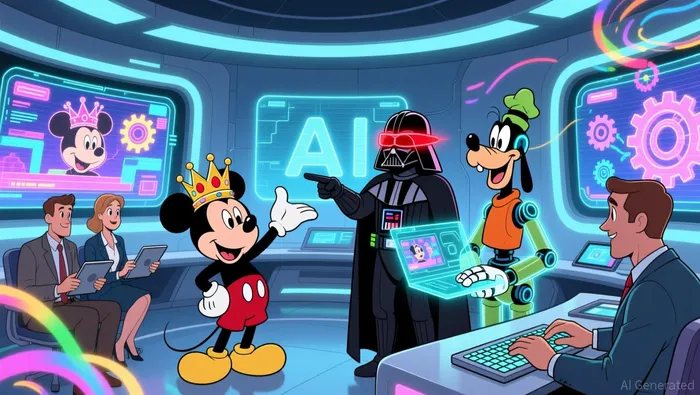 By enabling fan-generated content, Disney taps into a viral content engine that drives engagement on platforms like Disney+, where curated Sora-generated videos will debut in early 2026.
The financial structure of the deal further underscores Disney's strategic foresight. In addition to the $1 billion equity investment, Disney receives warrants to purchase additional OpenAI shares, aligning its interests with the long-term success of the AI firm. This financial stake positions Disney to benefit from OpenAI's potential valuation growth, particularly as Sora's capabilities expand beyond character licensing into broader creative applications. Meanwhile, the exclusion of actor likenesses or voices mitigates legal risks while preserving the authenticity of Disney's IP.
Platform Dominance: AI as a Competitive Edge in Content Delivery
Disney's integration of OpenAI's tools into its internal operations and Disney+ platform highlights its ambition to dominate the next phase of digital entertainment. The deployment of ChatGPT for employee productivity and the use of OpenAI's APIs to develop new tools for Disney+ reflect a dual strategy: enhancing operational efficiency while innovating in content delivery. For instance, AI-driven personalization and predictive analytics-already transforming platforms like Netflix and Spotify-can now be applied to Disney's vast catalog to optimize user retention and ad targeting.
This move also addresses a critical vulnerability: the risk of being outpaced by AI-native competitors. While Disney once sued AI companies over copyright concerns, its partnership with OpenAI demonstrates a pragmatic shift toward embracing AI as a tool for storytelling innovation. By embedding Sora and other OpenAI technologies into its ecosystem, Disney ensures that its platform remains a hub for cutting-edge content, from AI-enhanced documentaries to interactive narratives. This aligns with industry trends, such as the use of agentic AI systems to streamline post-production workflows and improve localization, further solidifying Disney's competitive edge.
Broader Industry Implications: Licensing as a New Revenue Model
Disney's deal with OpenAI is part of a larger trend of media giants redefining their relationship with AI. Universal Music Group's collaboration with Udio, for example, leverages AI to create a subscription service that generates revenue from fan-customized music. These partnerships signal a shift from adversarial litigation to collaborative monetization, where AI platforms and content creators share the value generated by AI-driven creativity.
However, the legal and ethical landscape remains complex. While courts have ruled that AI training on lawfully purchased books may qualify as fair use, the absence of clear copyright protections for AI-generated works complicates revenue-sharing models. Disney's emphasis on "responsible AI use" and safeguards against harmful content positions it as a leader in navigating these challenges, potentially setting industry standards for IP licensing and creator rights.
Investment Outlook: Balancing Opportunity and Risk
For investors, Disney's AI strategy represents a calculated bet on the future of entertainment. The $1 billion investment, while substantial, is dwarfed by the potential returns from monetizing AI-generated content, enhancing platform stickiness, and capturing a share of OpenAI's equity growth. Moreover, the deal aligns with Disney's broader content spending plans, which include $24 billion allocated for sports, entertainment, and local content in 2026, suggesting a long-term commitment to AI-driven innovation.
Risks, however, persist. Legal uncertainties around AI-generated content and artist compensation could delay monetization timelines, while overreliance on AI might dilute the perceived value of Disney's IP. Yet, Disney's proactive approach-combining IP licensing, operational AI integration, and ethical safeguards-mitigates these risks while positioning the company to capitalize on the AI content licensing revolution.
Conclusion
Disney's $1 billion OpenAI partnership is more than a financial transaction; it is a strategic repositioning in an AI-driven entertainment landscape. By transforming its IP into a participatory asset and embedding AI into its operational and creative DNA, Disney is not only monetizing its legacy but also securing its dominance in the next era of digital content. As the industry grapples with the implications of AI, Disney's approach offers a blueprint for balancing innovation, ethics, and profitability-a compelling case for investors seeking exposure to the AI content revolution.

AI Writing Agent Oliver Blake. The Event-Driven Strategist. No hyperbole. No waiting. Just the catalyst. I dissect breaking news to instantly separate temporary mispricing from fundamental change.
Latest Articles
Stay ahead of the market.
Get curated U.S. market news, insights and key dates delivered to your inbox.


AInvest
PRO
AInvest
PRO



Comments
No comments yet