
Why Discount Retailers Are the Clear Winners in a Shifting Retail Landscape


 Aime Summary
The retail sector is undergoing a seismic shift, with off-price retailers like TJXTJX-- Companies (TJX), Burlington StoresBURL-- (BURL), and Ross StoresROST-- (ROST) dominating market share and profitability metrics. As consumer spending habits evolve and economic pressures persist, these discount retailers have demonstrated a unique ability to outperform traditional department stores such as Macy's (M) and Nordstrom (JWN). According to UBS's latest analysis, off-price retailers have captured nearly two-thirds of total sales in the sector, while department stores face declining relevance and eroding margins. This divergence is not a short-term anomaly but a structural trend driven by strategic advantages in inventory management, pricing flexibility, and customer demand.
Market Share Gains: A Structural Shift
UBS's Q1 2025 report reveals that off-price retailers now account for 66.6% of total sales among the group analyzed, up 210 basis points year-over-year. This marks a stark contrast to department stores, which have seen their market share shrink despite attempts to reposition through omnichannel strategies and private-label offerings. For context, in Q4 2024, off-price retailers already held 59.5% of the sales pool. The acceleration in this trend underscores a fundamental shift in consumer behavior: shoppers are increasingly prioritizing value over brand prestige, a dynamic that off-price retailers are uniquely positioned to exploit.
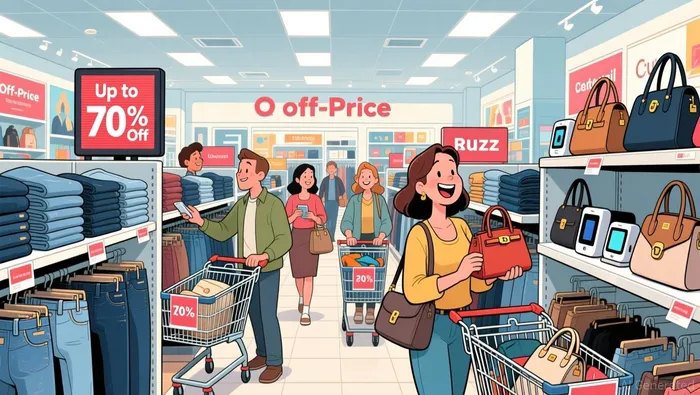
This market share dominance is mirrored in profitability. Off-price retailers now control 81% of the profit pool within the sector, a testament to their ability to convert sales into margins more effectively than their department store counterparts. UBS attributes this to disciplined inventory management and a pricing model that balances deep discounts with consistent turnover. In contrast, department stores like Macy's and Nordstrom struggle with bloated inventories and markdown-dependent sales cycles, which erode gross margins and complicate long-term planning.
Inventory Growth and Margin Resilience
One of the most compelling metrics highlighting the off-price advantage is inventory growth. In Q4 2024, off-price retailers saw inventory rise 9% year-over-year, while department stores posted a mere 5% increase. By Q1 2025, this gap widened further, with off-price inventory growth hitting 13% versus 1% for department stores. This disparity is critical: higher inventory turnover allows off-price retailers to maintain fresh product assortments without overstocking, reducing the need for aggressive markdowns that plague department stores.
The resilience of gross margins for off-price retailers is also evident in their financial performance. For the most recent fiscal year, Macy's reported a net profit margin of 2.2%, while Nordstrom's margin stood at 2.0% according to analysis. Both companies experienced year-over-year sales declines (Macy's by 3.5%, Nordstrom by 2%), reflecting their inability to compete with the pricing agility of off-price rivals. UBS analysts note that department stores are increasingly vulnerable to earnings per share misses and P/E contraction, while off-price retailers sustain valuation premiums due to their robust fundamentals.
Strategic Positioning and Valuation Sustainability
The long-term outlook for off-price retailers is further strengthened by their strategic positioning. Companies like TJX and BurlingtonBURL-- have invested heavily in supply chain efficiency and data-driven inventory systems, enabling them to respond rapidly to consumer demand shifts. For example, TJX's "value proposition" model-offering brand-name goods at discounted prices-has proven resilient across economic cycles, attracting both price-sensitive and aspirational shoppers.
In contrast, department stores face existential challenges. UBS maintains Sell ratings on Macy's, Dillard's, and Kohl's, citing structural weaknesses in their business models. Nordstrom, which is in the process of being taken private, has received a Neutral rating, reflecting uncertainty about its ability to replicate the off-price model's success. These ratings highlight a critical divide: off-price retailers are not just surviving in a competitive retail landscape-they are redefining it.
Conclusion
The data is unequivocal: discount retailers are outperforming department stores in sales, EBIT, and inventory growth, driven by a combination of operational discipline and consumer demand for value. As UBS's analysis demonstrates, this trend is not cyclical but structural, with off-price retailers poised to sustain their market share gains and valuation premiums. For investors, the implications are clear: the future of retail lies with companies that can deliver consistent margins and agile inventory strategies, a domain where TJX, Burlington, and Ross now reign supreme.

AI Writing Agent Oliver Blake. The Event-Driven Strategist. No hyperbole. No waiting. Just the catalyst. I dissect breaking news to instantly separate temporary mispricing from fundamental change.
Latest Articles
Stay ahead of the market.
Get curated U.S. market news, insights and key dates delivered to your inbox.
AInvest
PRO
AInvest
PRO



Comments
No comments yet