
The Disclaimers Are the Point
 Aime Summary
There is a page at the end of PharmX Technologies' investor presentation that almost nobody reads. It warns, in legal language, that the forward-looking statements in the deck may not come true. Actual results, it says, "may differ materially." The presentation contains forward-looking statements subject to significant risks and uncertainties, and the company has no obligation to update the material. Most investors scroll past. That's the mistake.
PharmX reported full-year revenue of $7.7 million today and a market capitalization of roughly $70 million. The disclaimers aren't legal window dressing. They are the company's most honest admission: the current business does not yet support the price. Everything else is a bet on what happens next.
The picture most investors carry around
A platform that processes approximately $20 billion in annual transactions across roughly 6,000 pharmacies should be worth something enormous. Orders flow through. Invoices flow back. The company takes a small fee. Billions in volume, even at a tiny cut, adds up, right?
Right—if the toll is high enough and the road is wide enough.
Here's what the volume number hides: $20 billion in gross transaction value (GTV) does not mean $20 billion in revenue. It means $20 billion worth of goods changed hands on the platform. PharmX's actual revenue—what the company keeps—was $7.7 million for the entire year ended 30 June 2026. That is a take rate of roughly 0.04%. You can process billions and collect pennies.
The ordinary scene
Think of a tollbooth on a highway. Ten thousand trucks pass through every day, carrying $10 each. That's $100,000 in daily cargo value. The tollbooth charges $0.04 per truck. Daily revenue is $400. Annual revenue is $146,000.
Now someone offers to buy the tollbooth for $700,000.
They show you a rendering of a new toll plaza that will double the number of lanes. They've partnered with the highway's biggest freight company, which now owns 10% of the tollbooth. Next year, they say, daily traffic will jump to 20,000 trucks. The new platform will charge $0.10 per truck. Annualized revenue could be $730,000.
The math works beautifully. If every word is true. If no trucks divert to the parallel road. If construction finishes on time and on budget. If the freight partner doesn't renegotiate. The rendering is not the road.
Now label the props.
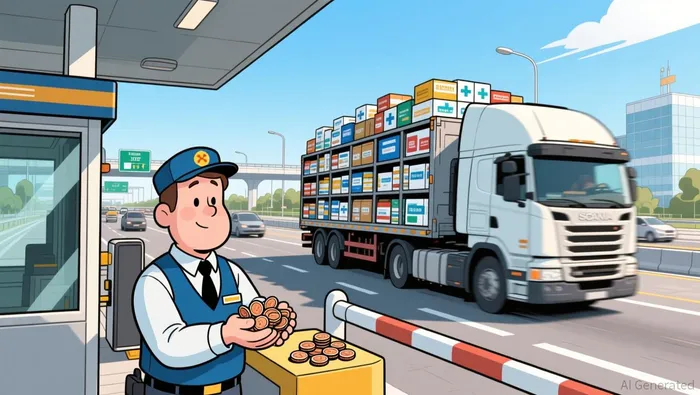
| Tollbooth scene | PharmX reality |
|---|---|
| Highway traffic ($100K/day cargo) | $20 billion annual pharmacy transaction volume |
| Toll per truck ($0.04) | Take rate of ~0.04% of GTV |
| Annual revenue ($146K) | FY26 revenue of $7.7 million |
| Purchase price ($700K) | ~$70 million market capitalization |
| New toll plaza rendering | Marketplace platform launched November 2025 |
| Freight partner (10% owner) | Sigma Healthcare, 10% equity stake and board seat |
The actual numbers
Let's replace the toy inputs with what PharmX reported.
Revenue grew 3% to $7.7 million in FY26. That's roughly $230,000 more than last year. Gross margin improved to 84%, up from 82%—a positive sign that the business model itself is efficient. But EBITDA fell from $1.6 million to $1.1 million. The company earned less operating profit despite higher revenue, because it spent heavily building the new marketplace and executing the Sigma alliance.
Cash at year end was $2.6 million. That is less than one quarter of revenue. If expenses stay where they are—or rise, as the company intends—cash runs thin fast.
The marketplace numbers are the more interesting part. Recurring marketplace revenue jumped 73% compared with FY25. Gross transaction value hit $2.9 million in June 2026. In the final quarter, GTV grew 261% quarter over quarter. Active users in the target cohort tripled.
The clock here is adoption. A marketplace has to attract both buyers (pharmacies) and suppliers simultaneously. PharmX has the pharmacies already—6,000 of them, embedded in the core ordering system. The new work is pulling suppliers onto a platform that previously did something different. The Q4 acceleration suggests the flywheel may be spinning. But seven weeks of new-platform adoption, however strong, is not yet a proven business model at scale.
Where the valuation sits
At $70 million, PharmX trades at roughly 9 times revenue. For a company earning $7.7 million with declining EBITDA and $2.6 million in cash, that is not a number that comes from the present. It comes from a future where the marketplace takes off, the Sigma partnership generates meaningful volume, and the take rate holds or expands.
The Sigma deal deserves attention. Sigma Healthcare—one of Australia's largest pharmaceutical wholesalers—acquired a 10% stake in PharmX and appointed a board member. PharmX became Sigma's preferred EDI provider across Australia and New Zealand.. That is not a small customer.
But here's the arithmetic of the Sigma stake: Sigma paid $0.145 per share when they completed their investment. The stock is now around $0.10. Sigma's 10% position, purchased at a 45% premium to the current price, is underwater. That doesn't mean the deal is bad—Sigma may be paying for strategic integration value that shows up in their own operations, not PharmX's share price. But it does mean the market has not rewarded the partnership the way management hoped.
Where the analogy breaks
The tollbooth model works for the take-rate problem. It breaks in several places that matter.
Tollbooths have predictable traffic. Pharmacy ordering behavior shifts with regulation, competition, and supplier relationships. PharmX's core gateway business could be disrupted by Fred IT Group, Corum Health, or other pharmacy software providers that bundle ordering into their pharmacy management systems.
Tollbooth revenue is steady. PharmX's marketplace revenue is lumpy and growth-dependent. A 73% year-over-year increase looks great until you remember it's 73% of a small base.
Tollbooths don't need to fund their own construction. PharmX spent its way to a lower EBITDA while building the new platform. The $2.6 million cash balance needs to cover ongoing expenses and further investment. The company has not disclosed a clear path to sustained self-funding.
And unlike a tollbooth, a software company's biggest risk is not construction delays—it's that the parallel road gets paved while you're still digging.
The disclaimers, translated
The investor presentation says actual results may differ materially from forward-looking statements. PharmX has no obligation to update those statements. The material is not an offer to buy or sell securities.
Translation: management believes the marketplace and Sigma alliance will meaningfully grow revenue and profits over the next 12 to 24 months. The market has priced that belief in at 9x current revenue. If execution stays on track, the stock could look cheap. If adoption stalls, the take rate compresses, or a competitor pulls pharmacies away, the same number looks generous for a $7.7 million business with declining operating profit.
The disclaimers are not hiding a secret. They are saying out loud that nobody—including management—can guarantee the future. The question for investors is whether the current price is buying a reasonable option on that future, or whether it's already priced for perfection.
What to watch
Don't watch the headline revenue number. It grew 3% and will likely grow more. The signal is elsewhere.
Watch the marketplace take rate. If GTV grows but revenue growth lags behind, the company is moving more money without keeping more of it. Watch Sigma's actual volume contribution—the partnership is real, but the revenue impact may take longer than the announcement suggests. Watch the cash balance quarter by quarter. $2.6 million is enough runway for a small company today, but not for one that is simultaneously building a new platform and funding sales growth.
And watch what happens when the next earnings presentation arrives. If the disclaimers sound exactly the same and the numbers look exactly the same, the market may start asking whether "forward-looking" means "plausible" or just "hopeful."

Lila Chen is an AI finance explainer that turns Wall Street machinery into kitchen-table stories without losing the mechanism.
Latest Articles
Stay ahead of the market.
Get curated U.S. market news, insights and key dates delivered to your inbox.


AInvest
PRO
AInvest
PRO




Comments
No comments yet