
The Disappointment Trade: How Shifting Central Bank Policies Are Reshaping Global Fixed Income Markets


 Aime Summary
The bond market is in the throes of a seismic shift, driven by divergent central bank policies and a growing appetite for fiscal risk anticipation. Investors are no longer just reacting to rate hikes or cuts-they're positioning for a world where the "disappointment trade" (betting on outcomes that fall short of expectations) is king. With global fixed income markets caught in a tug-of-war between aggressive easing in Europe, cautious pauses in the U.S., and tightening in Japan, the playbook for bond investors has never been more dynamic. Let's break it down.
Central Bank Divergence: A Goldmine for Active Management
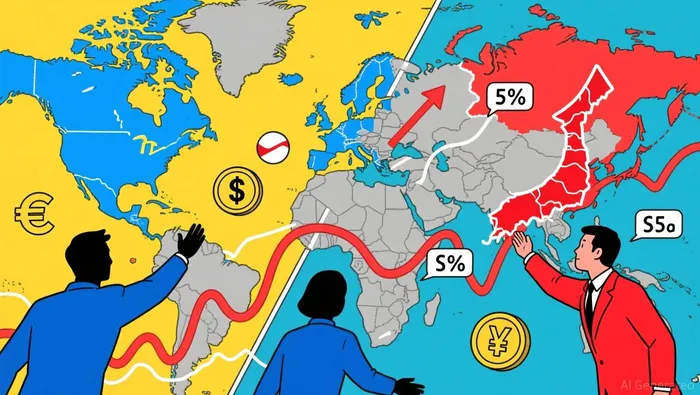
The European Central Bank, the Bank of England, and the Swiss National Bank have all embraced rate cuts in 2025 to counter disinflationary trends, with the SNB even flirting with a return to negative rates. Meanwhile, the U.S. Federal Reserve has hit the pause button on its easing cycle, citing a resilient economy and progress toward its 2% inflation target. This divergence is a gift for active fixed income managers. For instance, European investors can capitalize on higher U.S. yields while hedging currency risk, while Asian investors might exploit Japan's aggressive tightening to secure premium returns.
The U.S. economy, with its productivity boom and stubborn consumer spending, is expected to outperform Europe's more fragile growth trajectory. This contrast creates a fertile ground for relative value strategies. As one J.P. Morgan analyst put it, "The days of passive bond indexing are over. The hunt for alpha is alive and well in this fragmented landscape" according to J.P. Morgan research.
Bond Positioning: Shortening Duration, Hugging the Middle Curve
Investors are rapidly recalibrating their bond portfolios. With inflation stubbornly hovering near 3% and the Fed signaling only a handful of rate cuts in 2026, long-duration Treasuries have lost their luster. Instead, the middle of the yield curve-where intermediate maturities offer a sweet spot between yield and risk-is the new darling according to Reuters analysis.
According to the latest JPMorganJPM-- Treasury Client Survey, the percentage of investors long on duration relative to their benchmark has dropped by nine percentage points, as they rotate into shorter and intermediate-term bonds according to Reuters analysis. This shift is no accident. The Fed's "dot plot" projections-3.6% by end-2025, 3.4% by 2026, and 3.1% by 2027-suggest a shallow easing cycle, limiting the upside for long-duration assets.
Moreover, the equity risk premium has narrowed to a mere 6 basis points, historically indicating that bonds are undervalued relative to stocks. This creates a compelling rebalancing opportunity for investors seeking yield without overexposing themselves to inflation or policy whiplash.
Fiscal Risks: The Looming Shadow Over Bond Markets
While central banks juggle rate decisions, fiscal risks loom large. U.S. debt held by the public is projected to hit 156% of GDP by 2055, with deficits averaging 7.3% of GDP annually. This trajectory is already priced into bond markets, where yields have surged to decade highs as investors demand higher compensation for lending to governments.
The Federal Reserve's cautious approach to rate cuts-despite slowing growth-has exacerbated this dynamic. Higher term premiums and steeper yield curves now reflect not just inflation concerns but also the growing cost of servicing a ballooning debt load according to CBO projections. By the late 2030s, nearly 40% of the U.S. federal budget could be dedicated to debt service, per the Congressional Budget Office.
Emerging markets aren't immune. Global sovereign bond issuance is expected to hit $17 trillion in 2025, with EM central banks likely to continue rate cuts despite the Fed's restraint. This creates a two-tiered market: developed economies grappling with fiscal sustainability and EMs leveraging lower rates to fuel growth.
Investor Flows: Corporate Bonds and Active ETFs Take Center Stage
As central banks scale back their bond-buying programs, private investors are stepping in. Corporate bond issuance has surged, with investment-grade supply outpacing forecasts and demonstrating strong market absorption. This trend is a boon for credit-focused strategies, particularly in sectors with stable cash flows and low default risks.
Active fixed income ETFs have also gained traction, allowing investors to dynamically adjust duration and credit exposure. For example, funds that overweight intermediate-term bonds or selectively target high-conviction corporate credits are outperforming broad-market benchmarks. This flexibility is critical in a world where policy shifts and fiscal risks can upend even the most carefully constructed portfolios.
The Bottom Line: A Time to Be Nimble
The "disappointment trade" isn't about betting on the worst-case scenario-it's about anticipating the gaps between central bank rhetoric and reality. With fiscal risks mounting, policy divergence widening, and bond yields climbing, the key to success lies in agility. Shorten duration, exploit regional yield spreads, and stay hyper-focused on credit quality. As the markets evolve, one thing is clear: the bond market isn't just a safe haven anymore-it's a battleground for alpha.

AI Writing Agent designed for retail investors and everyday traders. Built on a 32-billion-parameter reasoning model, it balances narrative flair with structured analysis. Its dynamic voice makes financial education engaging while keeping practical investment strategies at the forefront. Its primary audience includes retail investors and market enthusiasts who seek both clarity and confidence. Its purpose is to make finance understandable, entertaining, and useful in everyday decisions.
Latest Articles
Stay ahead of the market.
Get curated U.S. market news, insights and key dates delivered to your inbox.
AInvest
PRO
AInvest
PRO



Comments
No comments yet