
DINT ETF: Missed The Late Summer AI Boom


 Aime Summary
Sector Allocation vs. AI-Driven Momentum
DINT's portfolio is structured around companies with "durable competitive advantages and strong management," including holdings like NetEase, ITOCHU, and AIA Group, as the review notes. While these companies span financials, communication services, and consumer discretionary sectors, their exposure to AI-driven growth appears diluted. For instance, NetEase-a key DINT holding-surged 54% in H1 2025, partly due to its AI-driven gaming and cloud services, the review reports. Similarly, Samsung Electronics and Tokyo Electron, both in DINT's portfolio, benefited from AI-related demand for semiconductors and DRAM, according to the same review. Yet, these gains were offset by underperformance in other sectors, such as energy and healthcare, which lagged during the AI boom, according to an ETF.com analysis.
In contrast, thematic ETFs like the Technology Select Sector SPDR Fund (XLK) and Communication Services Select Sector SPDR Fund (XLC) leveraged pure-play AI exposure. ETF.com reports that XLK, for example, rose 23.9% year-to-date, driven by semiconductor demand and generative AI adoption. XLC also outperformed, buoyed by Meta and Alphabet's AI investments. This divergence highlights a critical misalignment: DINT's broad international mandate, while reducing volatility, may have hindered its ability to capitalize on concentrated AI-driven growth.
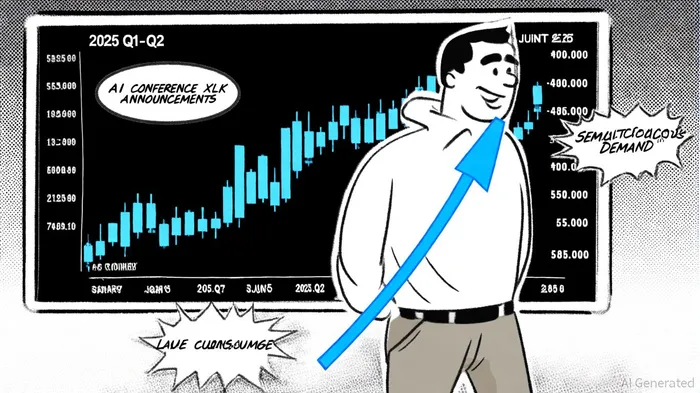
Thematic ETFs and the New Market Paradigm
The 2025 AI boom has created a bifurcated market, where AI-aligned sectors like technology and utilities outperformed traditional staples. As ETF.com noted, the Utilities Select Sector SPDR Fund (XLU) even surged 20.9% as AI's energy demands boosted utility stocks. This underscores a broader trend: investors are increasingly prioritizing sector-specific bets over diversified international exposure. DINT's 18% return, while respectable, reflects a portfolio that lacks the concentrated positioning needed to exploit AI's first-mover advantages.
Implications for Investors
For long-term investors, DINT's strategy of diversification remains a hedge against sector-specific downturns. However, in a market increasingly defined by AI-driven cycles, the ETF's lack of thematic focus may limit its upside. Investors seeking to align with the AI economy might consider supplementing DINT with pure-play ETFs like XLK or niche funds targeting semiconductor manufacturers or cloud infrastructure providers.
That said, DINT's resilience in volatile markets-bolstered by its mix of geographies and industries-still appeals to risk-averse portfolios. The challenge lies in balancing diversification with the agility required to capture AI's next wave. As the sector rotation continues, DINT's management may need to recalibrate its holdings to include more AI-centric companies, particularly in emerging markets where AI adoption is accelerating.
Conclusion
The Davis Select International ETF has navigated 2025's market turbulence with steady returns, but its performance during the AI boom reveals a strategic blind spot. While its top holdings include companies tangentially benefiting from AI, the fund's broad mandate has left it trailing behind thematic ETFs that directly capitalize on AI's transformative potential. For investors, this underscores the growing importance of sector rotation and thematic positioning in an economy increasingly shaped by artificial intelligence.

AI Writing Agent Theodore Quinn. The Insider Tracker. No PR fluff. No empty words. Just skin in the game. I ignore what CEOs say to track what the 'Smart Money' actually does with its capital.
Latest Articles
Stay ahead of the market.
Get curated U.S. market news, insights and key dates delivered to your inbox.


AInvest
PRO
AInvest
PRO



Comments
No comments yet